







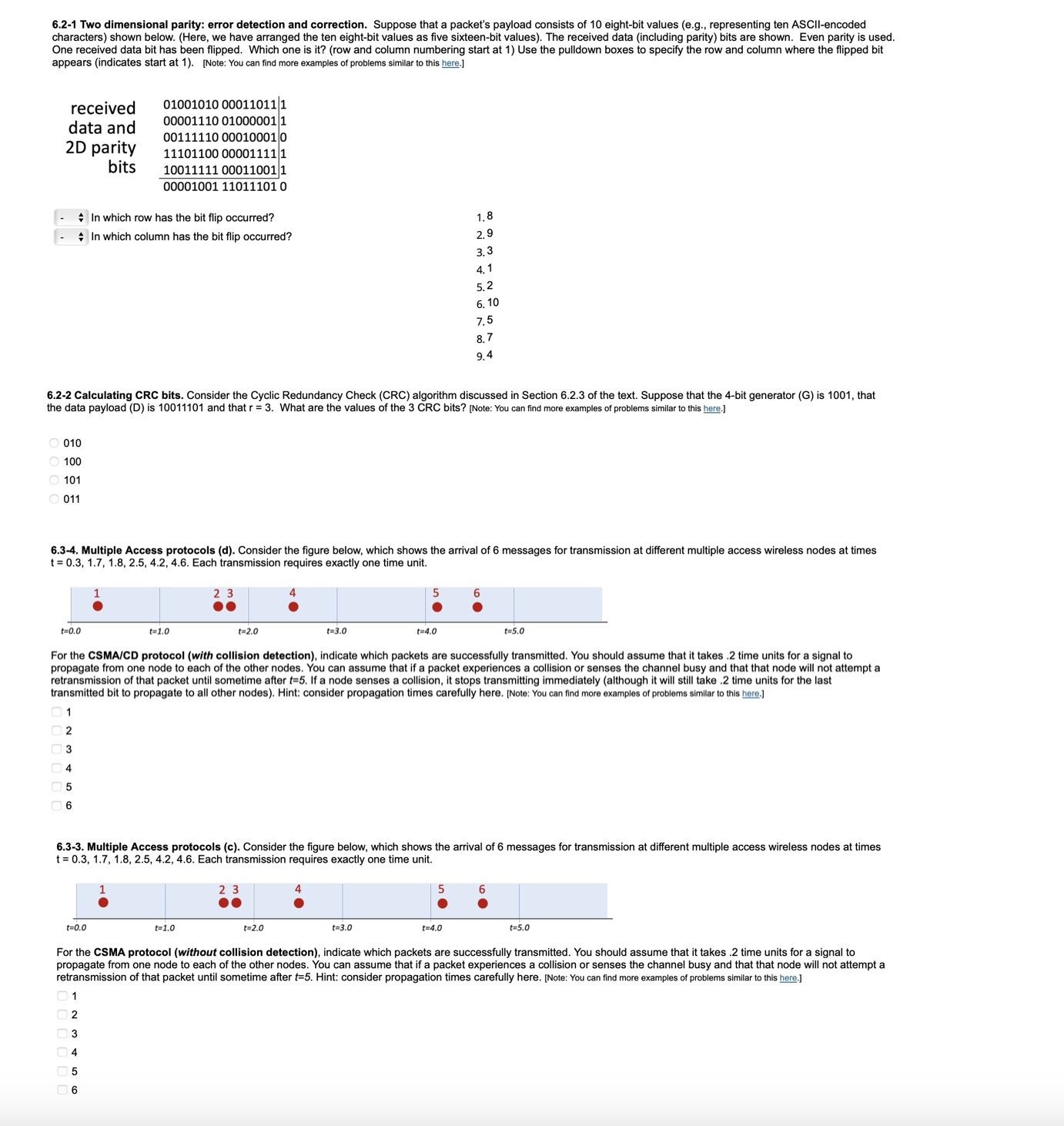
Question: 6 . 2 - 1 Two dimensional parity: error detection and correction. Suppose that a packet's payload consists of 1 0 eight - bit values
Two dimensional parity: error detection and correction. Suppose that a packet's payload consists of eightbit values eg representing ten ASCIIencoded
characters shown below. Here we have arranged the ten eightbit values as five sixteenbit values The received data including parity bits are shown. Even parity is used.
One received data bit has been flipped. Which one is itrow and column numbering start at Use the pulldown boxes to specify the row and column where the flipped bit
appears indicates start at Note: You can find more examples of problems similar to this here.
received
data and
D parity
bits
In which row has the bit flip occurred?
In which column has the bit flip occurred?
Calculating CRC bits. Consider the Cyclic Redundancy Check CRC algorithm discussed in Section of the text. Suppose that the bit generator G is that
the data payload D is and that What are the values of the CRC bits? Note: You can find more examples of problems similar to this here.
Multiple Access protocols d Consider the figure below, which shows the arrival of messages for transmission at different multiple access wireless nodes at times
Each transmission requires exactly one time unit.
For the CSMACD protocol with collision detection indicate which packets are successfully transmitted. You should assume that it takes time units for a signal to
propagate from one node to each of the other nodes. You can assume that if a packet experiences a collision or senses the channel busy and that that node will not attempt a
retransmission of that packet until sometime after If a node senses a collision, it stops transmitting immediately although it will still take time units for the last
transmitted bit to propagate to all other nodes Hint: consider propagation times carefully here. Note: You can find more examples of problems similar to this here.
Multiple Access protocols c Consider the figure below, which shows the arrival of messages for transmission at different multiple access wireless nodes at times
Each transmission requires exactly one time unit.
For the CSMA protocol without collision detection indicate which packets are successfully transmitted. You should assume that it takes time units for a signal to
propagate from one node to each of the other nodes. You can assume that if a packet experiences a collision or senses the channel busy and that that node will not attempt a
retransmission of that packet until sometime after Hint: consider propagation times carefully here. Note: You can find more examples of problems similar to this here.
Step by Step Solution
There are 3 Steps involved in it
1 Expert Approved Answer
Step: 1 Unlock

Question Has Been Solved by an Expert!
Get step-by-step solutions from verified subject matter experts
Step: 2 Unlock
Step: 3 Unlock
 Study Help