







Question: 6 . 2 : Consider a real gas that is confined within a vertical box of cross - sectional area ( A )
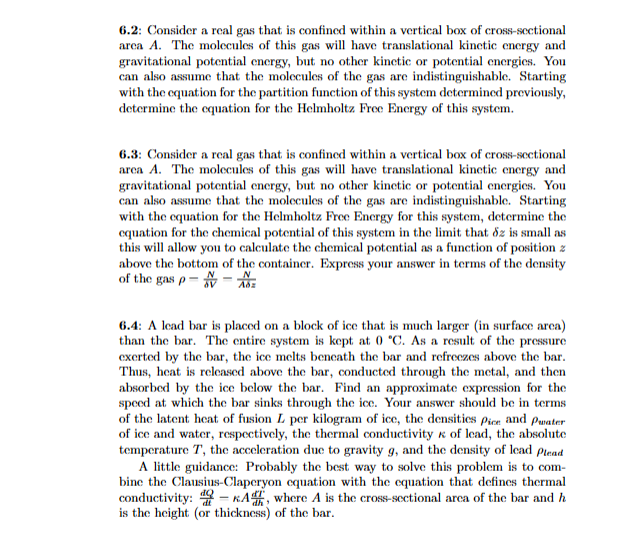
: Consider a real gas that is confined within a vertical box of crosssectional area A The molecules of this gas will have translational kinetic energy and gravitational potential energy, but no other kinetic or potential energies. You can also assume that the molecules of the gas are indistinguishable. Starting with the equation for the partition function of this system determined previously, determine the equation for the Helmholtz Free Energy of this system.
: Consider a real gas that is confined within a vertical box of crosssectional area A The molecules of this gas will have translational kinetic energy and gravitational potential energy, but no other kinctic or potential energies. You can also assume that the molecules of the gas are indistinguishable. Starting with the equation for the Helmholtz Free Energy for this system, determine the equation for the chemical potential of this system in the limit that delta z is small as this will allow you to calculate the chemical potential as a function of position z above the bottom of the container. Express your answer in terms of the density of the gas rhofracNdelta VfracNA delta z
: A lead bar is placed on a block of ice that is much larger in surface area than the bar. The entire system is kept at circmathrmC As a result of the pressure exerted by the bar, the ice melts beneath the bar and refreczes above the bar. Thus, heat is released above the bar, conducted through the metal, and then absorbed by the ice below the bar. Find an approximate expression for the speed at which the bar sinks through the ice. Your answer should be in terms of the latent heat of fusion L per kilogram of ice, the densities rhotext ice and rhotext water of ice and water, respectively, the thermal conductivity kappa of lead, the absolute temperature T the acceleration due to gravity g and the density of lead rhotext lead
A little guidance: Probably the best way to solve this problem is to combine the ClausiusClaperyon equation with the equation that defines thermal conductivity: fracd Qd tkappa A fracd Td h where A is the crosssectional area of the bar and h is the height or thickness of the bar.
Step by Step Solution
There are 3 Steps involved in it
1 Expert Approved Answer
Step: 1 Unlock

Question Has Been Solved by an Expert!
Get step-by-step solutions from verified subject matter experts
Step: 2 Unlock
Step: 3 Unlock
 Study Help