





Question: 6. (20 points) Solving an Integer Program with AMPL. Consider an almost exact version of the inventory problem considered in HW 2. Namely: Suppose a

6. (20 points) Solving an Integer Program with6. (20 points) Solving an Integer Program with6. (20 points) Solving an Integer Program with

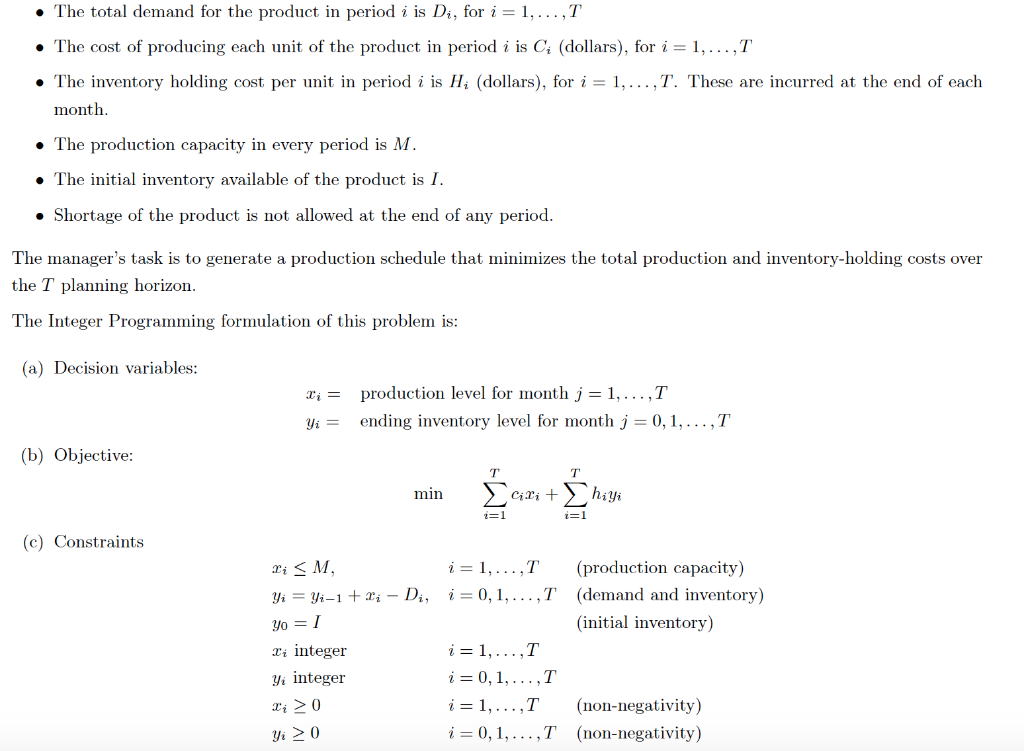
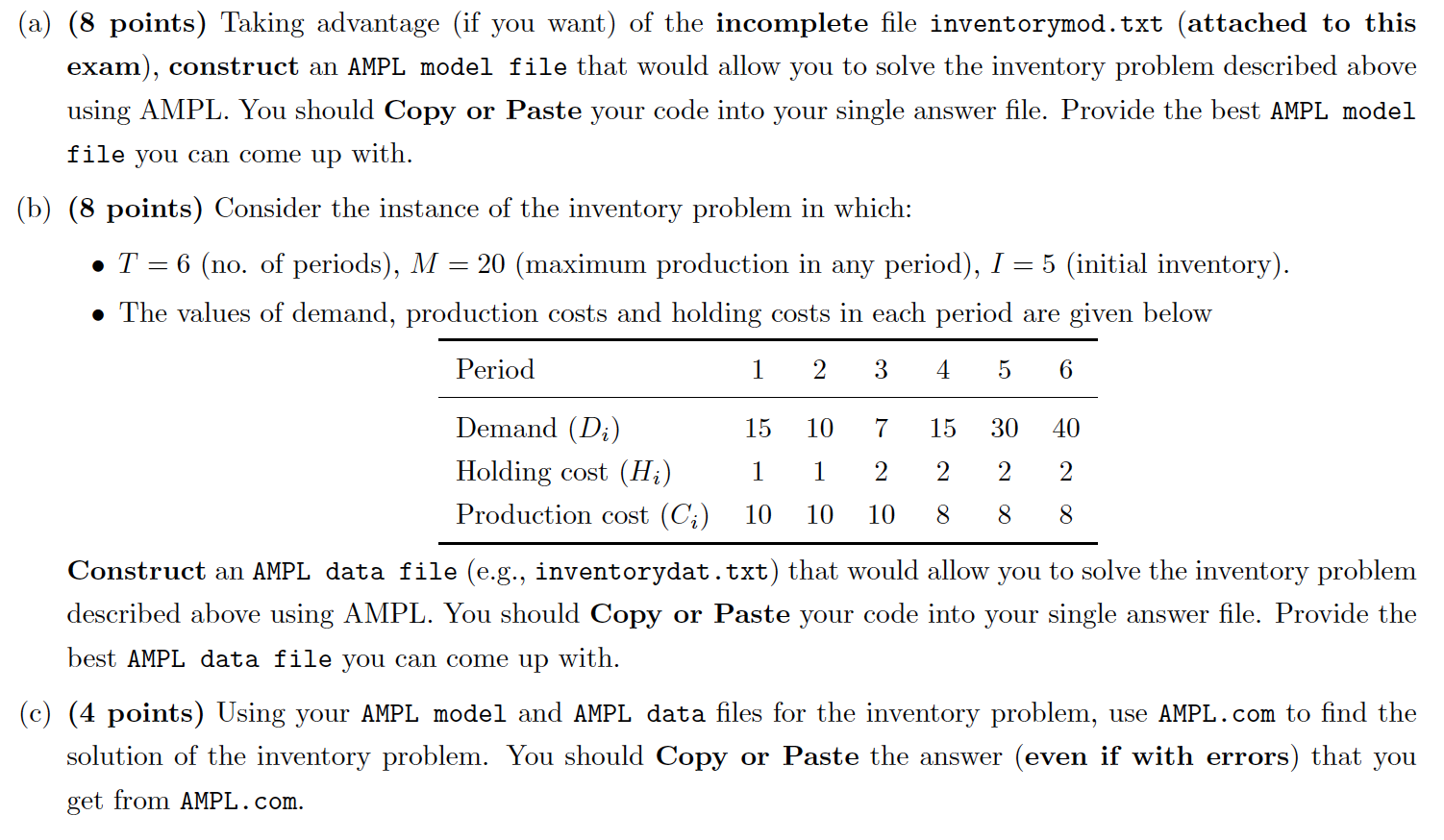
6. (20 points) Solving an Integer Program with AMPL. Consider an almost exact version of the inventory problem considered in HW 2. Namely: Suppose a production manager is responsible for scheduling the monthly production levels of a certain product for a planning horizon of T periods. For planning purposes, the manager was given the following information: The total demand for the product in period i is Di, for i = 1, ...,T The cost of producing each unit of the product in period i is C; (dollars), for i = 1, ...,T The inventory holding cost per unit in period i is Hi (dollars), for i = 1, ...,T. These are incurred at the end of each month. The production capacity in every period is M. The initial inventory available of the product is I. Shortage of the product is not allowed at the end of any period. The manager's task is to generate a production schedule that minimizes the total production and inventory-holding costs over the T planning horizon. The Integer Programming formulation of this problem is: (a) Decision variables: Ti = production level for month j = 1,...,T ending inventory level for month j = 0,1,...,T Yi = (b) Objective: min cizi + huy Cici + i=1 i=1 (c) Constraints 2 0 i= 1, ...,T (production capacity) i = 0,1,...,T (demand and inventory) (initial inventory) i=1, ...,T i = 0,1,...,1 i= 1,...,T (non-negativity) i=0,1,...,T (non-negativity) Yi > 0 (a) (8 points) Taking advantage (if you want) of the incomplete file inventorymod.txt (attached to this exam), construct an AMPL model file that would allow you to solve the inventory problem described above using AMPL. You should Copy or Paste your code into your single answer file. Provide the best AMPL model file you can come up with. (b) (8 points) Consider the instance of the inventory problem in which: T 6 (no. of periods), M 20 (maximum production in any period), I = 5 (initial inventory). The values of demand, production costs and holding costs in each period are given below Period 1 2 3 4 5 6 15 10 7 15 30 40 Demand (D;) Holding cost (H;) Production cost (C;) 1 1 2 2 2 2 10 10 10 8 8 8 Construct an AMPL data file (e.g., inventorydat.txt) that would allow you to solve the inventory problem described above using AMPL. You should Copy or Paste your code into your single answer file. Provide the best AMPL data file you can come up with. (c) (4 points) Using your AMPL model and AMPL data files for the inventory problem, use AMPL.com to find the solution of the inventory problem. You should Copy or Paste the answer (even if with errors) that you get from AMPL.com. 6. (20 points) Solving an Integer Program with AMPL. Consider an almost exact version of the inventory problem considered in HW 2. Namely: Suppose a production manager is responsible for scheduling the monthly production levels of a certain product for a planning horizon of T periods. For planning purposes, the manager was given the following information: The total demand for the product in period i is Di, for i = 1, ...,T The cost of producing each unit of the product in period i is C; (dollars), for i = 1, ...,T The inventory holding cost per unit in period i is Hi (dollars), for i = 1, ...,T. These are incurred at the end of each month. The production capacity in every period is M. The initial inventory available of the product is I. Shortage of the product is not allowed at the end of any period. The manager's task is to generate a production schedule that minimizes the total production and inventory-holding costs over the T planning horizon. The Integer Programming formulation of this problem is: (a) Decision variables: Ti = production level for month j = 1,...,T ending inventory level for month j = 0,1,...,T Yi = (b) Objective: min cizi + huy Cici + i=1 i=1 (c) Constraints 2 0 i= 1, ...,T (production capacity) i = 0,1,...,T (demand and inventory) (initial inventory) i=1, ...,T i = 0,1,...,1 i= 1,...,T (non-negativity) i=0,1,...,T (non-negativity) Yi > 0 (a) (8 points) Taking advantage (if you want) of the incomplete file inventorymod.txt (attached to this exam), construct an AMPL model file that would allow you to solve the inventory problem described above using AMPL. You should Copy or Paste your code into your single answer file. Provide the best AMPL model file you can come up with. (b) (8 points) Consider the instance of the inventory problem in which: T 6 (no. of periods), M 20 (maximum production in any period), I = 5 (initial inventory). The values of demand, production costs and holding costs in each period are given below Period 1 2 3 4 5 6 15 10 7 15 30 40 Demand (D;) Holding cost (H;) Production cost (C;) 1 1 2 2 2 2 10 10 10 8 8 8 Construct an AMPL data file (e.g., inventorydat.txt) that would allow you to solve the inventory problem described above using AMPL. You should Copy or Paste your code into your single answer file. Provide the best AMPL data file you can come up with. (c) (4 points) Using your AMPL model and AMPL data files for the inventory problem, use AMPL.com to find the solution of the inventory problem. You should Copy or Paste the answer (even if with errors) that you get from AMPL.com
Step by Step Solution

There are 3 Steps involved in it

1 Expert Approved Answer
Step: 1 Unlock blur-text-image

Question Has Been Solved by an Expert!

Get step-by-step solutions from verified subject matter experts

Step: 2 Unlock
Step: 3 Unlock

Students Have Also Explored These Related General Management Questions!