







Question: 6. (25 pts) Consider a process where a fraction p (if p=.07 then 7 parts out of 100 parts are defective) of the items processed
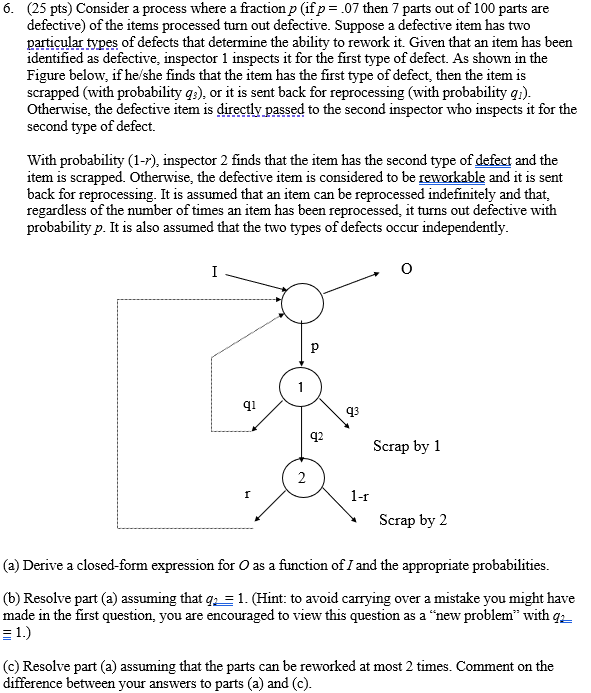
6. (25 pts) Consider a process where a fraction p (if p=.07 then 7 parts out of 100 parts are defective) of the items processed turn out defective. Suppose a defective item has two particular types of defects that determine the ability to rework it. Given that an item has been identified as defective, inspector 1 inspects it for the first type of defect. As shown in the Figure below, if he/she finds that the item has the first type of defect, then the item is scrapped (with probability q3 ), or it is sent back for reprocessing (with probability ql ). Otherwise, the defective item is directly passsed to the second inspector who inspects it for the second type of defect. With probability (1-r), inspector 2 finds that the item has the second type of defect and the item is scrapped. Otherwise, the defective item is considered to be reworkable and it is sent back for reprocessing. It is assumed that an item can be reprocessed indefinitely and that, regardless of the number of times an item has been reprocessed, it turns out defective with probability p. It is also assumed that the two types of defects occur independently. (a) Derive a closed-form expression for O as a function of I and the appropriate probabilities. (b) Resolve part (a) assuming that q2=1. (Hint: to avoid carrying over a mistake you might have made in the first question, you are encouraged to view this question as a "new problem" with q2 1. (c) Resolve part (a) assuming that the parts can be reworked at most 2 times. Comment on the difference between your answers to parts (a) and (c). 6. (25 pts) Consider a process where a fraction p (if p=.07 then 7 parts out of 100 parts are defective) of the items processed turn out defective. Suppose a defective item has two particular types of defects that determine the ability to rework it. Given that an item has been identified as defective, inspector 1 inspects it for the first type of defect. As shown in the Figure below, if he/she finds that the item has the first type of defect, then the item is scrapped (with probability q3 ), or it is sent back for reprocessing (with probability ql ). Otherwise, the defective item is directly passsed to the second inspector who inspects it for the second type of defect. With probability (1-r), inspector 2 finds that the item has the second type of defect and the item is scrapped. Otherwise, the defective item is considered to be reworkable and it is sent back for reprocessing. It is assumed that an item can be reprocessed indefinitely and that, regardless of the number of times an item has been reprocessed, it turns out defective with probability p. It is also assumed that the two types of defects occur independently. (a) Derive a closed-form expression for O as a function of I and the appropriate probabilities. (b) Resolve part (a) assuming that q2=1. (Hint: to avoid carrying over a mistake you might have made in the first question, you are encouraged to view this question as a "new problem" with q2 1. (c) Resolve part (a) assuming that the parts can be reworked at most 2 times. Comment on the difference between your answers to parts (a) and (c)
Step by Step Solution
There are 3 Steps involved in it

Get step-by-step solutions from verified subject matter experts
 Study Help