







Question: 6. (3 points) Bonus Question Consider two arbitrary strings $a$ and $b$ over respective alphabets $Sigma_{1}$ and $Sigma_{2}$ of the form $a=$ $a_{1} a_{2} ldots
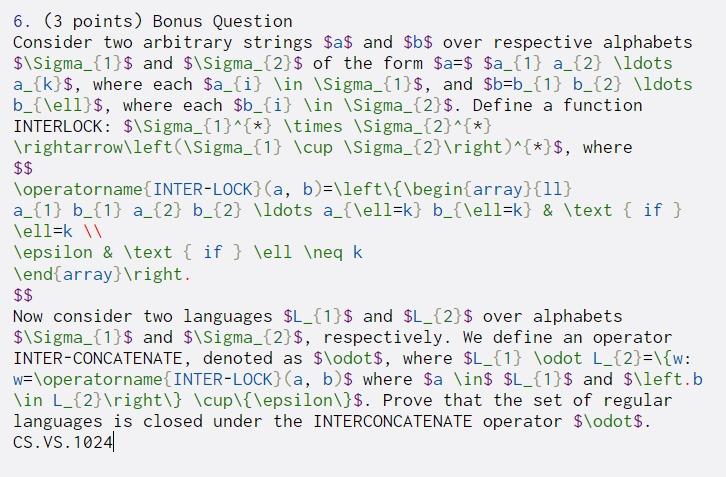
6. (3 points) Bonus Question Consider two arbitrary strings $a$ and $b$ over respective alphabets $\Sigma_{1}$ and $\Sigma_{2}$ of the form $a=$ $a_{1} a_{2} \ldots a_{k}$, where each $a_{i} \in \Sigma_{1}$, and $b=b_{1} b_{2} \ldots b_{\ell}$, where each $b_{i} \in Sigma_{2}$. Define a function INTERLOCK: $\Sigma_{1}^{*} \times \Sigma_{2}^{*} ightarrow\left(\Sigma_{1} \cup \Sigma_{2} ight)^{*}$, where $$ operatorname{INTER-LOCK} (a, b)=\left\{\begin{array}{11} a_{1} b_{1} a_{2} b_{2} \ldots a_{\ell=k} b_{\ell=k} & \text { if} lell=k Tepsilon & \text { if } \ell eq k \end{array} ight. $$ Now consider two languages $L_{1}$ and $L_{2}$ over alphabets $\Sigma_{1}$ and $\Sigma_{2}$, respectively. We define an operator INTER-CONCATENATE, denoted as $\odots, where $L_{1} \odot L_{2}=\{w: w=\operatorname{INTER-LOCK} (a, b) $ where $a \in$ $L_{1}$ and $\left.b \in L_{2} ight\} \cup\{\epsilon\}$. Prove that the set of regular languages is closed under the INTERCONCATENATE operator $\odot$. CS.VS. 1024
Step by Step Solution
There are 3 Steps involved in it

Get step-by-step solutions from verified subject matter experts
 Study Help