







Question: 6. (57 points) An enzyme reversibly binds a single substrate and irreversibly catalyzes product formation E+S ES E+P A portion of the enzyme's amino acid
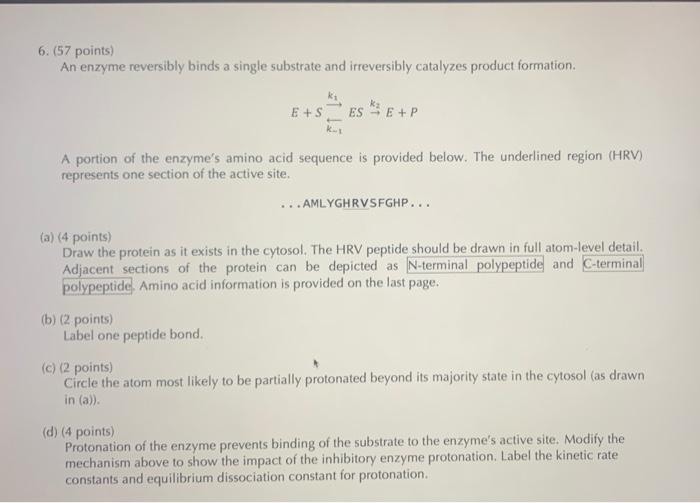

6. (57 points) An enzyme reversibly binds a single substrate and irreversibly catalyzes product formation E+S ES E+P A portion of the enzyme's amino acid sequence is provided below. The underlined region (HRV) represents one section of the active site. ..AMLYGHRVSFGHP... (a) (4 points) Draw the protein as it exists in the cytosol. The HRV peptide should be drawn in full atom-level detail. Adjacent sections of the protein can be depicted as N-terminal polypeptide and C-terminal polypeptide, Amino acid information is provided on the last page. (b) (2 points) Label one peptide bond (c) (2 points) Circle the atom most likely to be partially protonated beyond its majority state in the cytosol (as drawn in (a)). (d) (4 points) Protonation of the enzyme prevents binding of the substrate to the enzyme's active site. Modify the mechanism above to show the impact of the inhibitory enzyme protonation. Label the kinetic rate constants and equilibrium dissociation constant for protonation (e) (22 points) Derive an expression for the rate (v) of product formation as a function of rate constants, total enzyme concentration (E.), equilibrium dissociation constant for protonation, and the free substrate concentration (S)). (1) (3 points) What is the value of the equilibrium dissociation constant for protonation
Step by Step Solution
There are 3 Steps involved in it

Get step-by-step solutions from verified subject matter experts
 Study Help