







Question: 6 6. Merge Bubble Sort: a) How does the merge bubble sort break the array into sublists? b) What does it need to use for
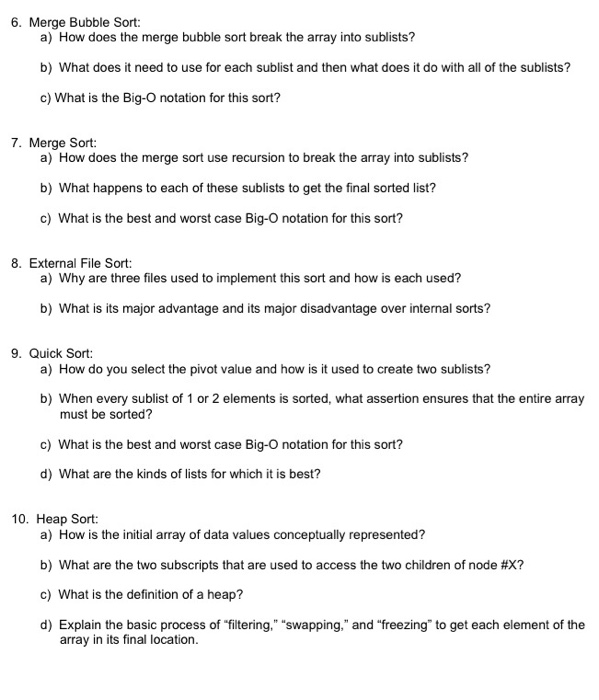
6. Merge Bubble Sort: a) How does the merge bubble sort break the array into sublists? b) What does it need to use for each sublist and then what does it do with all of the sublists? c) What is the Big-O notation for this sort? 7. Merge Sort: a) How does the merge sort use recursion to break the array into sublists? b) What happens to each of these sublists to get the final sorted list? c) What is the best and worst case Big-O notation for this sort? 8. External File Sort: a) Why are three files used to implement this sort and how is each used? b) What is its major advantage and its major disadvantage over internal sorts? 9. Quick Sort: a) How do you select the pivot value and how is it used to create two sublists? b) When every sublist of 1 or 2 elements is sorted, what assertion ensures that the entire array must be sorted? c) What is the best and worst case Big-O notation for this sort? d) What are the kinds of lists for which it is best? 10. Heap Sort: a) How is the initial array of data values conceptually represented? b) what are the two subscripts that are used to access the two children of node #X? c) What is the definition of a heap? d) Explain the basic process of filtering," "swapping," and "freezing" to get each element of the array in its final location
Step by Step Solution
There are 3 Steps involved in it

Get step-by-step solutions from verified subject matter experts
 Study Help