







Question: 6 9 EXERCISE Allocating Merit Raises I. Objectives A . To make you aware of the difficulties involved in making merit raise decisions. B .
EXERCISE
Allocating Merit Raises
I. Objectives
A To make you aware of the difficulties involved in making merit raise decisions.
B To familiarize you with possible criteria a manager can use in making merit raise decisions.
II OutofClass Preparation Time: minutes to read exercise and decide each professor's merit raise
III. InClass time Suggested: minutes
IV PROCEDURES
Either at the beginning of or before coming to class, you should read the exercise and determine merit raises for each professor.
To start the exercise, the instructor will divide the class into groups of three to five students. Each group should develop a fair procedure that will be used to determine merit raises and then decide the dollar raise to be given to each professor. After each group finishes, one member will write the raise amounts on the board or overhead for all class members to see. Then, once all groups have disclosed their raises, a spokesperson for each group will explain the procedure used to determine their raises.
SITUATION
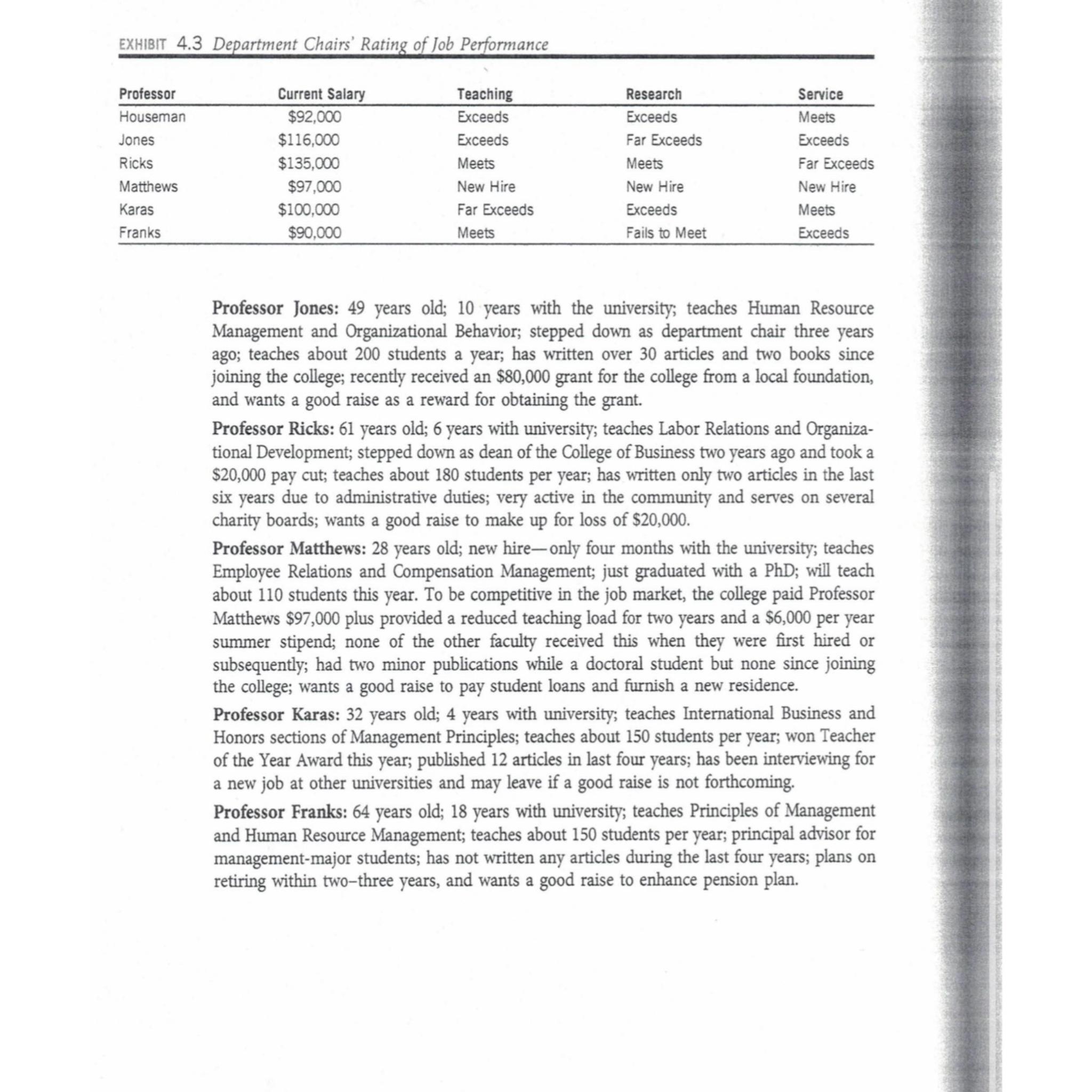
Small State University is located in the eastern part of the United States and has an enrollment of about students. The College of Business has fulltime and more than parttime faculty members. The college is divided into five departments: Management, Marketing, Finance and Accounting, Decision Sciences, and Information Technology. Faculty members in the Management Department are evaluated each year based on three primary criteria: teaching, research, and service. Teaching performance is based on student course evaluations over a twoyear period. Service to the university, college, profession, and community is also based on accomplishments over a twoyear period. Research is based on the number of journal articles published over a threeyear period. Teaching and research are considered more important than service to the university. In judging faculty performance, the department chair evaluates each professor in terms of four standards: Far Exceeds Standards, Exceeds Standards, Meets Standards, and Fails to Meet Standards. The results of this year's evaluations are shown in Exhibit
Due to financial problems and cutbacks this year, Small State University has agreed to give raises totaling just $ to the Management Department. Your task as department chair is to divide the $ among the faculty members. Keep in mind that these raises will likely set a precedent for the future and that the professors will view the raises as a signal for what behavior and achievements are valued.
A profile of each of the professors is provided below.
Professor Houseman: years old; years with the university; teaches Principles of Management sections; teaches over students per year; has written over articles and given over presentations since joining the college; wants a good raise to catch up with others.
Exercise Allocating Merit Raises
EXHIBIT Department Chairs' Rating of Job Performance
tableProfessorCurrent Salary,Teaching,Research,ServiceHouseman$Exceeds,Exceeds,MeetsJones$Exceeds,Far Exceeds,ExceedsRicks$Meets,Meets,Far ExceedsMatthews$New Hire,New Hire,New HireKaras$Far Exceeds,Exceeds,MeetsFranks$Meets,Fails to Meet,Exceeds
Professor Jones: years old; years with the university; teaches Human Resource Management and Organizational Behavior; stepped down as department chair three years ago; teaches about students a year; has written over articles and two books since joining the college; recently received an $ grant for the college from a local foundation, and wants a good raise as a reward for obtaining the grant.
Professor Ricks: years old; years with university; teaches Labor Relations and Organizational Development; stepped down as dean of the College of Business two years ago and took a $ pay cut; teaches about students per year; has written only two articles in the last six years due to administrative duties; very active in the community and serves on several charity boards; wants a good raise to make up for loss of $
Professor Matthews: years old; new hireonly four months with the university; teaches Employee Relations and Compensation Management; just graduated with a ; will teach about students this year. To be competitive in the job market, the college paid Professor Matthews $ plus provided a reduced teaching load for two years and a $ per year summer stipend; none
Step by Step Solution
There are 3 Steps involved in it
1 Expert Approved Answer
Step: 1 Unlock

Question Has Been Solved by an Expert!
Get step-by-step solutions from verified subject matter experts
Step: 2 Unlock
Step: 3 Unlock
 Study Help