







Question: 6) a) An investor has a utility function u(x) = Vx, , the investor maximizes Expected Utility, and is faced with an investment that pays
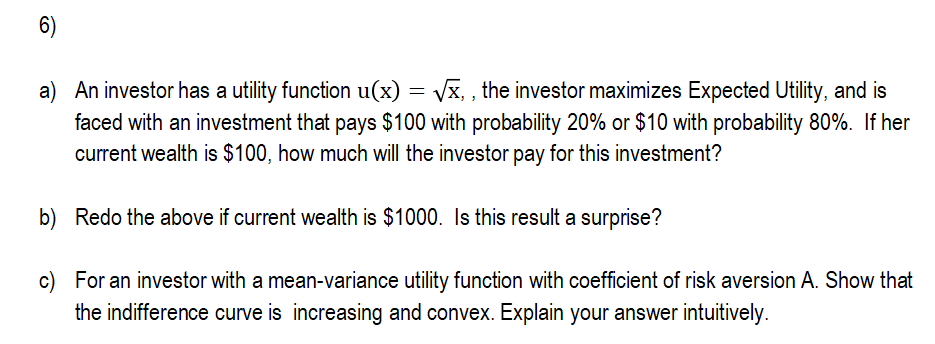
6) a) An investor has a utility function u(x) = Vx, , the investor maximizes Expected Utility, and is faced with an investment that pays $100 with probability 20% or $10 with probability 80%. If her current wealth is $100, how much will the investor pay for this investment? b) Redo the above if current wealth is $1000. Is this result a surprise? c) For an investor with a mean-variance utility function with coefficient of risk aversion A. Show that the indifference curve is increasing and convex. Explain your answer intuitively. 6) a) An investor has a utility function u(x) = Vx, , the investor maximizes Expected Utility, and is faced with an investment that pays $100 with probability 20% or $10 with probability 80%. If her current wealth is $100, how much will the investor pay for this investment? b) Redo the above if current wealth is $1000. Is this result a surprise? c) For an investor with a mean-variance utility function with coefficient of risk aversion A. Show that the indifference curve is increasing and convex. Explain your answer intuitively
Step by Step Solution
There are 3 Steps involved in it

Get step-by-step solutions from verified subject matter experts
 Study Help