







Question: # 6. a) Consider the sequence of iid random variable of random variables (X,t = 1, 2, ..} with P(Xt=1)=P(Xt =-1)=p, which is called a
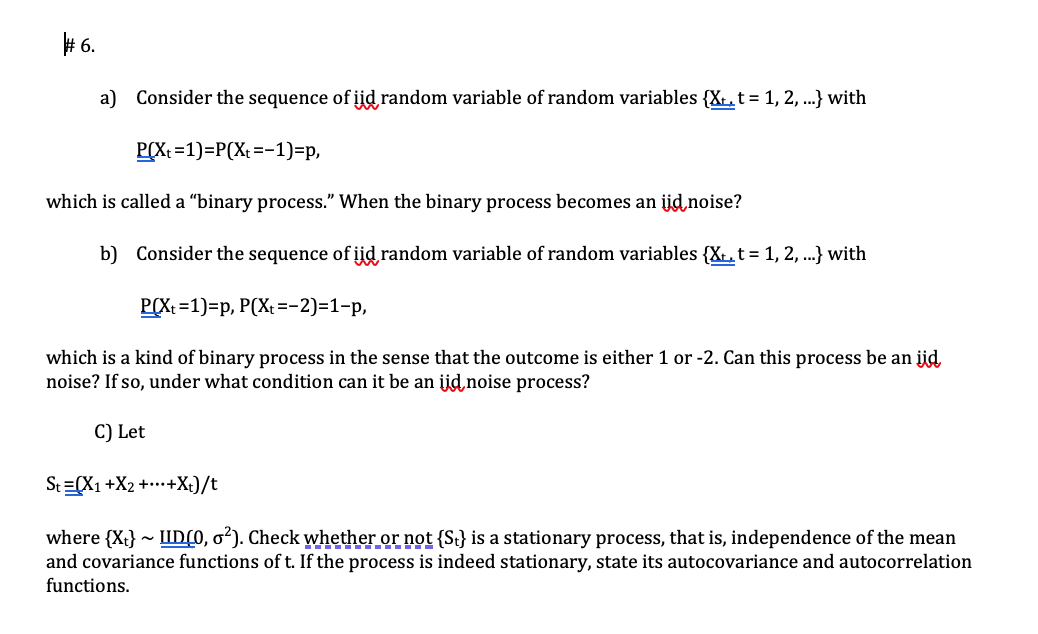
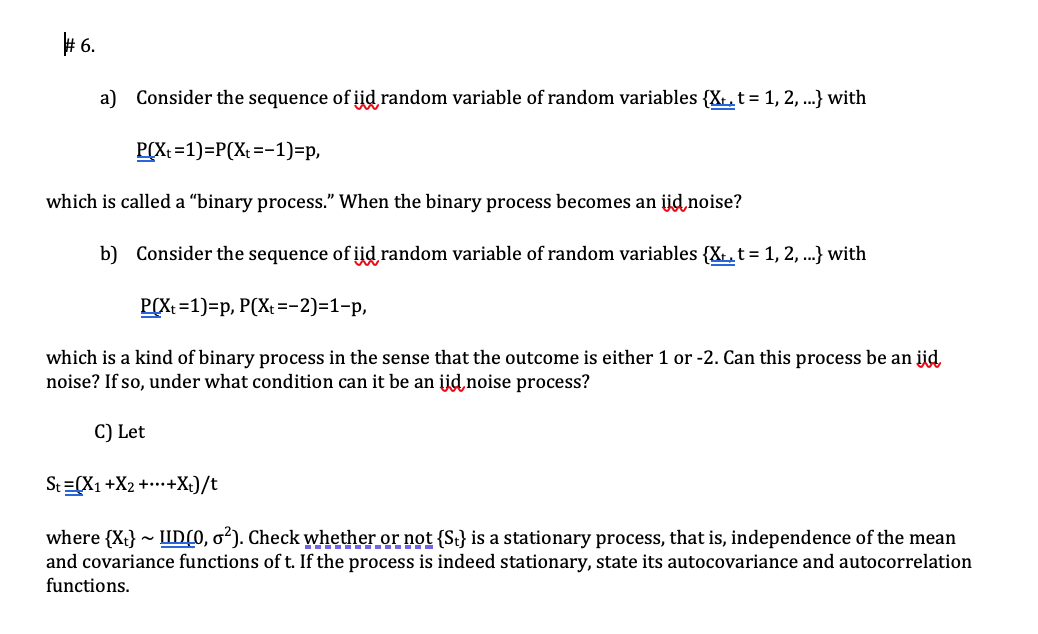
# 6. a) Consider the sequence of iid random variable of random variables (X,t = 1, 2, ..} with P(Xt=1)=P(Xt =-1)=p, which is called a "binary process." When the binary process becomes an ud noise? b) Consider the sequence of iid random variable of random variables (X, t = 1, 2, ..} with P(Xt =1)=p, P(Xt=-2)=1-p, which is a kind of binary process in the sense that the outcome is either 1 or -2. Can this process be an iid noise? If so, under what condition can it be an id noise process? C) Let St =(X1 +X2 +.".+Xt)/t where (Xt) ~ UID(0, o2). Check whether or not {St) is a stationary process, that is, independence of the mean and covariance functions of t. If the process is indeed stationary, state its autocovariance and autocorrelation functions
Step by Step Solution
There are 3 Steps involved in it

Get step-by-step solutions from verified subject matter experts
 Study Help