







Question: 6, (a) Derive a third order method for solving f(x) = 0 in a way similar to the derivation of Newton's method, using evaluations of
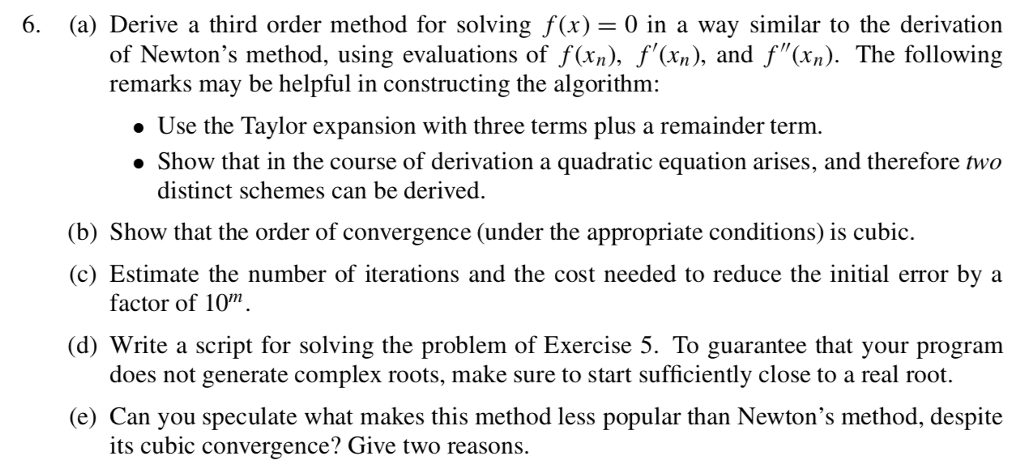

6, (a) Derive a third order method for solving f(x) = 0 in a way similar to the derivation of Newton's method, using evaluations of f(xn), f'(an), and f"(x). The following remarks may be helpful in constructing the algorithm: Use the Taylor expansion with three terms plus a remainder term. Show that in the course of derivation a quadratic equation arises, and therefore two distinct schemes can be derived. (b) Show that the order of convergence (under the appropriate conditions) is cubic. (c) Estimate the number of iterations and the cost needed to reduce the initial error by a factor of 10n d) Write a script for solving the problem of Exercise 5. To guarantee that your program does not generate complex roots, make sure to start sufficiently close to a real root. (e) Can you speculate what makes this method less popular than Newton's method, despite its cubic convergence? Give two reasons
Step by Step Solution
There are 3 Steps involved in it

Get step-by-step solutions from verified subject matter experts
 Study Help