Question: 6. Alice designs a double-RSA cipher. She first generates two secret primes p and q, and compute n=p*q, then choose two public encryption exponents ei
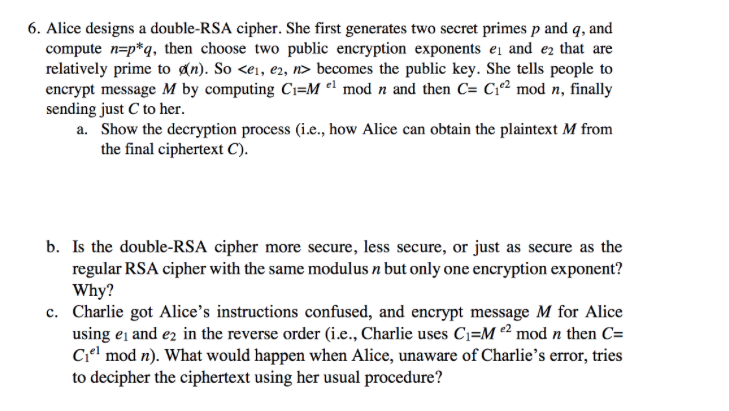
6. Alice designs a double-RSA cipher. She first generates two secret primes p and q, and compute n=p*q, then choose two public encryption exponents ei and e2 that are relatively prime to n). So becomes the public key. She tells people to encrypt message M by computing Ci-M mod n and then C- Ch2 mod n, finally sending just C to her. a. Show the decryption process (i.e., how Alice can obtain the plaintext M from the final ciphertext C) b. Is the double-RSA cipher more secure, less secure, or just as secure as the regular RSA cipher with the same modulus n but only one encryption exponent? Why? c. Charlie got Alice's instructions confused, and encrypt message M for Alice using e and e2 in the reverse order (i.e., Charlie uses Ci-M mod n then C- Ce mod n). What would happen when Alice, unaware of Charlie's error, tries to decipher the ciphertext using her usual procedure? 6. Alice designs a double-RSA cipher. She first generates two secret primes p and q, and compute n=p*q, then choose two public encryption exponents ei and e2 that are relatively prime to n). So becomes the public key. She tells people to encrypt message M by computing Ci-M mod n and then C- Ch2 mod n, finally sending just C to her. a. Show the decryption process (i.e., how Alice can obtain the plaintext M from the final ciphertext C) b. Is the double-RSA cipher more secure, less secure, or just as secure as the regular RSA cipher with the same modulus n but only one encryption exponent? Why? c. Charlie got Alice's instructions confused, and encrypt message M for Alice using e and e2 in the reverse order (i.e., Charlie uses Ci-M mod n then C- Ce mod n). What would happen when Alice, unaware of Charlie's error, tries to decipher the ciphertext using her usual procedure









 Study Help