







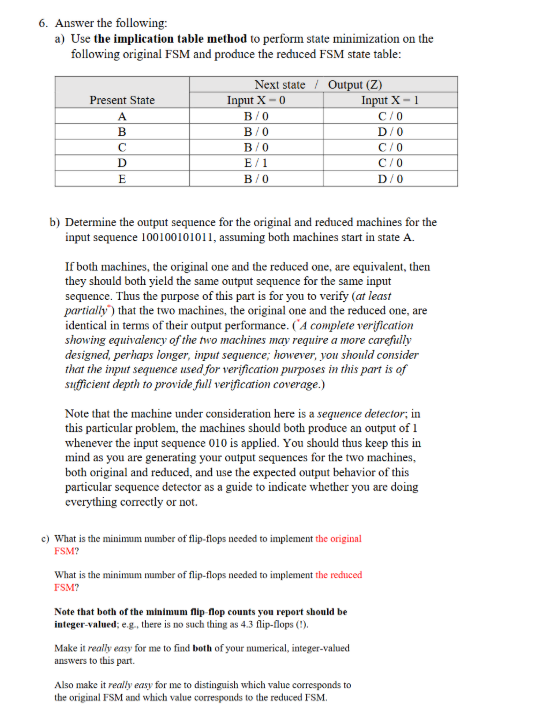
Question: 6 . Answer the following: a ) Use the implication table method to perform state minimization on the following original FSM and produce the reduced
Answer the following:
a Use the implication table method to perform state minimization on the following original FSM and produce the reduced FSM state table:
b Determine the output sequence for the original and reduced machines for the input sequence assuming both machines start in state A
If both machines, the original one and the reduced one, are equivalent, then they should both yield the same output sequence for the same input sequence. Thus the purpose of this part is for you to verify at least partially" that the two machines, the original one and the reduced one, are identical in terms of their output performance. A complete verification showing equivalency of the two machines may require a more carefully designed, perhaps longer, input sequence; however, you should consider that the input sequence used for verification purposes in this part is of sufficient depth to provide full verification coverage.
Note that the machine under consideration here is a sequence detector; in this particular problem, the machines should both produce an output of whenever the input sequence is applied. You should thus keep this in mind as you are generating your output sequences for the two machines, both original and reduced, and use the expected output behavior of this particular sequence detector as a guide to indicate whether you are doing everything correctly or not.
c What is the minimum number of flipflops needed to implement the original FSM
What is the minimum number of flipflops needed to implement the reduced FSM
Note that both of the minimum flipflop counts you report should be integervalued; eg there is no such thing as flipflops
Make it really easy for me to find both of your numerical, integervalued answers to this part.
Also make it really easy for me to distinguish which value corresponds to the original FSM and which value corresponds to the reduced FSM
Step by Step Solution
There are 3 Steps involved in it
1 Expert Approved Answer
Step: 1 Unlock

Question Has Been Solved by an Expert!
Get step-by-step solutions from verified subject matter experts
Step: 2 Unlock
Step: 3 Unlock
 Study Help