







Question: 6. CASE STUDY You are a management consultant called in to advise an organisation which has undergone significant change, involving both voluntary and compulsory redundancies,
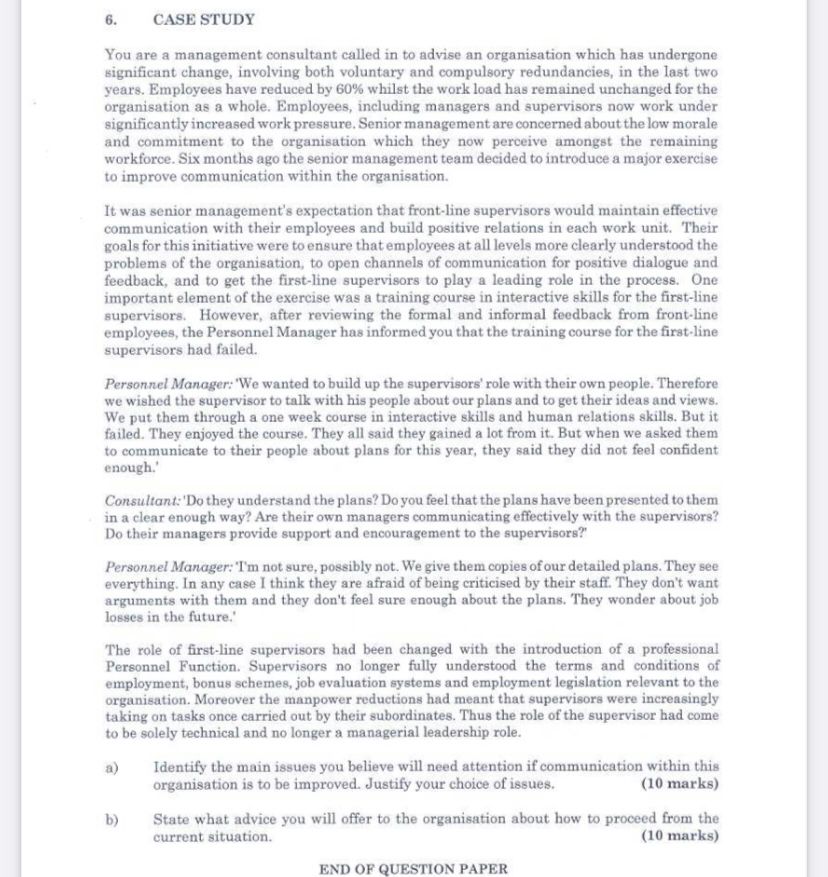
6. CASE STUDY You are a management consultant called in to advise an organisation which has undergone significant change, involving both voluntary and compulsory redundancies, in the last two years. Employees have reduced by 60% whilst the work load has remained unchanged for the organisation as a whole. Employees, including managers and supervisors now work under significantly increased work pressure. Senior management are concerned about the low morale and commitment to the organisation which they now perceive amongst the remaining workforce. Six months ago the senior management team decided to introduce a major exercise to improve communication within the organisation. It was senior management's expectation that front-line supervisors would maintain effective communication with their employees and build positive relations in each work unit. 'Their goals for this initiative were to ensure that employees at all levels more clearly understood the problems of the organisation, to open channels of communication for positive dialogue and feedback, and to get the first-line supervisors to play a leading role in the process. One important element of the exercise was a training course in interactive skills for the first-line supervisors. However, after reviewing the formal and informal feedback from front-line employees, the Personnel Manager has informed you that the training course for the first-line supervisors had failed. Personnel Manager: 'We wanted to build up the supervisors' role with their own people. Therefore we wished the supervisor to talk with his people about our plans and to get their ideas and views. We put them through a one week course in interactive skills and human relations skills. But it failed. They enjoyed the course. They all said they gained a lot from it. But when we asked them to communicate to their people about plans for this year, they said they did not feel confident enough.' Consultant: 'Do they understand the plans? Do you feel that the plans have been presented to them in a clear enough way? Are their own managers communicating effectively with the supervisors? Do their managers provide support and encouragement to the supervisors?" Personnel Manager: 'Tm not sure, possibly not. We give them copies of our detailed plans. They see everything. In any case I think they are afraid of being criticised by their staft. They don't want arguments with them and they don't feel sure enough about the plans. They wonder about job losses in the future.' The role of first-line supervisors had been changed with the introduction of a professional Personnel Function. Supervisors no longer fully understood the terms and conditions of employment, bonus schemes, job evaluation systems and employment legislation relevant to the organisation. Moreover the manpower reductions had meant that supervisors were increasingly taking on tasks once carried out by their subordinates. Thus the role of the supervisor had come to be solely technical and no longer a managerial leadership role. a) Identify the main issues you believe will need attention if communication within this organisation is to be improved. Justify your choice of issues. (10 marks) b) State what advice you will offer to the organisation about how to proceed from the current situation. (10 marks) END OF QUESTION PAPER
Step by Step Solution
There are 3 Steps involved in it

Get step-by-step solutions from verified subject matter experts
 Study Help