







Question: 6 Chrome File Edit View History Bookmarks Profiles Tab Window Help 0 O I: laurelsprings,geniussis.cov X AP Calculus AB 0L v4 A - X
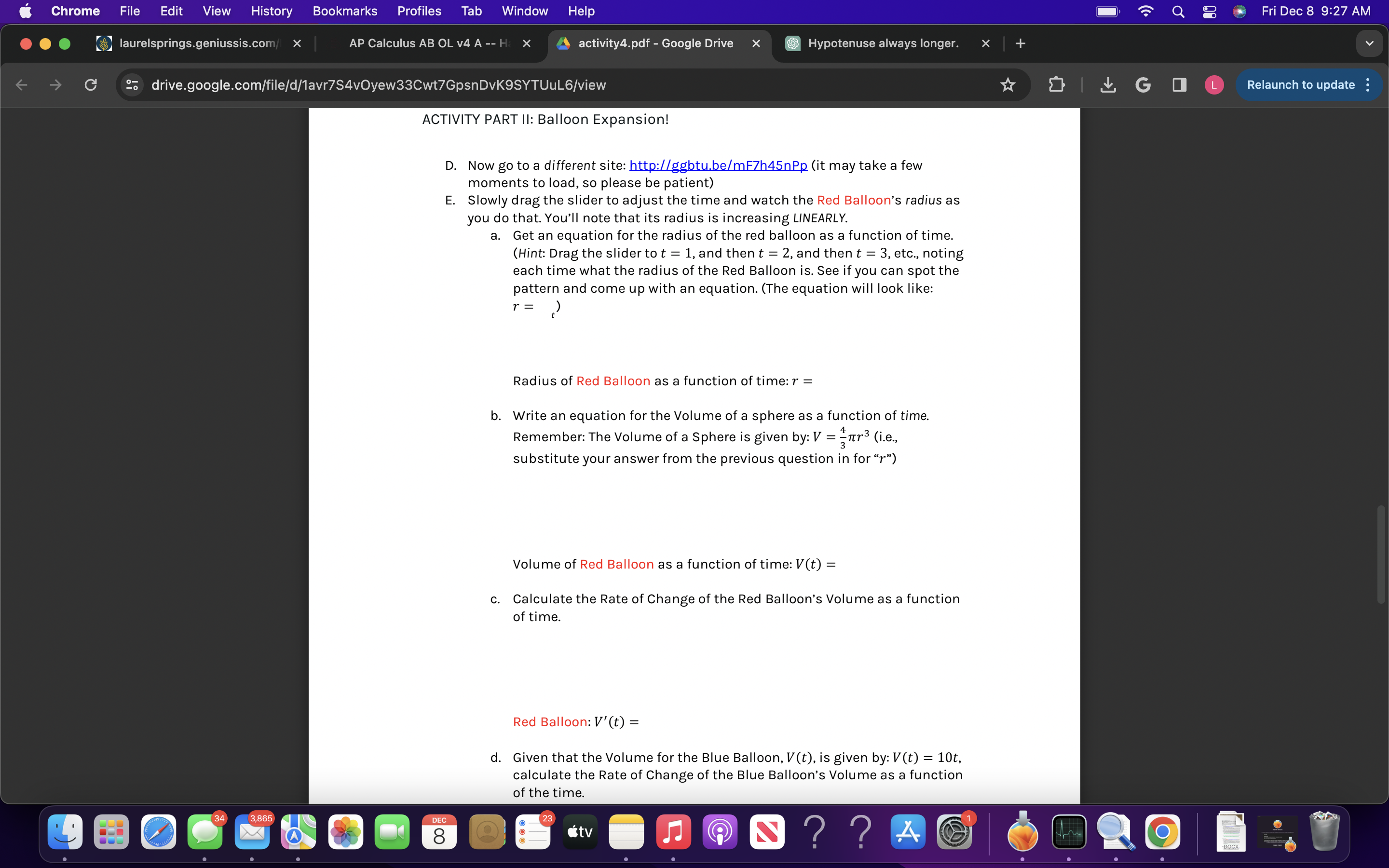
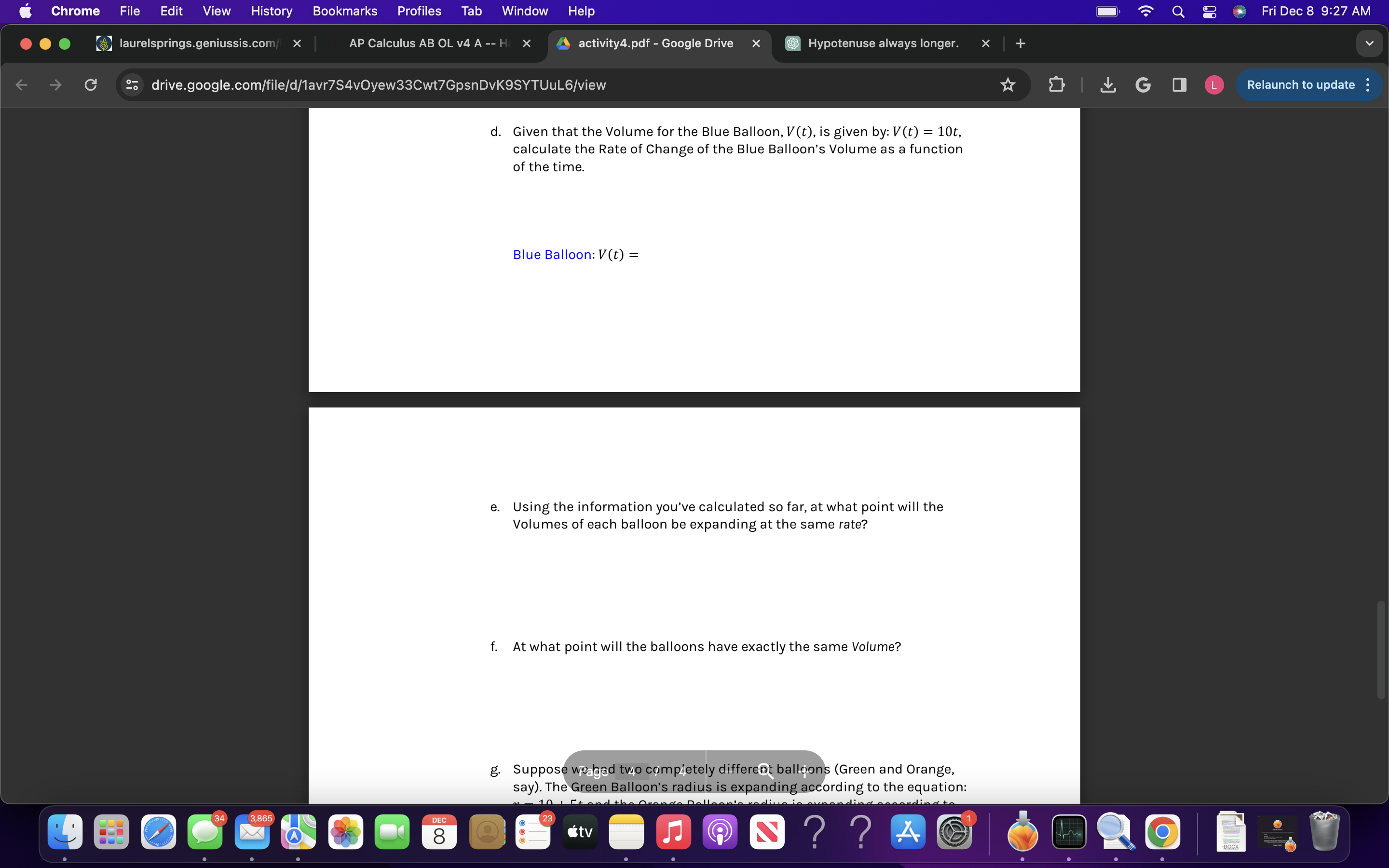
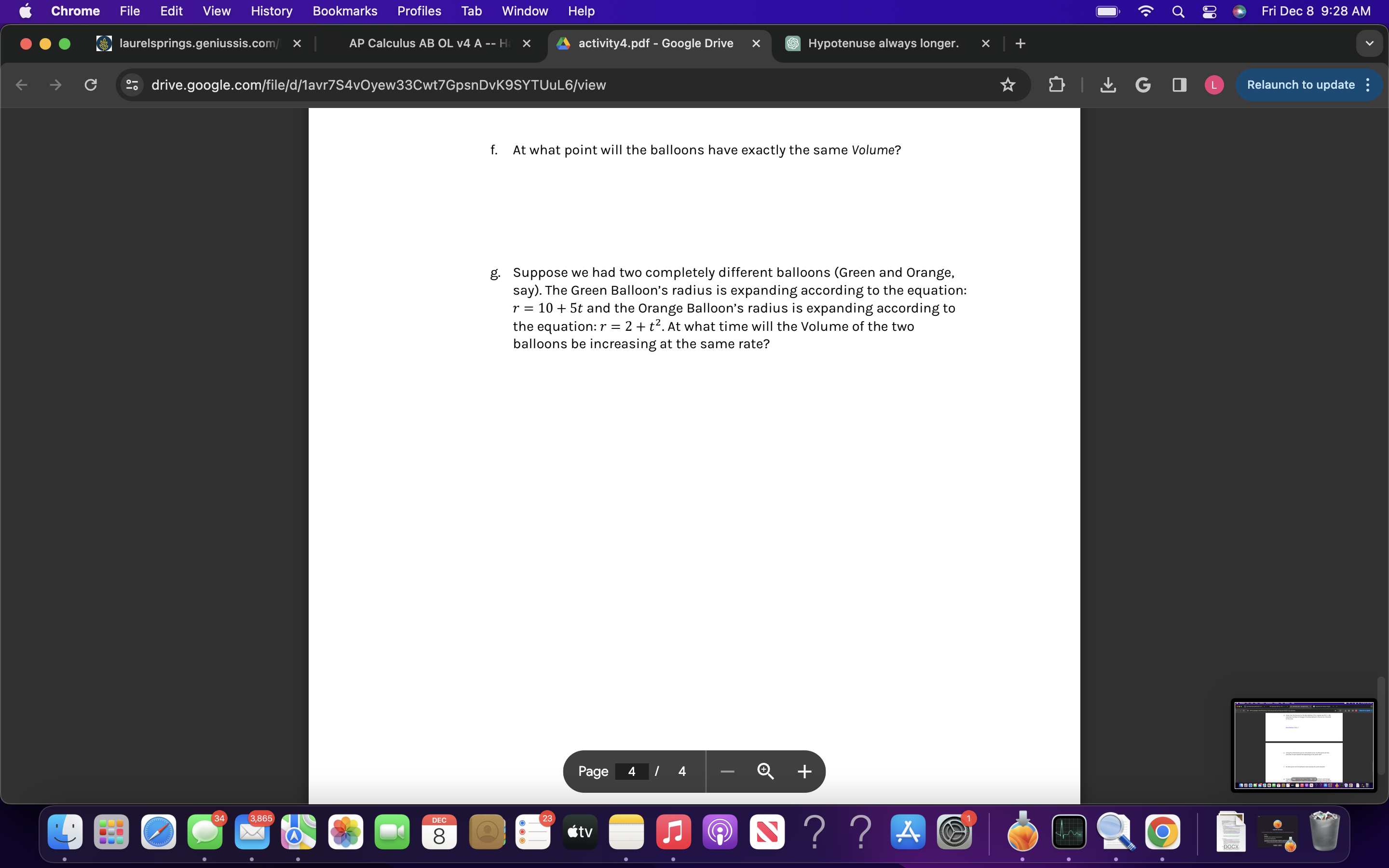
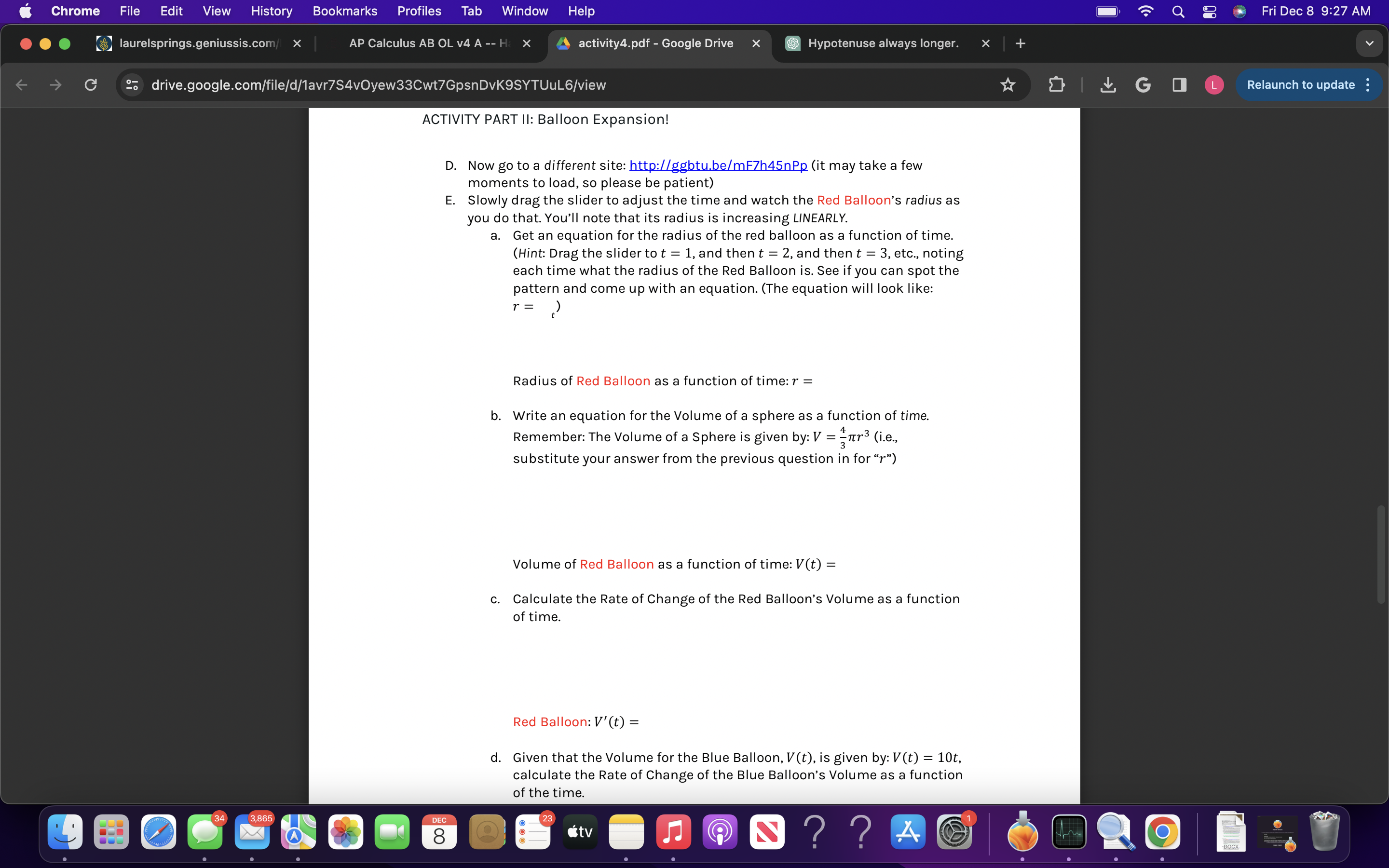
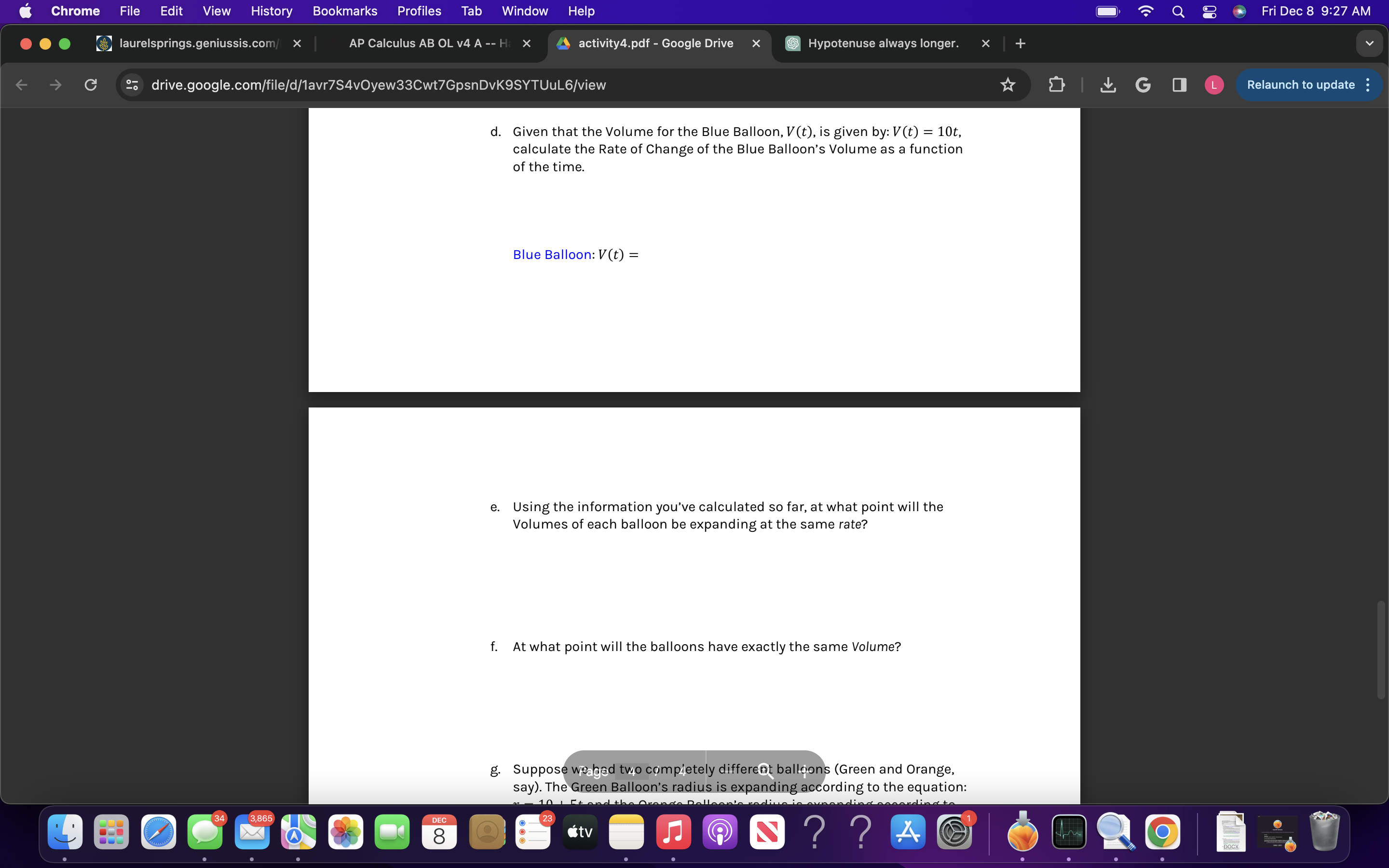
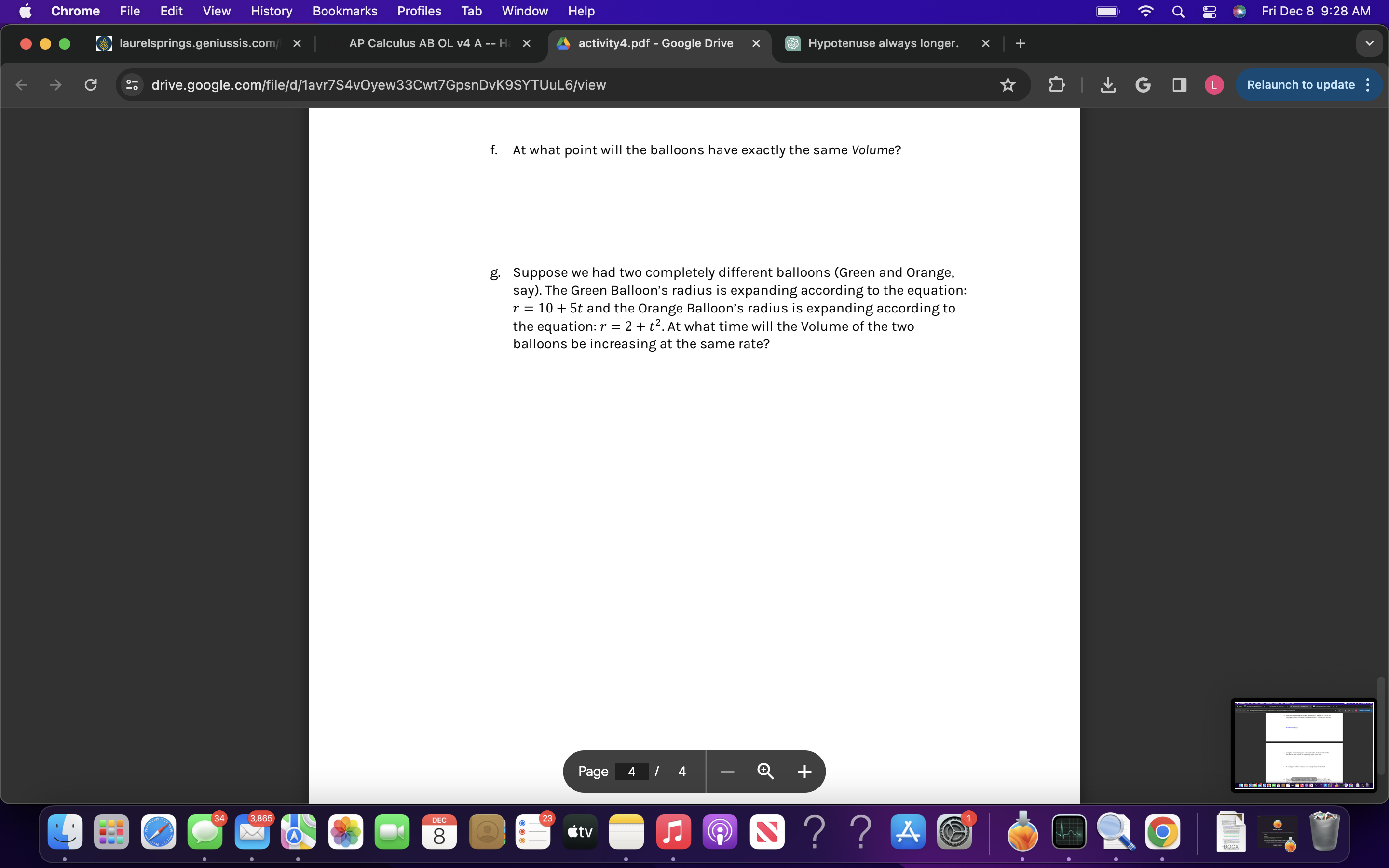
6 Chrome File Edit View History Bookmarks Profiles Tab Window Help 0 O I: laurelsprings,geniussis.cov X AP Calculus AB 0L v4 A - X \\ activity4.pdf Google Drive x I Hypotenuse always longer. 0 '1: drivetgoogletcom/file/d/lavr7SAVOyew33th7GpsanK95YTUuL6/view ACTIVITY PART II: Balloon Expansion! Now go to a different site: bitmggbtbeLmEZbAinEp (it may take a few moments to load, so please be patient) Slowly drag the slider to adjust the time and watch the Red Balloon's radius as you do that. You'll note that its radius is increasing LINEARLY. a. Get an equation for the radius of the red balloon as a function of time. (Hint: Drag the sliderto t = 1. and then t = 2, and then t = 3. etc. noting each time what the radius of the Red Balloon is. See ifyou can spot the pattern and come up with an equation, (The equation will look like: 1': r) Radius of Red Balloon as a function of time:r : Write an equation for the Volume of a sphere as a function of time. Remember: The Volume of a Sphere is given by: V : HT3 (Le. substitute your answer from the previous question in for \"r\") Volume of Red Balloon as a function of time: V(t) : Calculate the Rate of Change of the Red Balloon's Volume as a function of time. Red Balloon: V'(t) = Given that the Volume for the Blue Balloon. V(t), is given by: V(t) : 10:, calculate the Rate of Change of the Blue Balloon's Volume as a function of the time. Fri Dec 8 9:27 AM Relaunch to update 6 Chrome File Edit View History Bookmarks Profiles Tab Window Help ' Fri Dec8 9:27AM 0 O I: Iaurelspringsgeniussiscov X AP Calculus AB 0L v4 A - X \\ activity4'pdf Google Drive x I Hypotenuse always longer. drivelgooglelcom/tile/d/lavr7S4v0yew330wt7GpsanK95YTUuL6/view Relaunch to update E Given that the Volume for the Blue Balloon. V(t), is given by: V(t) : 10:, calculate the Rate of Change of the Blue Balloon's Volume as a function of the time. Blue Balloon: V(t) = Using the information you've calculated so far, at what point will the Volumes of each balloon be expanding at the same rate? At what point will the balloons have exactly the same Volume? Suppose we hadnompjetely different balloons (Green and Orange. say), Themmalrlanmmmsaisupamdinganc'ording to the equation: 3,865 Chrome File Edit View History Bookmarks Profiles Tab Window Help Q 8 @ Fri Dec 8 9:28 AM . . . laurelsprings.geniussis.com/ x AP Calculus AB OL v4 A -- H X activity4.pdf - Google Drive X Hypotenuse always longer. X + G 20 drive.google.com/file/d/1avr7S4vOyew33Cwt7GpsnDvK9SYTUuL6/view DILGOL Relaunch to update : f. At what point will the balloons have exactly the same Volume? g. Suppose we had two completely different balloons (Green and Orange, say). The Green Balloon's radius is expanding according to the equation: r = 10 + 5t and the Orange Balloon's radius is expanding according to the equation:r = 2 + t2. At what time will the Volume of the two balloons be increasing at the same rate? e 4 / 4 - 34 3,865 DEC 23 8 DOCK
Step by Step Solution
There are 3 Steps involved in it

Get step-by-step solutions from verified subject matter experts
 Study Help