







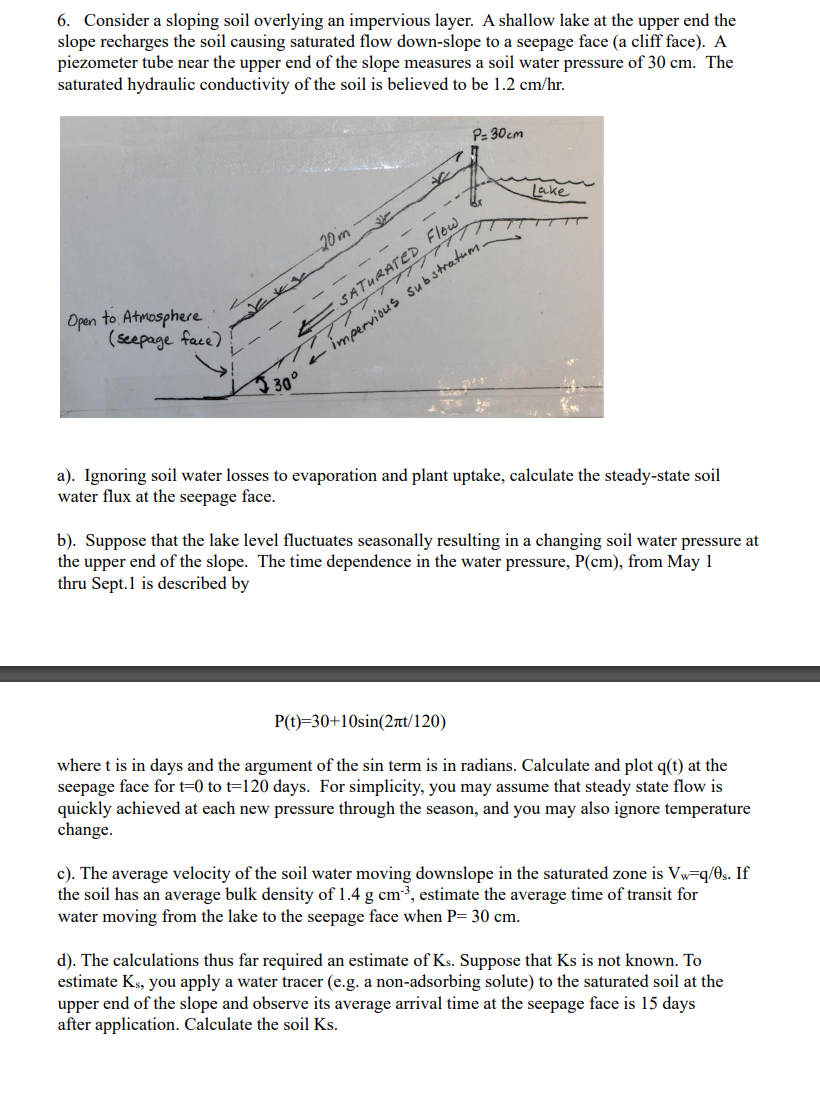
Question: 6 . Consider a sloping soil overlying an impervious layer. A shallow lake at the upper end the slope recharges the soil causing saturated flow
Consider a sloping soil overlying an impervious layer. A shallow lake at the upper end the slope recharges the soil causing saturated flow downslope to a seepage face a cliff face A piezometer tube near the upper end of the slope measures a soil water pressure of cm The saturated hydraulic conductivity of the soil is believed to be mathrm~cmmathrmhr
a Ignoring soil water losses to evaporation and plant uptake, calculate the steadystate soil water flux at the seepage face.
b Suppose that the lake level fluctuates seasonally resulting in a changing soil water pressure at the upper end of the slope. The time dependence in the water pressure, mathrmPmathrmcm from May thru Sept. is described by
mathrmPmathrmtsin pi mathrmt
where t is in days and the argument of the sin term is in radians. Calculate and plot qt at the seepage face for t to t days. For simplicity, you may assume that steady state flow is quickly achieved at each new pressure through the season, and you may also ignore temperature change.
c The average velocity of the soil water moving downslope in the saturated zone is mathrmVmathrmwmathrmqthetamathrms If the soil has an average bulk density of mathrm~gmathrm~cm estimate the average time of transit for water moving from the lake to the seepage face when mathrmPmathrm~cm
d The calculations thus far required an estimate of Ks Suppose that Ks is not known. To estimate mathrmKmathrms you apply a water tracer eg a nonadsorbing solute to the saturated soil at the upper end of the slope and observe its average arrival time at the seepage face is days after application. Calculate the soil Ks
Step by Step Solution
There are 3 Steps involved in it
1 Expert Approved Answer
Step: 1 Unlock

Question Has Been Solved by an Expert!
Get step-by-step solutions from verified subject matter experts
Step: 2 Unlock
Step: 3 Unlock
 Study Help