







Question: 6 . Consider Example 5 - 1 and discuss strategies that could help Amazon and its sellers solve the misalignment problem. The following article excerpt
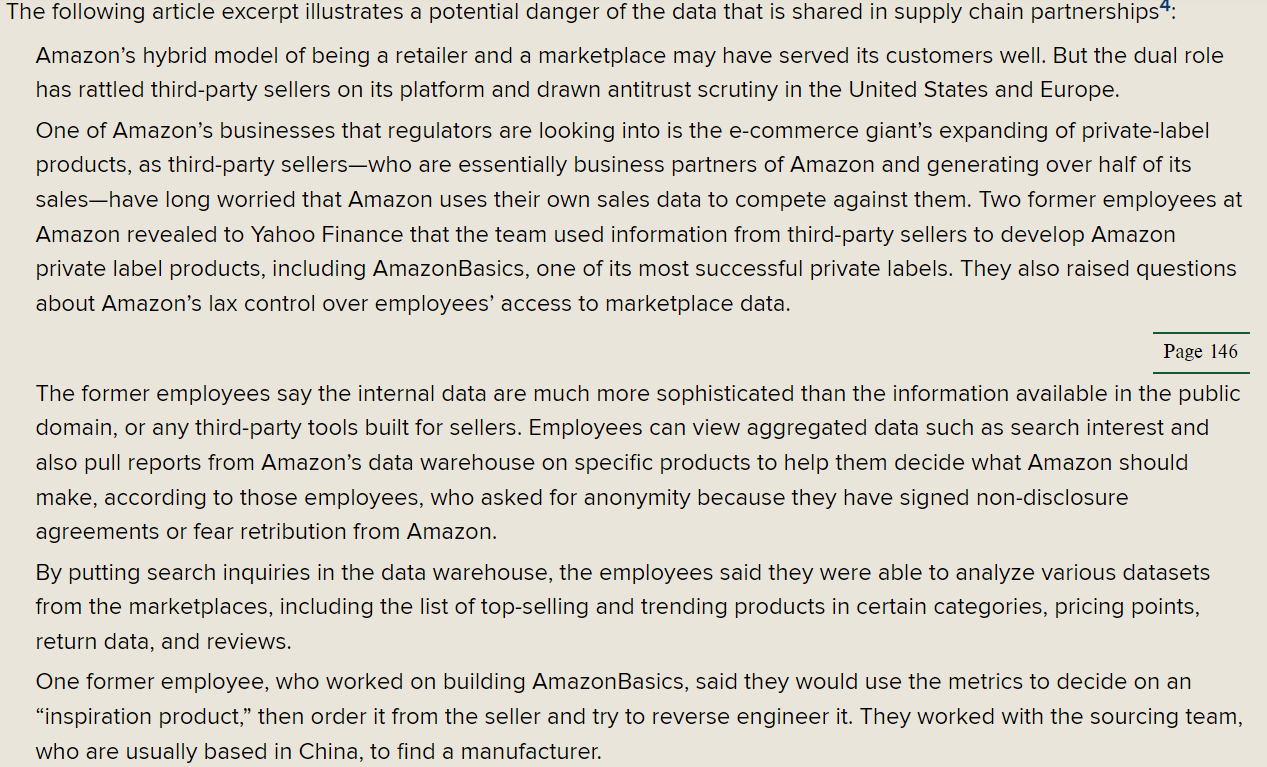
Consider Example and discuss strategies that could help Amazon and its sellers solve the misalignment problem. The following article excerpt illustrates a potential danger of the data that is shared in supply chain partnerships:
Amazon's hybrid model of being a retailer and a marketplace may have served its customers well. But the dual role
has rattled thirdparty sellers on its platform and drawn antitrust scrutiny in the United States and Europe.
One of Amazon's businesses that regulators are looking into is the ecommerce giant's expanding of privatelabel
products, as thirdparty sellerswho are essentially business partners of Amazon and generating over half of its
saleshave long worried that Amazon uses their own sales data to compete against them. Two former employees at
Amazon revealed to Yahoo Finance that the team used information from thirdparty sellers to develop Amazon
private label products, including AmazonBasics, one of its most successful private labels. They also raised questions
about Amazon's lax control over employees' access to marketplace data.
The former employees say the internal data are much more sophisticated than the information available in the public
domain, or any thirdparty tools built for sellers. Employees can view aggregated data such as search interest and
also pull reports from Amazon's data warehouse on specific products to help them decide what Amazon should
make, according to those employees, who asked for anonymity because they have signed nondisclosure
agreements or fear retribution from Amazon.
By putting search inquiries in the data warehouse, the employees said they were able to analyze various datasets
from the marketplaces, including the list of topselling and trending products in certain categories, pricing points,
return data, and reviews.
One former employee, who worked on building AmazonBasics, said they would use the metrics to decide on an
"inspiration product," then order it from the seller and try to reverse engineer it They worked with the sourcing team,
who are usually based in China, to find a manufacturer. In a statement to Yahoo Finance, an Amazon spokesperson said the company has policies in place and specifically
forbids employees from the above behavior. Amazon wouldn't confirm if employees who work on developing its
private label products can look up thirdparty sellers' data. In June, Amazon's CEO Worldwide Consumer Jeff Wilke
said the company doesn't allow anyone to have access to individual sellers' data in order to build a privatelabel
product.
We train employees extensively on it have technical controls in place, and audit compliance vigorously. Any
employee in violation of this policy would face severe consequences," the spokesperson said. Wilke also said the
data Amazon uses is "just the bestseller list" that is "fairly available to anybody." So the things that we end up
making in private labels are the things that sell the most that are at the top of search results," he said.
In a letter to the House Judiciary Committee in July, the company reiterated it prohibits the use of data related
specifically to individual sellers in its privatelabel strategy. "Like other retailers, we use aggregated store data eg
total sales and customer shopping behavior eg search volume to identify the categories and products with high
customer demand over a given time period," it wrote. Former employees said the use of data doesn't target
individual sellersbut they looked at specific products and categories. The team at Amazon who works to develop
private labels falls under the retail team, which is a separate department from Amazon Marketplace. Two teams
operate individually, with different management and financial goals. But they share the same access to the data
warehouse, which makes it possible for the retail team to use the data from marketplace sellers to develop private
labels, according to former employees.
There aren't enough restrictions on data access, former employees say. "Once you have data warehouse
permissions, you can see just about anything in the company. Employees who have access to the data warehouse
can pull individual orders, or sales for one particular seller, or all the different products from one particular vendor
code or one particular seller ID a former employee said. Another former manager at Amazon described it as a "freeforall" situation once employees get access, as long as
they have legitimate business reasons, which could be widely defined. This leaves room for employees to play
around with the dataset.
"They know price points, they know trends, they know the value, they know the history," the person said. "Thirdparty
sellers are using tools that are estimating and guesstimating those numbers. The tools have gotten better and better,
but none of them are nearly as good as Amazon's true data."
Step by Step Solution
There are 3 Steps involved in it
1 Expert Approved Answer
Step: 1 Unlock

Question Has Been Solved by an Expert!
Get step-by-step solutions from verified subject matter experts
Step: 2 Unlock
Step: 3 Unlock
 Study Help