



Question: 6. Consider the process inFig. 5.6 in which all units require three activities A,B, and C, performed in stations A,B, and C, respectively. Figure 5.6

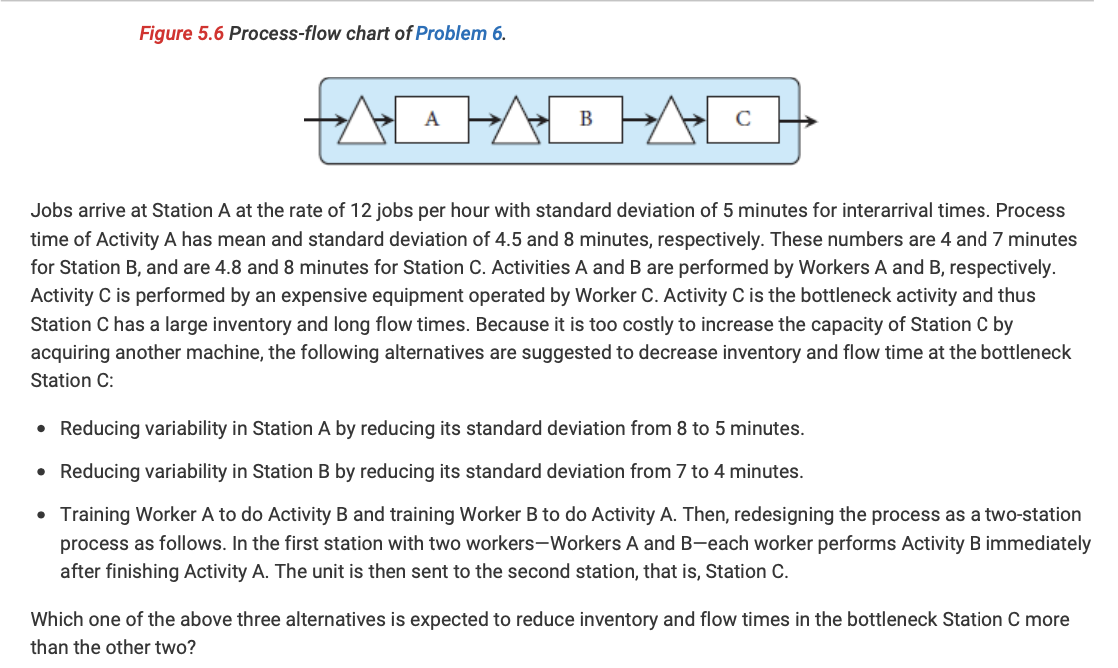
6. Consider the process inFig. 5.6 in which all units require three activities A,B, and C, performed in stations A,B, and C, respectively. Figure 5.6 Process-flow chart of Problem 6. Jobs arrive at Station A at the rate of 12 jobs per hour with standard deviation of 5 minutes for interarrival times. Process time of Activity A has mean and standard deviation of 4.5 and 8 minutes, respectively. These numbers are 4 and 7 minutes for Station B, and are 4.8 and 8 minutes for Station C. Activities A and B are performed by Workers A and B, respectively. Activity C is performed by an expensive equipment operated by Worker C. Activity C is the bottleneck activity and thus Station C has a large inventory and long flow times. Because it is too costly to increase the capacity of Station C by acquiring another machine, the following alternatives are suggested to decrease inventory and flow time at the bottleneck Station C: - Reducing variability in Station A by reducing its standard deviation from 8 to 5 minutes. - Reducing variability in Station B by reducing its standard deviation from 7 to 4 minutes. - Training Worker A to do Activity B and training Worker B to do Activity A. Then, redesigning the process as a two-station process as follows. In the first station with two workers-Workers A and B-each worker performs Activity B immediately after finishing Activity A. The unit is then sent to the second station, that is, Station C. Which one of the above three alternatives is expected to reduce inventory and flow times in the bottleneck Station C more than the other two
Step by Step Solution
There are 3 Steps involved in it

Get step-by-step solutions from verified subject matter experts