







Question: 6. Construct a formal proof of each proposition: (a) If P M, M =T, M,T TV P, (b) If P = Q, ~PAR= S,~
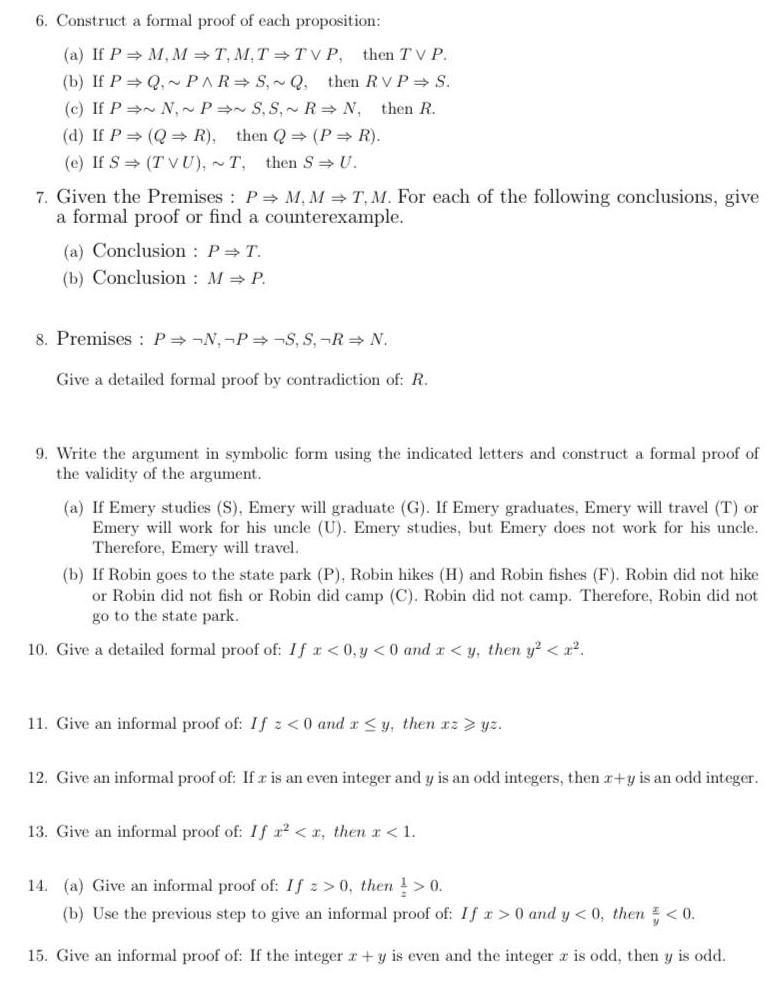
6. Construct a formal proof of each proposition: (a) If P M, M =T, M,T TV P, (b) If P = Q, ~PAR= S,~ Q. (c) If P N, P S, S,~ R= N, then R. (d) If P= (Q R), then Q (P= R). then T V P. then RV P = S. (e) If S (T Vv U), ~ T, then SU. 7. Given the Premises : P M, M T, M. For each of the following conclusions, give a formal proof or find a counterexample. (a) Conclusion : P T. (b) Conclusion : M P. 8. Premises : P=-N,-P = -S, S, -R = N. Give a detailed formal proof by contradiction of: R. 9. Write the argument in symbolic form using the indicated letters and construct a formal proof of the validity of the argument. (a) If Emery studies (S), Emery will graduate (G). If Emery graduates, Emery will travel (T) or Emery will work for his uncle (U). Emery studies, but Emery does not work for his uncle. Therefore, Emery will travel. (b) If Robin goes to the state park (P), Robin hikes (H) and Robin fishes (F). Robin did not hike or Robin did not fish or Robin did camp (C). Robin did not camp. Therefore, Robin did not go to the state park. 10. Give a detailed formal proof of: If x
Step by Step Solution
3.49 Rating (159 Votes )
There are 3 Steps involved in it

Get step-by-step solutions from verified subject matter experts
 Study Help