







Question: 6. Dividends, repurchases, and firm value Aa Aa E Remember that the primary goal of a firm is to maximize shareholder wealth by increasing the
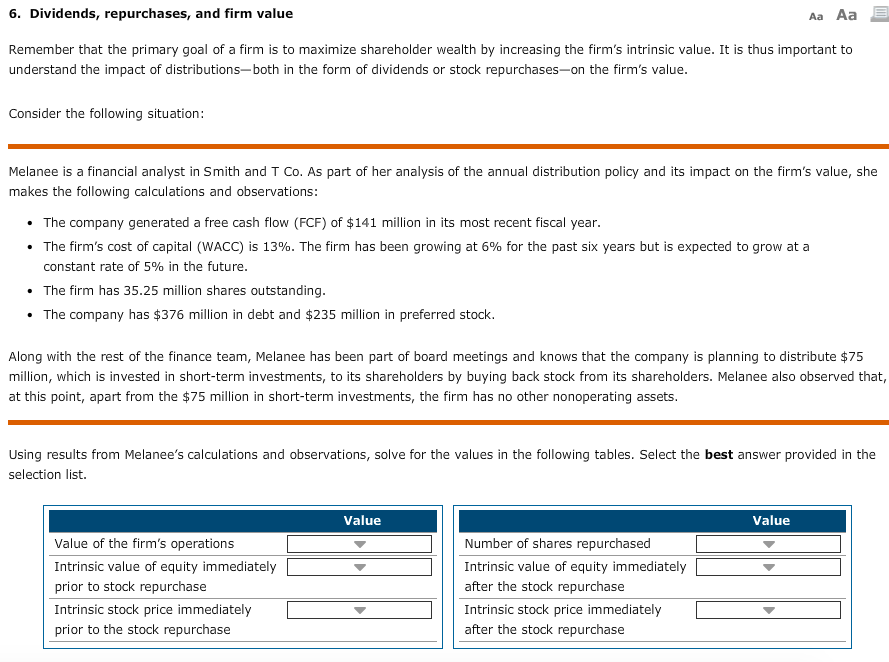
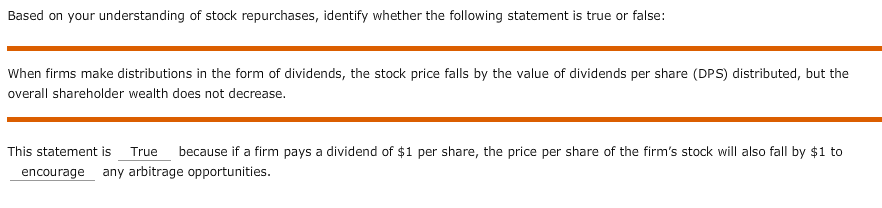
6. Dividends, repurchases, and firm value Aa Aa E Remember that the primary goal of a firm is to maximize shareholder wealth by increasing the firm's intrinsic value. It is thus important to understand the impact of distributions-both in the form of dividends or stock repurchases-on the firm's value. Consider the following situation: Melanee is a financial analyst in Smith and T Co. As part of her analysis of the annual distribution policy and its impact on the firm's value, she makes the following calculations and observations: The company generated a free cash flow (FCF) of $141 million in its most recent fiscal year. The firm's cost of capital (WACC) is 13%. The firm has been growing at 6% for the past six years but is expected to grow at a constant rate of 5% in the future. The firm has 35.25 million shares outstanding. The company has $376 million in debt and $235 million in preferred stock. Along with the rest of the finance team, Melanee has been part of board meetings and knows that the company is planning to distribute $75 million, which is invested in short-term investments, to its shareholders by buying back stock from its shareholders. Melanee also observed that, at this point, apart from the $75 million in short-term investments, the firm has no other nonoperating assets. Using results from Melanee's calculations and observations, solve for the values in the following tables. Select the best answer provided in the selection list. Value Value Value of the firm's operations Intrinsic value of equity immediately prior to stock repurchase Intrinsic stock price immediately prior to the stock repurchase Number of shares repurchased Intrinsic value of equity immediately after the stock repurchase Intrinsic stock price immediately after the stock repurchase Based on your understanding of stock repurchases, identify whether the following statement is true or false: When firms make distributions in the form of dividends, the stock price falls by the value of dividends per share (DPS) distributed, but the overall shareholder wealth does not decrease. This statement is True because if a firm pays a dividend of $1 per share, the price per share of the firm's stock will also fall by $1 to encourage any arbitrage opportunities. 6. Dividends, repurchases, and firm value Aa Aa E Remember that the primary goal of a firm is to maximize shareholder wealth by increasing the firm's intrinsic value. It is thus important to understand the impact of distributions-both in the form of dividends or stock repurchases-on the firm's value. Consider the following situation: Melanee is a financial analyst in Smith and T Co. As part of her analysis of the annual distribution policy and its impact on the firm's value, she makes the following calculations and observations: The company generated a free cash flow (FCF) of $141 million in its most recent fiscal year. The firm's cost of capital (WACC) is 13%. The firm has been growing at 6% for the past six years but is expected to grow at a constant rate of 5% in the future. The firm has 35.25 million shares outstanding. The company has $376 million in debt and $235 million in preferred stock. Along with the rest of the finance team, Melanee has been part of board meetings and knows that the company is planning to distribute $75 million, which is invested in short-term investments, to its shareholders by buying back stock from its shareholders. Melanee also observed that, at this point, apart from the $75 million in short-term investments, the firm has no other nonoperating assets. Using results from Melanee's calculations and observations, solve for the values in the following tables. Select the best answer provided in the selection list. Value Value Value of the firm's operations Intrinsic value of equity immediately prior to stock repurchase Intrinsic stock price immediately prior to the stock repurchase Number of shares repurchased Intrinsic value of equity immediately after the stock repurchase Intrinsic stock price immediately after the stock repurchase Based on your understanding of stock repurchases, identify whether the following statement is true or false: When firms make distributions in the form of dividends, the stock price falls by the value of dividends per share (DPS) distributed, but the overall shareholder wealth does not decrease. This statement is True because if a firm pays a dividend of $1 per share, the price per share of the firm's stock will also fall by $1 to encourage any arbitrage opportunities
Step by Step Solution
There are 3 Steps involved in it

Get step-by-step solutions from verified subject matter experts
 Study Help