







Question: 6. Given an array with 5 elements, is it true that one can always use 3 comparisons to determine an element that is among the
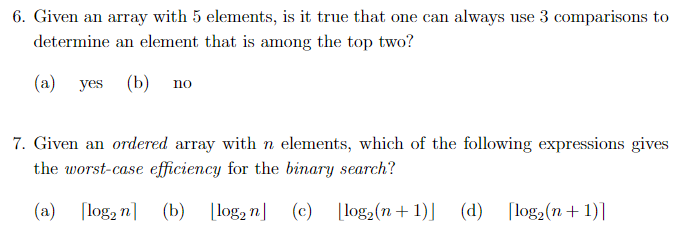
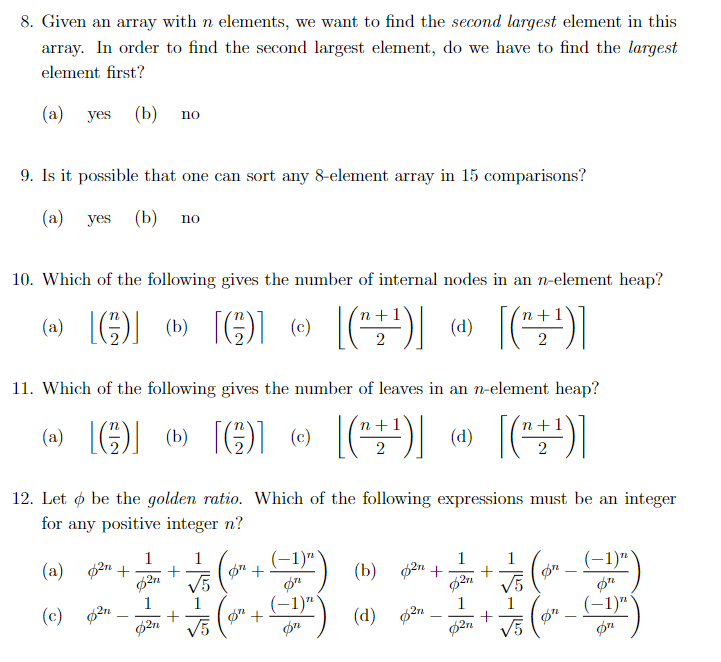
6. Given an array with 5 elements, is it true that one can always use 3 comparisons to determine an element that is among the top two? (a) yes (b) no 7. Given an ordered array with n elements, which of the following expressions gives the worst-case efficiency for the binary search? (a) log2n (b) log2n (c) log2(n+1) (d) log2(n+1) 8. Given an array with n elements, we want to find the second largest element in this array. In order to find the second largest element, do we have to find the largest element first? (a) yes (b) no 9. Is it possible that one can sort any 8-element array in 15 comparisons? (a) yes (b) no 10. Which of the following gives the number of internal nodes in an n-element heap? (a) (2n) (b) (2n) (c) (2n+1) (d) (2n+1) 11. Which of the following gives the number of leaves in an n-element heap? (a) (2n) (b) (2n) (c) (2n+1) (d) (2n+1) 12. Let be the golden ratio. Which of the following expressions must be an integer for any positive integer n ? (a) 2n+2n1+51(n+n(1)n) (b) 2n+2n1+51(nn(1)n) (c) 2n2n1+51(n+n(1)n) (d) 2n2n1+51(nn(1)n)
Step by Step Solution
There are 3 Steps involved in it

Get step-by-step solutions from verified subject matter experts
 Study Help