



Question: 6 Green Eggs and Hamming The Hamming distance between two length-n bit strings b and b2 is defined as the minimum number of bits in
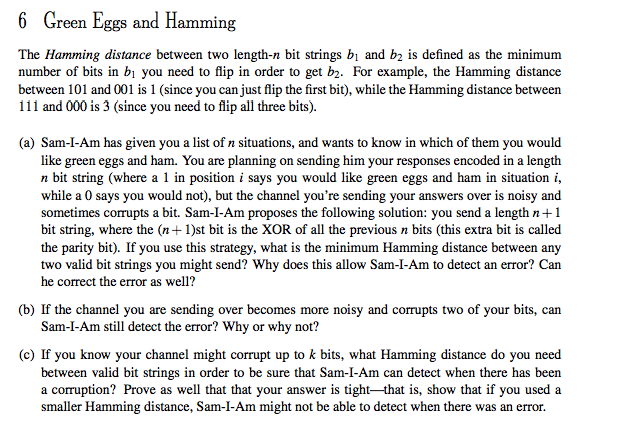
6 Green Eggs and Hamming The Hamming distance between two length-n bit strings b and b2 is defined as the minimum number of bits in bi you need to flip in order to get b2. For example, the Hamming distance between 101 and 001 is 1 (since you can just flip the first bit), while the Hamming distance between 111 and 000 is 3 (since you need to flip all three bits). (a) Sam-I-Am has given you a list of n situations, and wants to know in which of them you would like green eggs and ham. You are planning on sending him your responses encoded in a length n bit string (where a 1 in position i says you would like green eggs and ham in situation i, while a 0 says you would not), but the channel you're sending your answers over is noisy and sometimes corrupts a bit. Sam-I-Am proposes the following solution: you send a length n +1 bit string, where the (n+1)st bit is the XOR of all the previous n bits (this extra bit is called the parity bit). If you use this strategy, what is the minimum Hamming distance between any two valid bit strings you might send? Why does this allow Sam-I-Am to detect an error? Can he correct the error as well? (b) If the channel you are sending over becomes more noisy and corrupts two of your bits, can Sam-I-Am still detect the error? Why or why not? (c) If you know your channel might corrupt up to k bits, what Hamming distance do you need between valid bit strings in order to be sure that Sam-I-Am can detect when there has been a corruption? Prove as well that that your answer is tightthat is, show that if you used a smaller Hamming distance, Sam-I-Am might not be able to detect when there was an error. 6 Green Eggs and Hamming The Hamming distance between two length-n bit strings b and b2 is defined as the minimum number of bits in bi you need to flip in order to get b2. For example, the Hamming distance between 101 and 001 is 1 (since you can just flip the first bit), while the Hamming distance between 111 and 000 is 3 (since you need to flip all three bits). (a) Sam-I-Am has given you a list of n situations, and wants to know in which of them you would like green eggs and ham. You are planning on sending him your responses encoded in a length n bit string (where a 1 in position i says you would like green eggs and ham in situation i, while a 0 says you would not), but the channel you're sending your answers over is noisy and sometimes corrupts a bit. Sam-I-Am proposes the following solution: you send a length n +1 bit string, where the (n+1)st bit is the XOR of all the previous n bits (this extra bit is called the parity bit). If you use this strategy, what is the minimum Hamming distance between any two valid bit strings you might send? Why does this allow Sam-I-Am to detect an error? Can he correct the error as well? (b) If the channel you are sending over becomes more noisy and corrupts two of your bits, can Sam-I-Am still detect the error? Why or why not? (c) If you know your channel might corrupt up to k bits, what Hamming distance do you need between valid bit strings in order to be sure that Sam-I-Am can detect when there has been a corruption? Prove as well that that your answer is tightthat is, show that if you used a smaller Hamming distance, Sam-I-Am might not be able to detect when there was an error
Step by Step Solution
There are 3 Steps involved in it

Get step-by-step solutions from verified subject matter experts