







Question: 6 Let 1 3 f ( x , y , z ) = It of 6x + 3yz Part a. If Vf(1, 0, 2) =
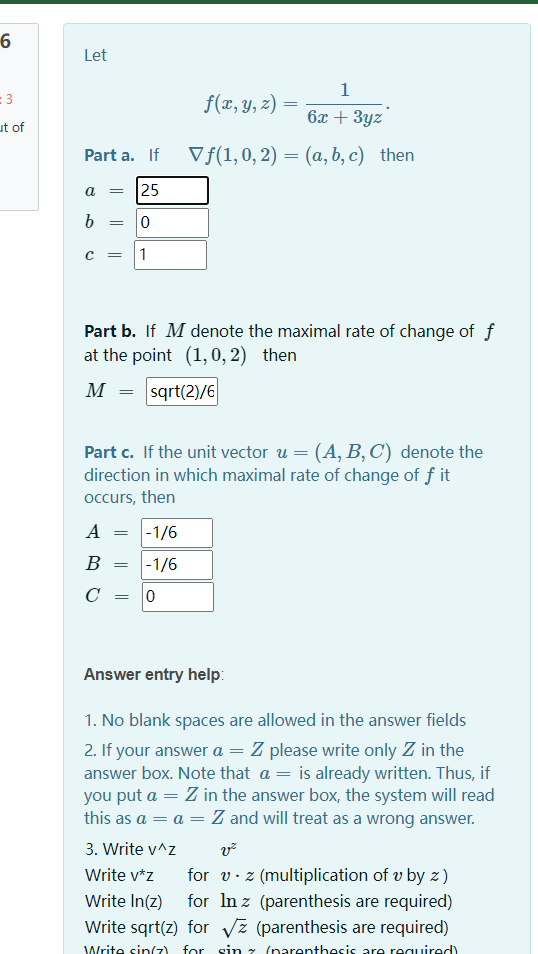
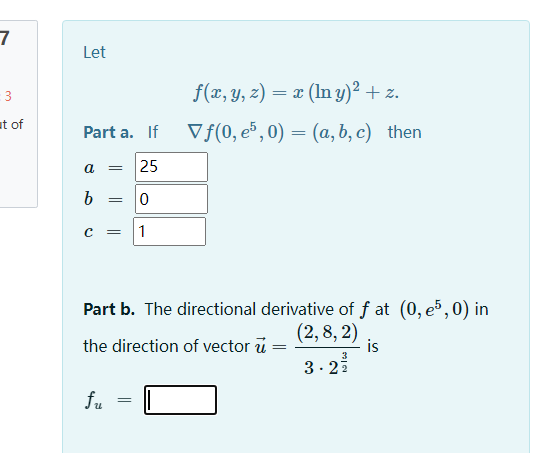
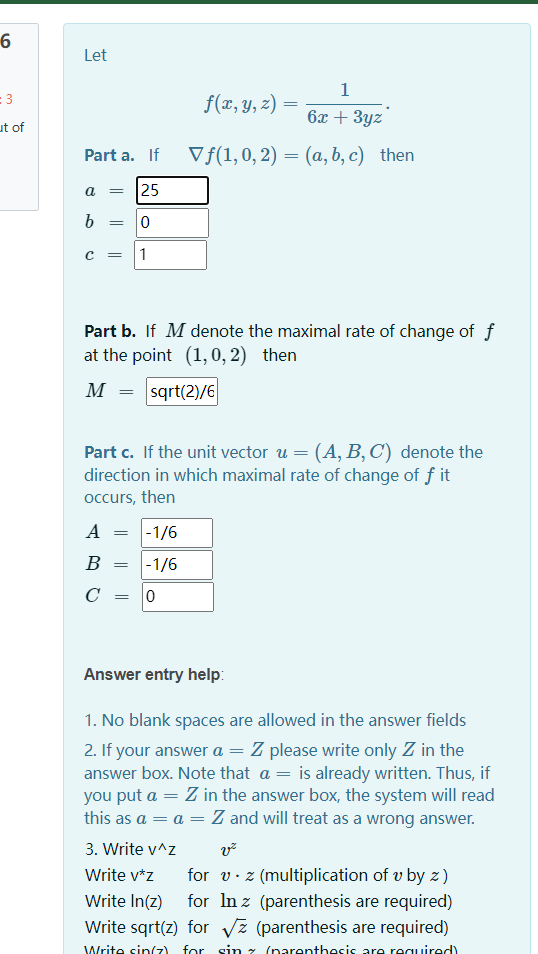
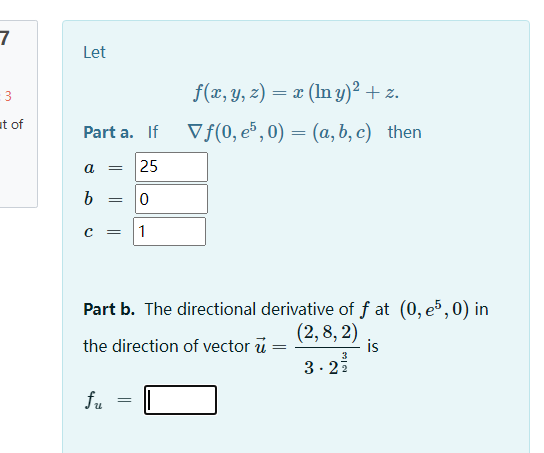
6 Let 1 3 f ( x , y , z ) = It of 6x + 3yz Part a. If Vf(1, 0, 2) = (a, b, c) then = 25 b 0 C = Part b. If M denote the maximal rate of change of f at the point (1, 0, 2) then M = sqrt(2)/6 Part c. If the unit vector u = (A, B, C) denote the direction in which maximal rate of change of f it occurs, then A = -1/6 B = -1/6 C 0 Answer entry help: 1. No blank spaces are allowed in the answer fields 2. If your answer a = Z please write only Z in the answer box. Note that a = is already written. Thus, if you put a = Z in the answer box, the system will read this as a = a = Z and will treat as a wrong answer. 3. Write VAZ Write v*z for v . z (multiplication of v by z ) Write In(z) for In z (parenthesis are required) Write sqrt(z) for Vz (parenthesis are required) WriteLet f(x, y, z) = x (Iny) +z. It of Part a. If Vf(0, e5, 0) = (a, b, c) then = 25 h 0 = 1 Part b. The directional derivative of f at (0, e5, 0) in (2, 8, 2) the direction of vector u = is 3 - 27 =
Step by Step Solution
There are 3 Steps involved in it

Get step-by-step solutions from verified subject matter experts
 Study Help