







Question: 6. Let f : R R be a function defined by f(x) = (x-3) (x-5), n, n EN. Then which of the following is
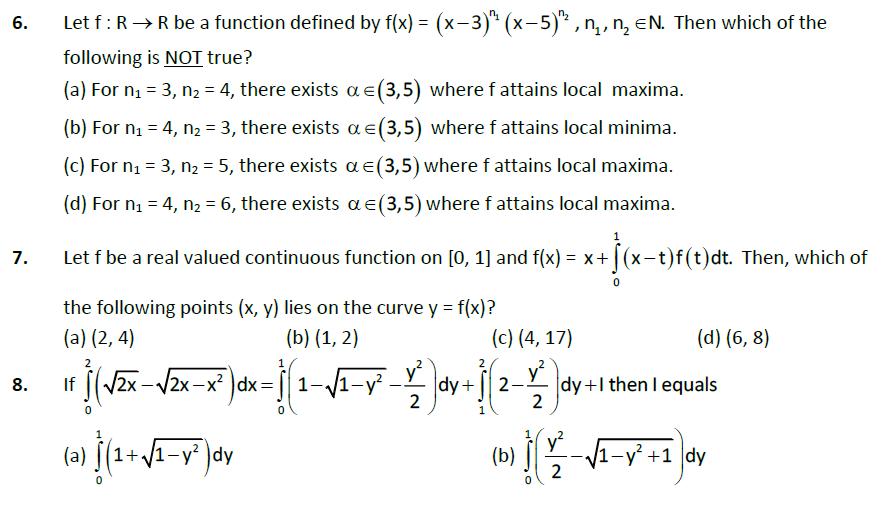

6. Let f : R R be a function defined by f(x) = (x-3)" (x-5), n, n EN. Then which of the following is NOT true? (a) For n = 3, n = 4, there exists = (3,5) where f attains local maxima. (b) For n = 4, n = 3, there exists a = (3,5) where f attains local minima. (c) For n = 3, n = 5, there exists = (3,5) where f attains local maxima. (d) For n = 4, n = 6, there exists a (3,5) where f attains local maxima. 7. Let f be a real valued continuous function on [0, 1] and f(x) = x+ (xt)f(t)dt. Then, which of 0 the following points (x, y) lies on the curve y = f(x)? (a) (2,4) (b) (1, 2) (c) (4, 17) (d) (6,8) 8. If 2x-x2 dx= y' y' 1- dy+ dy+I then I equals 2 2 (a) (1+ 1-v)dy y (b) }( - 1-y+1) dy 2 (c) (1-1-v)dy (d) }( + 1-y+1)dy 0 2
Step by Step Solution
There are 3 Steps involved in it

Get step-by-step solutions from verified subject matter experts
 Study Help