







Question: ( ( 6 mathrm { pts } ) quad ) 2 . Randomized max - cut. In this problem, all graphs
mathrmptsquad Randomized maxcut.
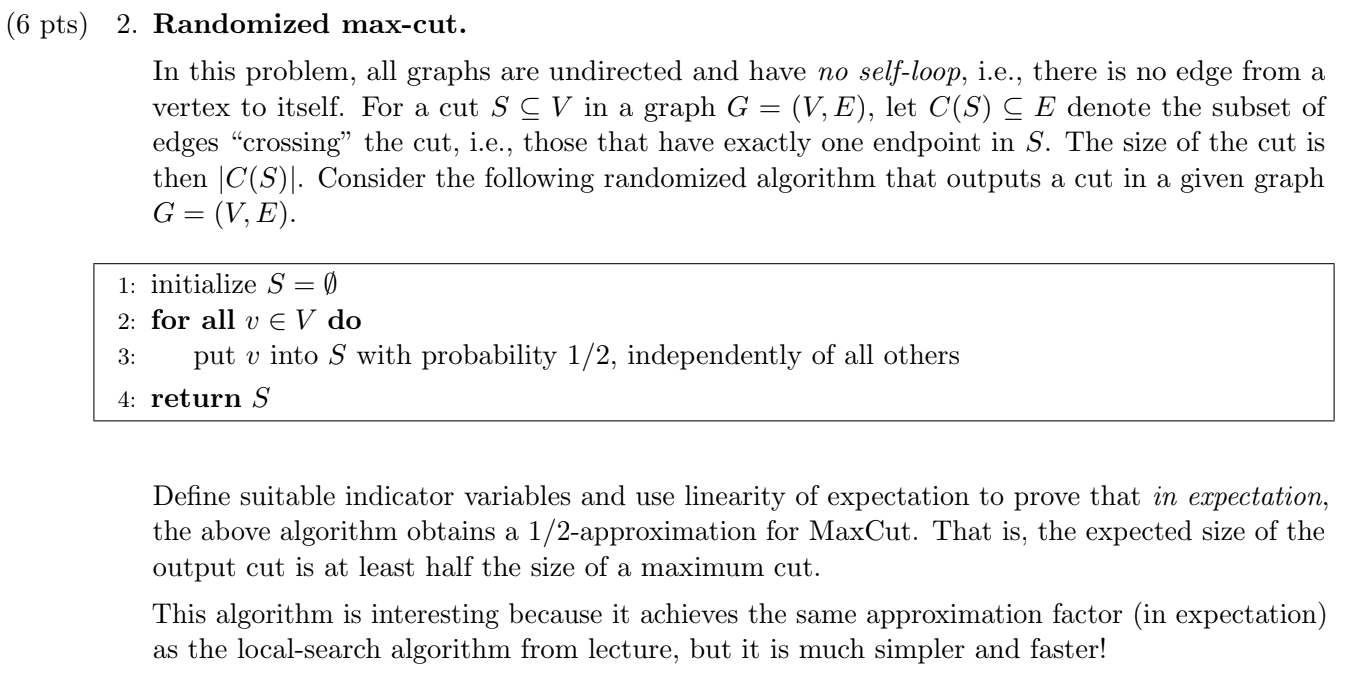
In this problem, all graphs are undirected and have no selfloop, ie there is no edge from a vertex to itself. For a cut S subseteq V in a graph GV E let CSsubseteq E denote the subset of edges "crossing" the cut, ie those that have exactly one endpoint in S The size of the cut is then CS Consider the following randomized algorithm that outputs a cut in a given graph GV E
initialize Semptyset
for all vinV do
put v into S with probability independently of all others
return S
Define suitable indicator variables and use linearity of expectation to prove that in expectation, the above algorithm obtains a approximation for MaxCut. That is the expected size of the output cut is at least half the size of a maximum cut.
This algorithm is interesting because it achieves the same approximation factor in expectation as the localsearch algorithm from lecture, but it is much simpler and faster!
Step by Step Solution
There are 3 Steps involved in it
1 Expert Approved Answer
Step: 1 Unlock

Question Has Been Solved by an Expert!
Get step-by-step solutions from verified subject matter experts
Step: 2 Unlock
Step: 3 Unlock
 Study Help