







Question: 6) Multiple choice: Answer each sub-question by stating whether the term indicated would increase, decrease, stay the same, or not enough info to say. (Note:
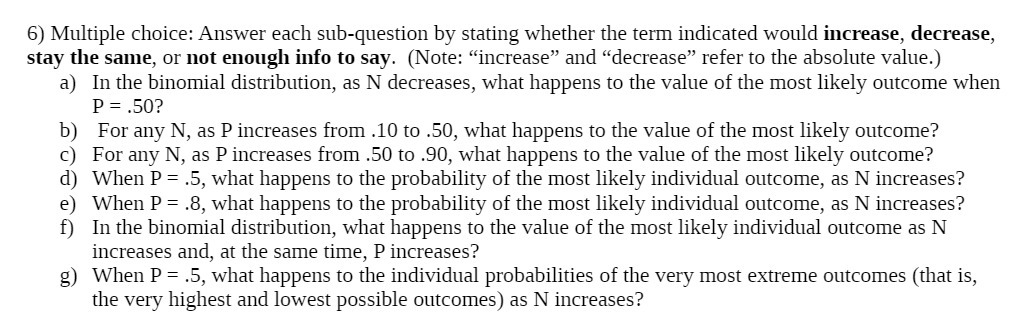
6) Multiple choice: Answer each sub-question by stating whether the term indicated would increase, decrease, stay the same, or not enough info to say. (Note: \"increase\" and \"decrease\" refer to the absolute value.) a) b) C} d) e) f) g) In the binomial distribution, as N decreases, what happens to the value of the most likely outcome when P = .50? For any N, as P increases from .10 to .50, what happens to the value of the most likely outcome? For any N, as P increases from .50 to .90, what happens to the value of the most likely outcome? When P = .5, what happens to the probability of the most likely individual outcome, as N increases? When P = .8, what happens to the probability of the most likely individual outcome, as N increases? In the binomial distribution, what happens to the value of the most likely individual outcome as N increases and, at the same time, P increases? W'hen P = .5, what happens to the individual probabilities of the very most extreme outcomes (that is, the very highest and lowest possible outcomes) as N increases
Step by Step Solution
There are 3 Steps involved in it

Get step-by-step solutions from verified subject matter experts
 Study Help