







Question: ( 6 points ) Decision Tree with C 4 . 5 Algorithm In the following questions, you will use the dataset below to train a
points Decision Tree with C Algorithm
In the following questions, you will use the dataset below to train a decision tree which
predicts if students enrolled in a machine learning class would pass Yes or No based on
their previous GPA, number of lectures attended out of lectures the whole semester
and whether or not they studied after class. You will apply C algorithm to build a
Table : Student dataset
decision tree, namely, the splitting criterion is to maximize the information gain of a
split. As the preparation step, you need to transform the two numeric variables into
categorical variables with the following criteria:
GPA: categorized as 'Low' when GPA ; categorized as 'Medium' when
GPA ; categorized as 'High' when GPA
Attendance: categorized as 'Good' when number of lectures attended ; catego
rized as 'Bad' when number of lectures attended
points Decision Tree with C AlgorithmIn your calculation, you may need the following logarithm terms. To simplify calculation,
you can use the rounded values below instead of calculating the exact logarithm values.
logloglogloglog
loglogloglog
In iteration what is the information gain of splitting on the GPA levels? The
split will produce three children nodes: GPA 'Low', GPA 'Medium', GPA
'High'. Pick the closest rounded value below.
A
B
C
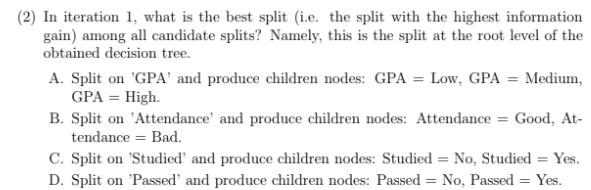
D In iteration what is the best split ie the split with the highest information
gain among all candidate splits? Namely, this is the split at the root level of the
obtained decision tree.
A Split on 'GPA' and produce children nodes: GPA Low, GPA Medium,
GPA High.
B Split on 'Attendance' and produce children nodes: Attendance Good, At
tendance Bad.
C Split on 'Studied' and produce children nodes: Studied No Studied Yes.
D Split on 'Passed' and produce children nodes: Passed No Passed Yes.
Step by Step Solution
There are 3 Steps involved in it
1 Expert Approved Answer
Step: 1 Unlock

Question Has Been Solved by an Expert!
Get step-by-step solutions from verified subject matter experts
Step: 2 Unlock
Step: 3 Unlock
 Study Help