







Question: 6 . Problem 7 - 6 ( page 1 8 8 ) on fuzzy sorting of intervals . 7 - 6 Fuzzy sorting of intervals
Problem page on fuzzy sorting of intervals Fuzzy sorting of intervals
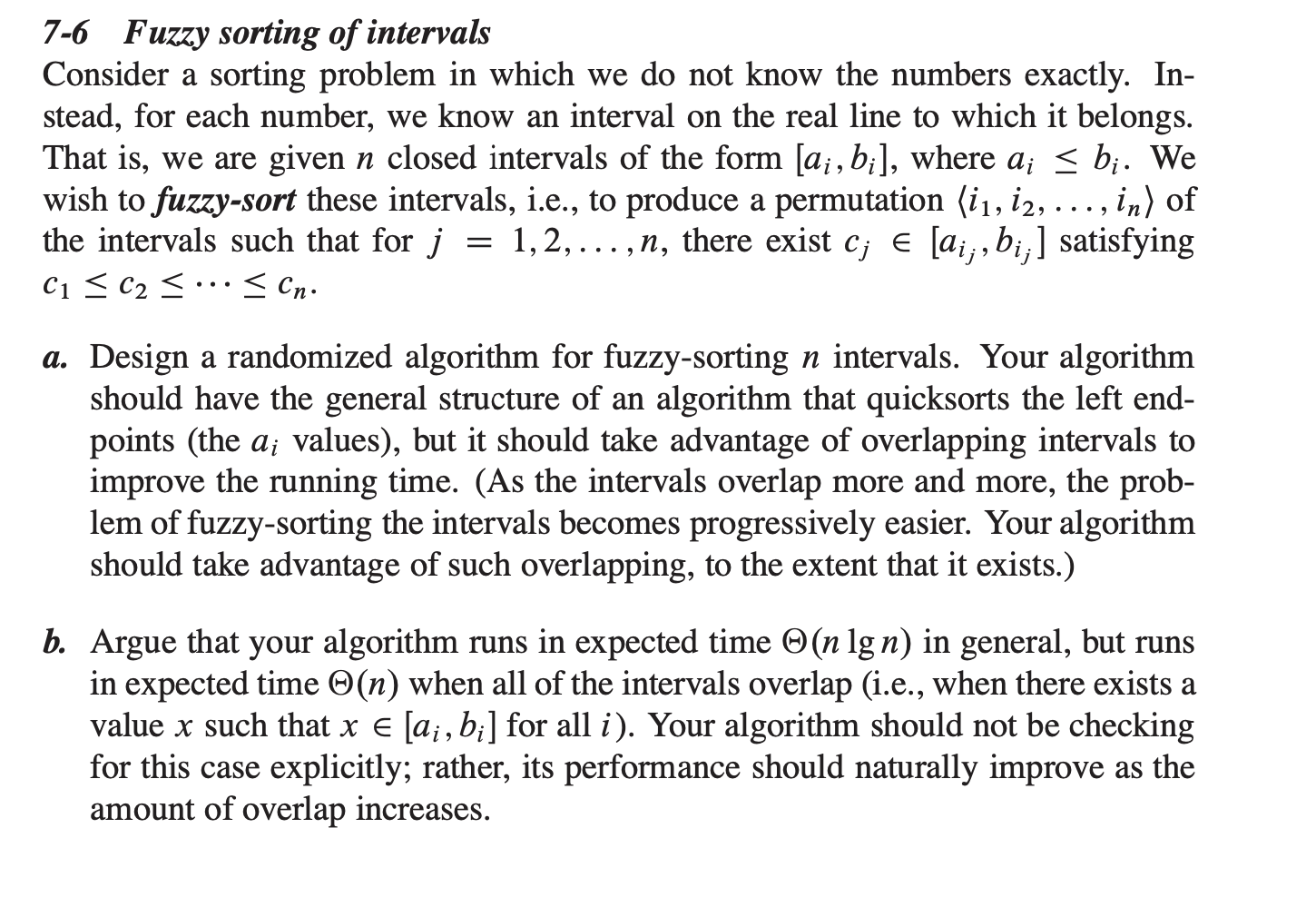
Consider a sorting problem in which we do not know the numbers exactly. In
stead, for each number, we know an interval on the real line to which it belongs.
That is we are given closed intervals of the form where We
wish to fuzzysort these intervals, ie to produce a permutation :dots,: of
the intervals such that for dots, there exist satisfying
cdots
a Design a randomized algorithm for fuzzysorting intervals. Your algorithm
should have the general structure of an algorithm that quicksorts the left end
points the values but it should take advantage of overlapping intervals to
improve the running time. As the intervals overlap more and more, the prob
lem of fuzzysorting the intervals becomes progressively easier. Your algorithm
should take advantage of such overlapping, to the extent that it exists.
b Argue that your algorithm runs in expected time in general, but runs
in expected time when all of the intervals overlap ie when there exists a
value such that xin for all Your algorithm should not be checking
for this case explicitly; rather, its performance should naturally improve as the
amount of overlap increases.
Step by Step Solution
There are 3 Steps involved in it
1 Expert Approved Answer
Step: 1 Unlock

Question Has Been Solved by an Expert!
Get step-by-step solutions from verified subject matter experts
Step: 2 Unlock
Step: 3 Unlock
 Study Help