







Question: 6. Program evaluation with two-period panel data I Suppose the local government in a small town is concerned about a growing obesity epidemic among the
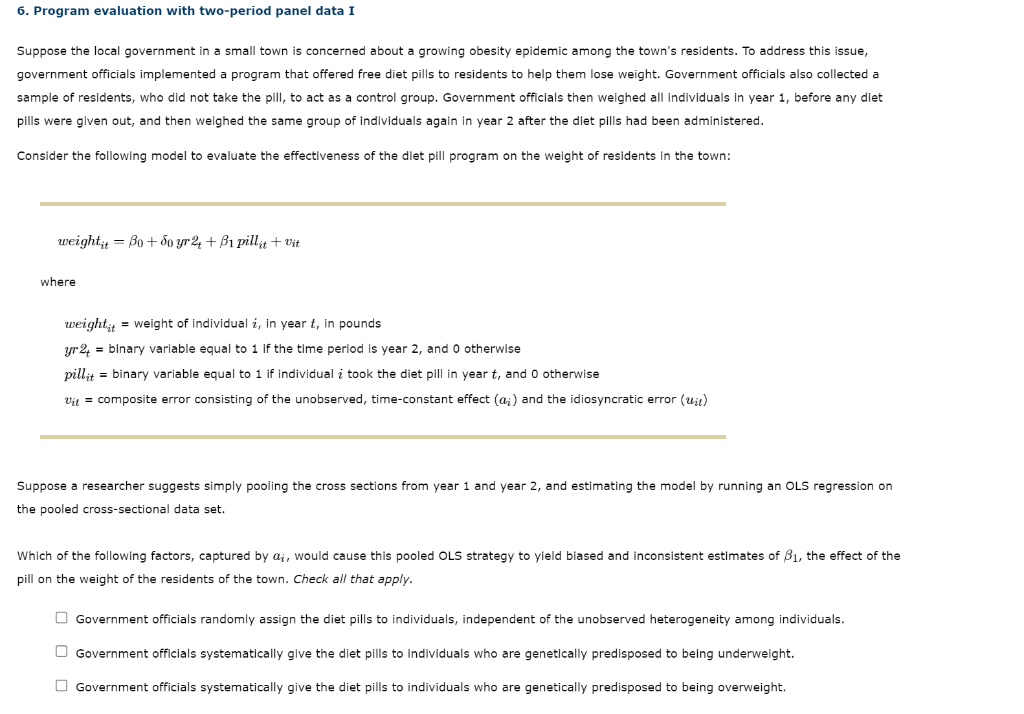
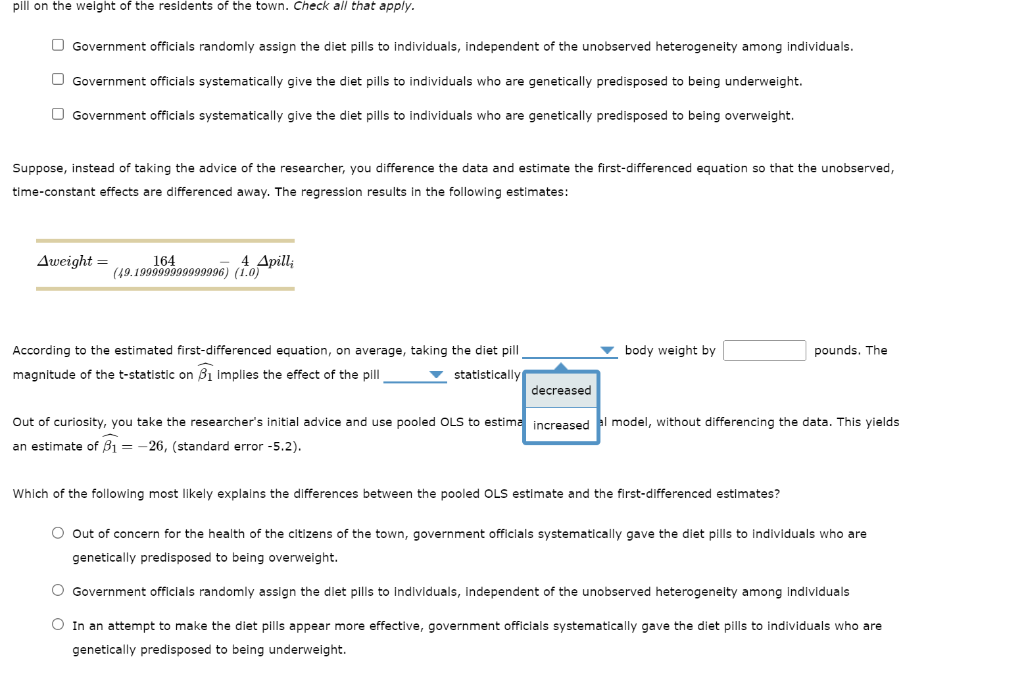
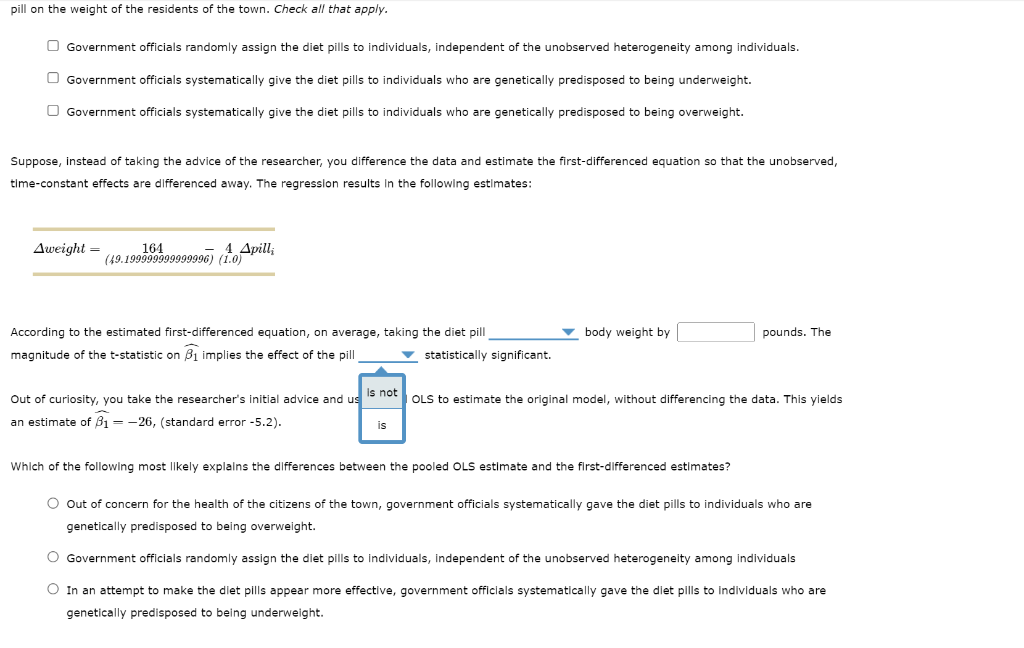
6. Program evaluation with two-period panel data I Suppose the local government in a small town is concerned about a growing obesity epidemic among the town's residents. To address this issue, government officials implemented a program that offered free diet pills to residents to help them lose weight. Government officials also collected a sample of residents, who did not take the pill, to act as a control group. Government officials then weighed all individuals in year 1, before any diet pills were given out, and then weighed the same group of individuals again in year 2 after the diet pills had been administered. Consider the following model to evaluate the effectiveness of the diet pill program on the weight of residents in the town: weightit = Bo + do yr2 + B1 prillit + Vit where weightit = weight of individual i, in year t, in pounds yr 2 = binary variable equal to 1 if the time period is year 2, and otherwise pillit = binary variable equal to 1 if individual i took the diet pill in year t, and otherwise Vit = composite error consisting of the unobserved, time-constant effect (ai) and the idiosyncratic error (uit) Suppose a researcher suggests simply pooling the cross sections from year 1 and year 2, and estimating the model by running an OLS regression on the pooled cross-sectional data set. Which of the following factors, captured by ai, would cause this pooled OLS strategy to yield biased and inconsistent estimates of B1, the effect of the pill on the weight of the residents of the town. Check all that apply. Government officials randomly assign the diet pills to individuals, independent of the unobserved heterogeneity among individuals. O Government officials systematically give the diet pills to individuals who are genetically predisposed to being underweight. Government officials systematically give the diet pills to individuals who are genetically predisposed to being overweight. pill on the weight of the residents of the town. Check all that apply. O Government officials randomly assign the diet pills to individuals, independent of the unobserved heterogeneity among individuals. O Government officials systematically give the diet pills to individuals who are genetically predisposed to being underweight. Government officials systematically give the diet pills to individuals who are genetically predisposed to being overweight. Suppose, instead of taking the advice of the researcher, you difference the data and estimate the first-differenced equation so that the unobserved, time-constant effects are differenced away. The regression results in the following estimates: Aweight = 164 4 Apilli (19.199999999999996) (1.07 body weight by pounds. The According to the estimated first-differenced equation, on average, taking the diet pill magnitude of the t-statistic on B1 Implies the effect of the pill statistically decreased Out of curiosity, you take the researcher's initial advice and use pooled OLS to estima increased model, without differencing the data. This yields an estimate of Bi = -26, (standard error-5.2). Which of the following most likely explains the differences between the pooled OLS estimate and the first-differenced estimates? O Out of concern for the health of the citizens of the town, government officials systematically gave the diet pills to individuals who are genetically predisposed to being overweight. O Government officials randomly assign the diet pills to Individuals, independent of the unobserved heterogeneity among Individuals In an attempt to make the diet pills appear more effective, government officials systematically gave the diet pills to individuals who are genetically predisposed to being underweight. pill on the weight of the residents of the town. Check all that apply. O Government officials randomly assign the diet pills to individuals, independent of the unobserved heterogeneity among individuals. Government officials systematically give the diet pills to individuals who are genetically predisposed to being underweight. Government officials systematically give the diet pills to individuals who are genetically predisposed to being overweight. Suppose, instead of taking the advice of the researcher, you difference the data and estimate the first-differenced equation so that the unobserved, time-constant effects are differenced away. The regression results in the following estimates: Aweight = 164 4 Apill; (49.199999999999996) (1.0) body weight by pounds. The According to the estimated first-differenced equation, on average, taking the diet pill magnitude of the t-statistic on Bi implies the effect of the pill statistically significant. is not Out of curiosity, you take the researcher's initial advice and us an estimate of B1 = -26, (standard error -5.2). OLS to estimate the original model, without differencing the data. This yields is Which of the following most likely explains the differences between the pooled OLS estimate and the first-differenced estimates? O Out of concern for the health of the citizens of the town, government officials systematically gave the diet pills to individuals who are genetically predisposed to being overweight. O Government officials randomly assign the diet pills to individuals, independent of the unobserved heterogeneity among individuals In an attempt to make the diet pills appear more effective, government officials systematically gave the diet pills to individuals who are genetically predisposed to being underweight. 6. Program evaluation with two-period panel data I Suppose the local government in a small town is concerned about a growing obesity epidemic among the town's residents. To address this issue, government officials implemented a program that offered free diet pills to residents to help them lose weight. Government officials also collected a sample of residents, who did not take the pill, to act as a control group. Government officials then weighed all individuals in year 1, before any diet pills were given out, and then weighed the same group of individuals again in year 2 after the diet pills had been administered. Consider the following model to evaluate the effectiveness of the diet pill program on the weight of residents in the town: weightit = Bo + do yr2 + B1 prillit + Vit where weightit = weight of individual i, in year t, in pounds yr 2 = binary variable equal to 1 if the time period is year 2, and otherwise pillit = binary variable equal to 1 if individual i took the diet pill in year t, and otherwise Vit = composite error consisting of the unobserved, time-constant effect (ai) and the idiosyncratic error (uit) Suppose a researcher suggests simply pooling the cross sections from year 1 and year 2, and estimating the model by running an OLS regression on the pooled cross-sectional data set. Which of the following factors, captured by ai, would cause this pooled OLS strategy to yield biased and inconsistent estimates of B1, the effect of the pill on the weight of the residents of the town. Check all that apply. Government officials randomly assign the diet pills to individuals, independent of the unobserved heterogeneity among individuals. O Government officials systematically give the diet pills to individuals who are genetically predisposed to being underweight. Government officials systematically give the diet pills to individuals who are genetically predisposed to being overweight. pill on the weight of the residents of the town. Check all that apply. O Government officials randomly assign the diet pills to individuals, independent of the unobserved heterogeneity among individuals. O Government officials systematically give the diet pills to individuals who are genetically predisposed to being underweight. Government officials systematically give the diet pills to individuals who are genetically predisposed to being overweight. Suppose, instead of taking the advice of the researcher, you difference the data and estimate the first-differenced equation so that the unobserved, time-constant effects are differenced away. The regression results in the following estimates: Aweight = 164 4 Apilli (19.199999999999996) (1.07 body weight by pounds. The According to the estimated first-differenced equation, on average, taking the diet pill magnitude of the t-statistic on B1 Implies the effect of the pill statistically decreased Out of curiosity, you take the researcher's initial advice and use pooled OLS to estima increased model, without differencing the data. This yields an estimate of Bi = -26, (standard error-5.2). Which of the following most likely explains the differences between the pooled OLS estimate and the first-differenced estimates? O Out of concern for the health of the citizens of the town, government officials systematically gave the diet pills to individuals who are genetically predisposed to being overweight. O Government officials randomly assign the diet pills to Individuals, independent of the unobserved heterogeneity among Individuals In an attempt to make the diet pills appear more effective, government officials systematically gave the diet pills to individuals who are genetically predisposed to being underweight. pill on the weight of the residents of the town. Check all that apply. O Government officials randomly assign the diet pills to individuals, independent of the unobserved heterogeneity among individuals. Government officials systematically give the diet pills to individuals who are genetically predisposed to being underweight. Government officials systematically give the diet pills to individuals who are genetically predisposed to being overweight. Suppose, instead of taking the advice of the researcher, you difference the data and estimate the first-differenced equation so that the unobserved, time-constant effects are differenced away. The regression results in the following estimates: Aweight = 164 4 Apill; (49.199999999999996) (1.0) body weight by pounds. The According to the estimated first-differenced equation, on average, taking the diet pill magnitude of the t-statistic on Bi implies the effect of the pill statistically significant. is not Out of curiosity, you take the researcher's initial advice and us an estimate of B1 = -26, (standard error -5.2). OLS to estimate the original model, without differencing the data. This yields is Which of the following most likely explains the differences between the pooled OLS estimate and the first-differenced estimates? O Out of concern for the health of the citizens of the town, government officials systematically gave the diet pills to individuals who are genetically predisposed to being overweight. O Government officials randomly assign the diet pills to individuals, independent of the unobserved heterogeneity among individuals In an attempt to make the diet pills appear more effective, government officials systematically gave the diet pills to individuals who are genetically predisposed to being underweight
Step by Step Solution
There are 3 Steps involved in it

Get step-by-step solutions from verified subject matter experts
 Study Help