



Question: (6 pts.) For two languages L1 and L2 over the alphabet , we define the quotient of Li and L2 to be the language Show
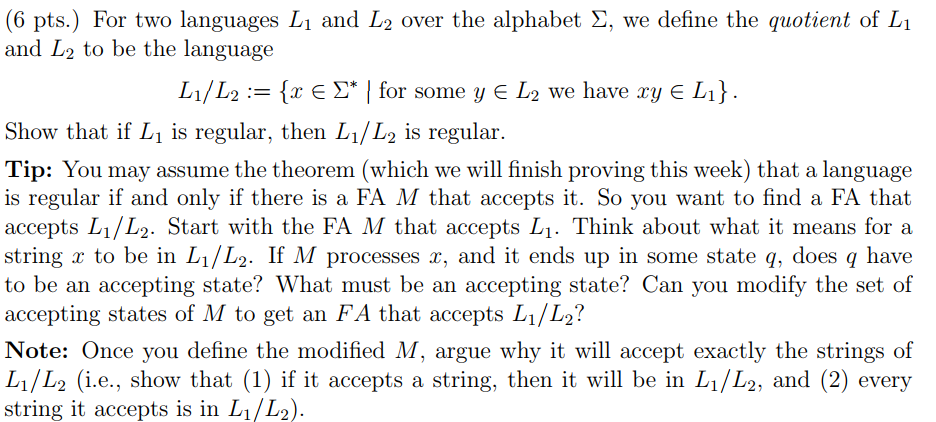
(6 pts.) For two languages L1 and L2 over the alphabet , we define the quotient of Li and L2 to be the language Show that if L is regular, then L/L2 is regular. Tip: You may assume the theorem (which we will finish proving this week) that a language is regular if and only if there is a FA M that accepts it. So you want to find a FA that accepts L1/Lo. Start with the FA M that accepts L. Think about what it means fora string a to be in L1/L2. If M processes a, and it ends up in some state q, does q have to be an accepting state? What must be an accepting state? Can you modify the set of accepting states of M to get an FA that accepts L/L2? Note: Once you define the modified M, argue why it will accept exactly the strings of L/L2 (i.e., show that (1) if it accepts a string, then it will be in L/L2, and (2) every string it accepts is in Li/L). (6 pts.) For two languages L1 and L2 over the alphabet , we define the quotient of Li and L2 to be the language Show that if L is regular, then L/L2 is regular. Tip: You may assume the theorem (which we will finish proving this week) that a language is regular if and only if there is a FA M that accepts it. So you want to find a FA that accepts L1/Lo. Start with the FA M that accepts L. Think about what it means fora string a to be in L1/L2. If M processes a, and it ends up in some state q, does q have to be an accepting state? What must be an accepting state? Can you modify the set of accepting states of M to get an FA that accepts L/L2? Note: Once you define the modified M, argue why it will accept exactly the strings of L/L2 (i.e., show that (1) if it accepts a string, then it will be in L/L2, and (2) every string it accepts is in Li/L)
Step by Step Solution
There are 3 Steps involved in it

Get step-by-step solutions from verified subject matter experts