







Question: 6) Sequence diagrams b) Describe what functionality is needed by actors that interact with the system c) Describe class attributes, operations, and how classes relate
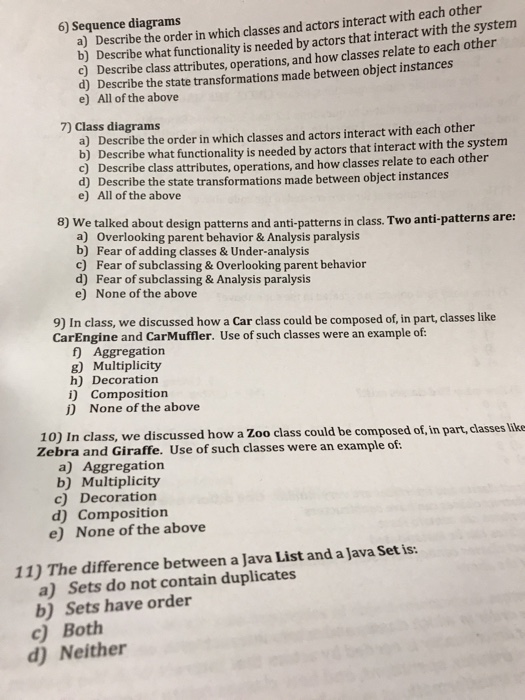
6) Sequence diagrams b) Describe what functionality is needed by actors that interact with the system c) Describe class attributes, operations, and how classes relate to each other d) Describe the state transformations made between object instances e) All of the above a) Describe the order in which classes and actors interact with each other 7) Class diagrams a) Describe the order in which classes and actors interact with each other b) Describe what functionality is needed by actors that interact with the system c) Describe class attributes, operations, and how classes relate to each other d) Describe the state transformations made between object instances e) All of the above 8) We talked about design patterns and anti-patterns in class. Two anti-patterns are: a) Overlooking parent behavior& Analysis paralysis b) Fear of adding classes & Under-analysis c) Fear of subclassing & Overlooking parent behavior d) Fear of subclassing & Analysis paralysis e) None of the above 9) In class, we discussed how a Car class could be composed of, in part, classes like CarEngine and CarMuffler. Use of such classes were an example of f) Aggregation g) Multiplicity h) Decoration i) Composition i) None of the above 10) In class, we discussed how a Zoo class could be composed of,in part, classes ik Zebra and Giraffe. Use of such classes were an example of: a) Aggregation b) Multiplicity c) Decoration d) Composition e) None of the above 11) The difference between a Java List and a Java Set is: a) Sets do not contain duplicates b) Sets have order c) Both d) Neither
Step by Step Solution
There are 3 Steps involved in it

Get step-by-step solutions from verified subject matter experts
 Study Help