Question: 6. significance. 6. Construct a confidence interval for mean from each of the 4 dig sites in parts 2 7. Write a summary of your
6.

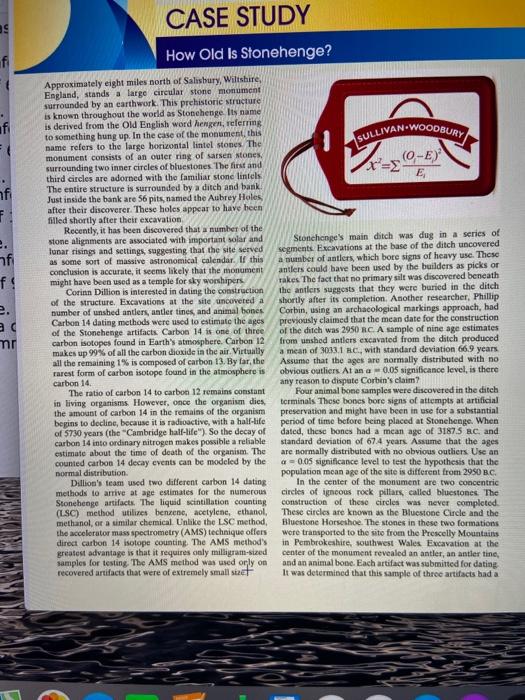
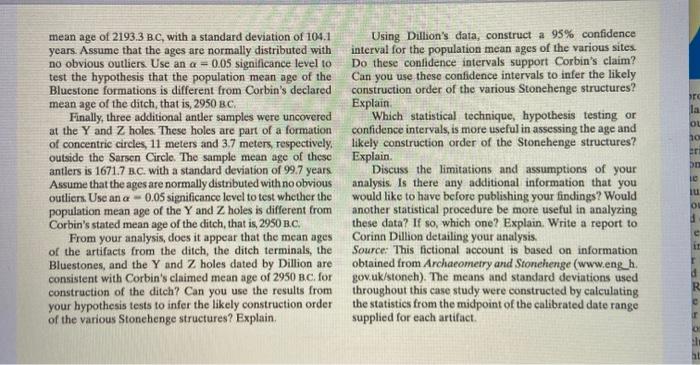
significance. 6. Construct a confidence interval for mean from each of the 4 dig sites in parts 2 7. Write a summary of your findings, including the following components: The results of the hypothesis tests for each of the 4 dig sites in a CASE STUDY of t=r(0-E) hf SULLIVAN-WOODBURY as f How Old Is Stonehenge? Approximately eight miles north of Salisbury, Wiltshire, England, stands a large circular stone monument surrounded by an earthwork. This prehistoric structure is known throughout the world as Stonehenge. Its name is derived from the Old English word henger, referring to something hung up. In the case of the monument this name refers to the large horizontal lintel stones. The monument consists of an outer ring of sarsen stones surrounding two inner circles of bluestones. The first and third circles are adorned with the familiar stone lintels E The entire structure is surrounded by a ditch and bank. Just inside the bank are 56 pits, named the Aubrey Holes F after their discoverer. These holes appear to have been filled shortly after their excavation Recently, it has been discovered that a number of the stone alignments are associated with important solar and Stonehenge's main ditch was dug in a series of tonar risings and settings, suggesting that the site served segments Excavations at the base of the ditch uncovered f as some sort of massive astronomical calendar. If this a number of antlers, which bore signs of heavy use. These conclusion is accurate, it seems likely that the monument antlers could have been used by the builders as picks or might have been used as a temple for sky worshipers takes. The fact that no primary silt was discovered beneath Corinn Dillion is interested in dating the construction the antlers suggests that they were buried in the ditch of the structure. Excavations at the site uncovered a shortly after its completion. Another researcher, Phillip number of unshed antlers, antler tines, and animal bones Corbin, using an archacological markings approach, had ac Carbon 14 dating methods were used to estimate the ages previously claimed that the mean date for the construction of the Stonehenge artifacts. Carbon 14 is one of three of the ditch was 2950 RC A sample of nine age estimates nr carbon isotopes found in Earth's atmosphere. Carbon 12 from unshod antiers excavated from the ditch produced makes up 99% of all the carbon dioxide in the air. Virtually a mean of 3033.1 C, with standard deviation 66.9 years all the remaining 1% is composed of carbon 13. By far, the Assume that the ages are normally distributed with no rarest form of carbon isotope found in the atmosphere is obvious outliers At an a 0.05 significance level, is there carbon 14 any reason to dispute Corbin's claim? The ratio of carbon 14 to carbon 12 remains constant Four animal bone samples were discovered in the ditch in living organisms. However, once the organism dies, terminals Those bones bore signs of attempts at artificial the amount of carbon 14 in the remains of the organism preservation and might have been in use for a substantial begins to decline, because it is radioactive, with a half-life period of time before being placed at Stonehenge. When of 5730 years (the "Cambridge half-life"). So the decay of dated, these bones had a mean age of 3187.5 BC. and carbon 14 into ordinary nitrogen makes possible a reliable standard deviation of 67.4 years Assume that the ages estimate about the time of death of the organism. The are normally distributed with no obvious outliers. Use an counted carbon 14 decay events can be modeled by the a = 0.05 significance level to test the hypothesis that the normal distribution population mean age of the site is different from 2950 BC, Dillion's team used two different carbon 14 dating In the center of the monument are two concentric methods to arrive at age estimates for the numerous circles of igneous rock pillars, called bluestones. The Stonehenge artifacts. The liquid scintillation counting construction of these circles was never completed (LSC) method utilizes benzene, acetylene, ethanol, These circles are known as the Bluestone Circle and the methanol, or a similar chemical Unlike the LSC method, Bluestone Horseshoe. The stones in these two formations the accelerator mass spectrometry (AMS) technique offers were transported to the site from the Prescelly Mountains direct carbon 14 isotope counting. The AMS method's in Pembrokeshire, southwest Wales Excavation at the greatest advantage is that it requires only milligram-sized center of the monument revealed an antler, an antler tine, samples for testing. The AMS method was used only on and an animal bone. Each artifact was submitted for dating recovered artifacts that were of extremely small size It was determined that this sample of three artifacts had a la OL 10 mean age of 2193.3 B.C, with a standard deviation of 104.1 years. Assume that the ages are normally distributed with no obvious outliers. Use an a = 0.05 significance level to test the hypothesis that the population mean age of the Bluestone formations is different from Corbin's declared mean age of the ditch, that is, 2950 BC. Finally, three additional antler samples were uncovered at the Y and Z holes. These holes are part of a formation of concentric circles, 11 meters and 3.7 meters, respectively, outside the Sarsen Circle. The sample mean age of these antiers is 1671.7 B.C. with a standard deviation of 99.7 years. Assume that the ages are normally distributed with no obvious outliers. Use an a-0.05 significance level to test whether the population mean age of the Y and Z holes is different from Corbin's stated mean age of the ditch, that is, 2950 B.C. From your analysis, does it appear that the mean ages of the artifacts from the ditch, the ditch terminals, the Bluestones, and the Y and Z holes dated by Dillion are consistent with Corbin's claimed mean age of 2950 BC. for construction of the ditch? Can you use the results from your hypothesis tests to infer the likely construction order of the various Stonehenge structures? Explain Using Dillion's data, construct a 95% confidence interval for the population mean ages of the various sites. Do these confidence intervals support Corbin's claim? Can you use these confidence intervals to infer the likely construction order of the various Stonehenge structures? Explain Which statistical technique, hypothesis testing or confidence intervals, is more useful in assessing the age and likely construction order of the Stonehenge structures? Explain Discuss the limitations and assumptions of your analysis. Is there any additional information that you would like to have before publishing your findings? Would another statistical procedure be more useful in analyzing these data? If so, which one? Explain. Write a report to Corinn Dillion detailing your analysis. Source: This fictional account is based on information obtained from Archaeometry and Stonehenge (www.eng_h. gov.uk/stonch). The means and standard deviations used throughout this case study were constructed by calculating the statistics from the midpoint of the calibrated date range supplied for each artifact 10 lu 11









 Study Help