


Question: 6. Suppose that you have two spatial locations A and B. You have a population of self-driving vehicles, that switch from location A to B,
6. Suppose that you have two spatial locations A
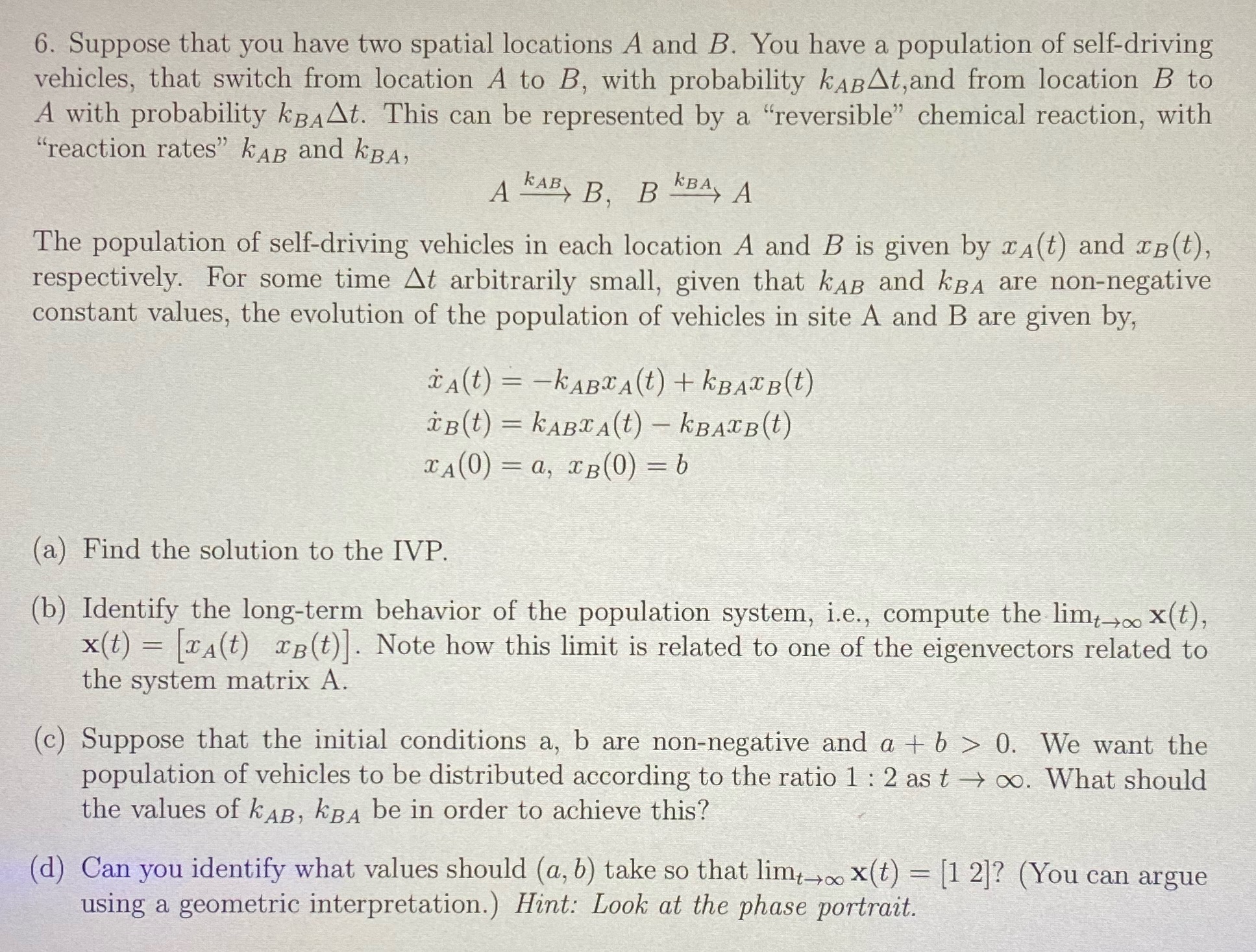
6. Suppose that you have two spatial locations A and B. You have a population of self-driving vehicles, that switch from location A to B, with probability KABAt, and from location B to A with probability kBAAt. This can be represented by a "reversible" chemical reaction, with "reaction rates" KAB and KBA, A KAB, B. BABA, A The population of self-driving vehicles in each location A and B is given by TA(t) and TB(t), respectively. For some time At arbitrarily small, given that KAB and KBA are non-negative constant values, the evolution of the population of vehicles in site A and B are given by, TA(t) = -KABXA(t) + KBAXB(t) TB(t) = KABA(t) - KBAXB(t) TA(0) = a, TB(0) = b (a) Find the solution to the IVP. (b) Identify the long-term behavior of the population system, i.e., compute the limt-. x(t), x(t) = [XA(t) IB(t)]. Note how this limit is related to one of the eigenvectors related to the system matrix A. (c) Suppose that the initial conditions a, b are non-negative and a + b > 0. We want the population of vehicles to be distributed according to the ratio 1 : 2 as t - co. What should the values of KAB, KBA be in order to achieve this? (d) Can you identify what values should (a, b) take so that limt . x(t) = [1 2]? (You can argue using a geometric interpretation.) Hint: Look at the phase portrait

Step by Step Solution

There are 3 Steps involved in it

1 Expert Approved Answer
Step: 1 Unlock blur-text-image

Question Has Been Solved by an Expert!

Get step-by-step solutions from verified subject matter experts

Step: 2 Unlock
Step: 3 Unlock

Students Have Also Explored These Related Mathematics Questions!