







Question: 6 SVM Classification using Power Spectrum In this part, we are going to train an SVM similar to what we did earlier. However, instead of
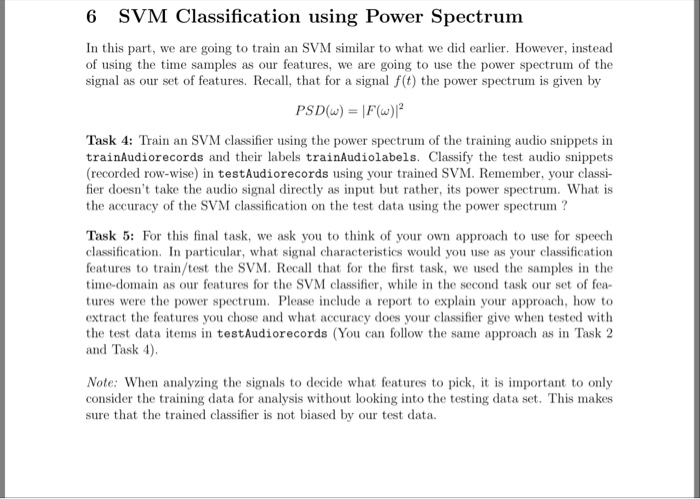
6 SVM Classification using Power Spectrum In this part, we are going to train an SVM similar to what we did earlier. However, instead of using the time samples as our features, we are going to use the power spectrum of the signal as our set of features. Recall, that for a signal f(t) the power spectrum is given by PSD(u) = | F(w)12 fier using the power spectrum of the training audio snippets in Task 4: Train an SVM classifier the trainAudiorecords and their labels trainAudiolabels. Classify the test audio snippets (recorded row-wise) in testAudiorecords using your trained SVM. Remember, your classi- fier doesn't take the audio signal directly as input but rather, its power spectrum. What is the accuracy of the SVM classification on the test data using the power spectrum? Task 5: For this final task, we ask you to think of your own approach to use for speech classification. In particular, what signal characteristics would you use as your classification features to train/test the SVM. Reca that for the first task, we used the samples in the time-domain as our features for the SVM classifier, while in the second task our set of fea- tures were the power spectrum. Please include a report to explain your approach, how to extract the features you chose and what accuracy does your classifier give when tested with the test data items in testAudiorecords (You can follow the same approach as in Task 2 and Task 4) Note: When analyzing the signals to decide what features to pick, it is important to only consider the training data for analysis without looking into the testing data set. This makes sure that the trained classifier is not biased by our test data
Step by Step Solution
There are 3 Steps involved in it

Get step-by-step solutions from verified subject matter experts
 Study Help