Question: 6. The below analytic study (conducted in 2018) attempts to answer whether there is a relationship between current socioeconomic status and child mental health. The
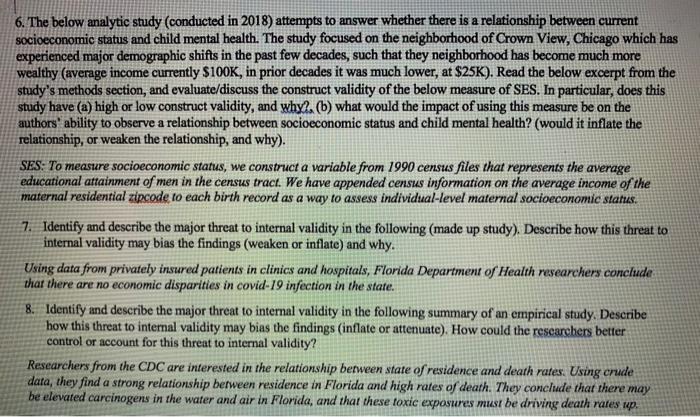
6. The below analytic study (conducted in 2018) attempts to answer whether there is a relationship between current socioeconomic status and child mental health. The study focused on the neighborhood of Crown View, Chicago which has experienced major demographic shifts in the past few decades, such that they neighborhood has become much more wealthy (average income currently $100K, in prior decades it was much lower, at $25K). Read the below excerpt from the study's methods section, and evaluate/discuss the construct validity of the below measure of SES. In particular, does this study have (a) high or low construct validity, and why?. (b) what would the impact of using this measure be on the authors' ability to observe a relationship between socioeconomic status and child mental health? (would it inflate the relationship, or weaken the relationship, and why). SES: To measure socioeconomic status, we construct a variable from 1990 census files that represents the average educational attainment of men in the census tract. We have appended census information on the average income of the maternal residential zincode to each birth record as a way to assess individual-level maternal socioeconomic status. 7. Identify and describe the major threat to internal validity in the following (made up study). Describe how this threat to internal validity may bias the findings (weaken or inflate) and why. Using data from privately insured patients in clinics and hospitals, Florida Department of Health researchers conclude that there are no economic disparities in covid-19 infection in the state. 8. Identify and describe the major threat to internal validity in the following summary of an empirical study. Describe how this threat to internal validity may bias the findings (inflate or attenuate). How could the researchers better control or account for this threat to internal validity? Researchers from the CDC are interested in the relationship between state of residence and death rates. Using crude data, they find a strong relationship between residence in Florida and high rates of death. They conclude that there may be elevated carcinogens in the water and air in Florida, and that these toxic exposures must be driving death rates up. 6. The below analytic study (conducted in 2018) attempts to answer whether there is a relationship between current socioeconomic status and child mental health. The study focused on the neighborhood of Crown View, Chicago which has experienced major demographic shifts in the past few decades, such that they neighborhood has become much more wealthy (average income currently $100K, in prior decades it was much lower, at $25K). Read the below excerpt from the study's methods section, and evaluate/discuss the construct validity of the below measure of SES. In particular, does this study have (a) high or low construct validity, and why?. (b) what would the impact of using this measure be on the authors' ability to observe a relationship between socioeconomic status and child mental health? (would it inflate the relationship, or weaken the relationship, and why). SES: To measure socioeconomic status, we construct a variable from 1990 census files that represents the average educational attainment of men in the census tract. We have appended census information on the average income of the maternal residential zincode to each birth record as a way to assess individual-level maternal socioeconomic status. 7. Identify and describe the major threat to internal validity in the following (made up study). Describe how this threat to internal validity may bias the findings (weaken or inflate) and why. Using data from privately insured patients in clinics and hospitals, Florida Department of Health researchers conclude that there are no economic disparities in covid-19 infection in the state. 8. Identify and describe the major threat to internal validity in the following summary of an empirical study. Describe how this threat to internal validity may bias the findings (inflate or attenuate). How could the researchers better control or account for this threat to internal validity? Researchers from the CDC are interested in the relationship between state of residence and death rates. Using crude data, they find a strong relationship between residence in Florida and high rates of death. They conclude that there may be elevated carcinogens in the water and air in Florida, and that these toxic exposures must be driving death rates up