







Question: 6. The payback period Aa Aa The payback method helps firms establish and identify a maximum acceptable payback period that helps in their capital budgeting
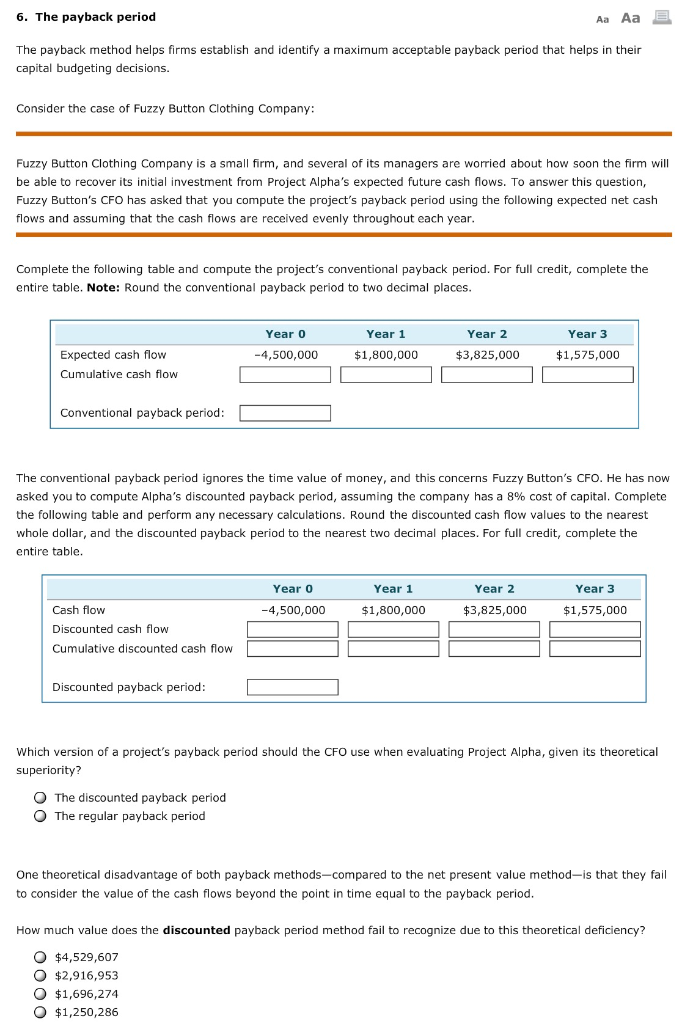
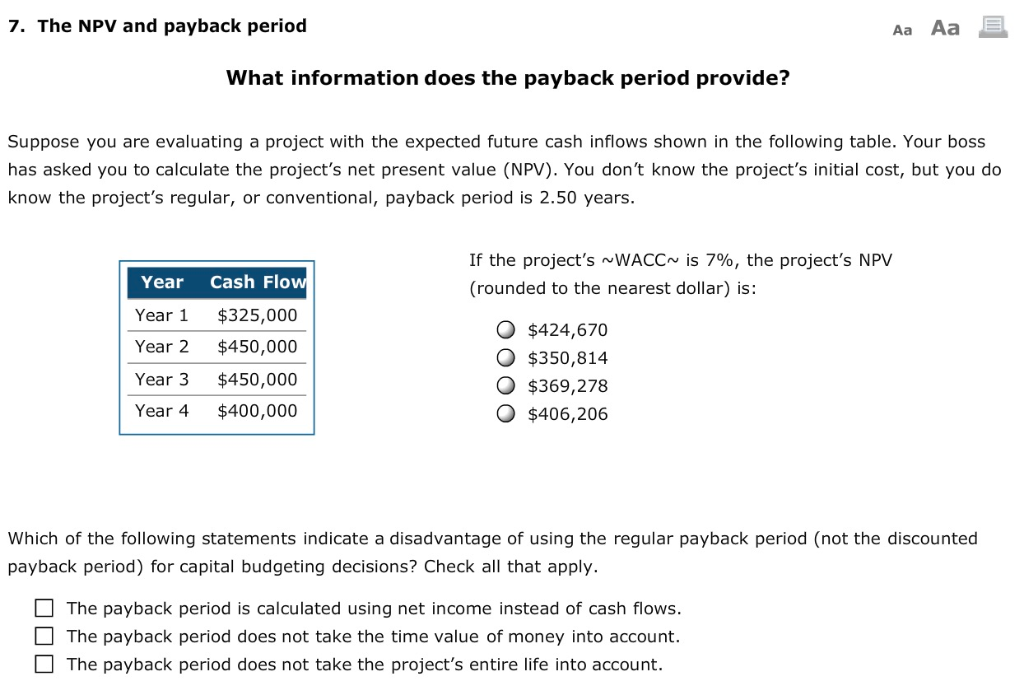
6. The payback period Aa Aa The payback method helps firms establish and identify a maximum acceptable payback period that helps in their capital budgeting decisions. Consider the case of Fuzzy Button Clothing Company: Fuzzy Button Clothing Company is a small firm, and several of its managers are worried about how soon the firm will be able to recover its initial investment from Project Alpha's expected future cash flows. To answer this question, Fuzzy Button's CFO has asked that you compute the project's payback period using the following expected net cash flows and assuming that the cash flows are received evenly throughout each year. Complete the following table and compute the project's conventional payback period. For full credit, complete the entire table. Note: Round the conventional payback period to two decimal places Year 0 Year 1 Year 2 Year 3 Expected cash flow Cumulative cash flow $3,825,000 $1,575,000 -4,500,000 $1,800,000 Conventional payback period The conventional payback period ignores the time value of money, and this concerns Fuzzy Button's CFO. He has now asked you to compute Alpha's discounted payback period, assuming the company has a 8% cost of capital. Complete the following table and perform any necessary calculations. Round the discounted cash flow values to the nearest whole dollar, and the discounted payback period to the nearest two decimal places. For full credit, complete the entire table. Year 0 Year 1 Year 2 Year 3 Cash flow Discounted cash flow Cumulative discounted cash flow -4,500,000 $1,800,000 $3,825,000 $1,575,000 Discounted payback period: Which version of a project's payback period should the CFO use when evaluating Project Alpha, given its theoretical superiority? O The discounted payback period O The regular payback period One theoretical disadvantage of both payback methods-compared to the net present value method-is that they fail to consider the value of the cash flows beyond the point in time equal to the payback period How much value does the discounted payback period method fail to recognize due to this theoretical deficiency? O $4,529,607 O $2,916,953 o $1,696,274 O $1,250,286 7. The NPV and payback period What information does the payback period provide? Suppose you are evaluating a project with the expected future cash inflows shown in the following table. Your boss has asked you to calculate the project's net present value (NPV). You don't know the project's initial cost, but you do know the project's regular, or conventional, payback period is 2.50 years. If the project's ~WACC~ is 7%, the project's NPV (rounded to the nearest dollar) is: Year Cash Flo Year 1 $325,000 Year 2 $450,000 Year 3 $450,000 Year 4 $400,000 O $424,670 O $350,814 O $369,278 O $406,206 Which of the following statements indicate a disadvantage of using the regular payback period (not the discounted payback period) for capital budgeting decisions? Check all that apply. The payback period is calculated using net income instead of cash flows. The payback period does not take the time value of money into account. The payback period does not take the project's entire life into account
Step by Step Solution
There are 3 Steps involved in it

Get step-by-step solutions from verified subject matter experts
 Study Help