







Question: 6. Under no arbitrage opportunity, the basis must equal it the dellvery date for the futures con- 1. Which is NOT the derivatives? A. stocks
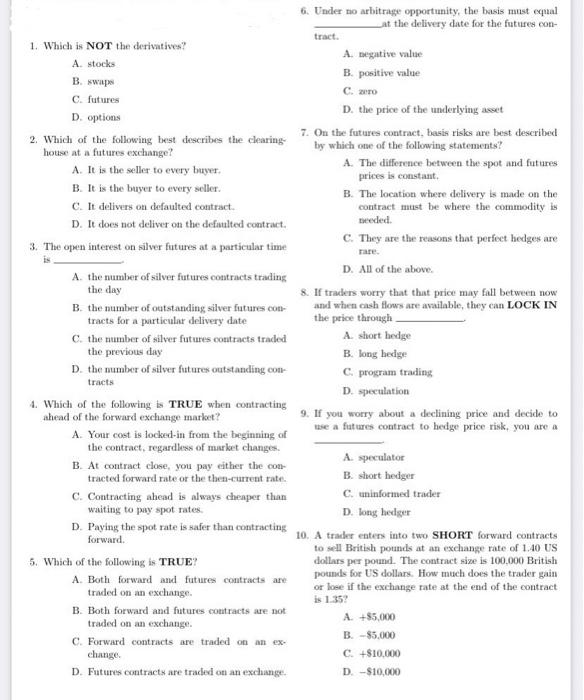
6. Under no arbitrage opportunity, the basis must equal it the dellvery date for the futures con- 1. Which is NOT the derivatives? A. stocks B. swape C. futures D. options 2. Which of the following best describes the clearinghouse at a futures exchange? A. It is the seller to every buyer. B. It is the buyer to every seller. C. It delivers on defaulted contract. D. It does not deliver on the defaulted contract. 3. The open interest on silver futures at a particular time is A. the number of silver futures contracts trading the day B. the number of outstanding silver futures contracts for a particular delivery date C. the number of silver futures contracts traded the previous day D. the number of silver futures outstanding contracts 4. Which of the following is TRUE when contracting ahead of the forward exchange market? A. Your cost is locked-in from the beginning of the contract, regardless of murket changes. B. At contract close, you pay either the contracted forward rate or the then-current rate. C. Contracting ahead is alway's cheaper than waiting to pay spot rates. D. Paying the spot rate is kafer than contracting forward. 5. Which of the following is TRUE? A. Both forward and futures contracts are traded on an exchange. B. Both forward and futures contracts are not traded on an exchange. C. Forward contracts are traded on an exchange. D. Futures contracts are tracled on an exchange. tract. A. negative value B. positive vilue C. zero D. the prio of the underlying asset 7. On the futures contract, basis risks are best described by which otse of the following statements? A. The difference between the spot and futures prices is constant. B. The location where delivery is made on the contract must be where the commodity is teceded. C. They are the reasons that perfect hedges are rare. D. All of the above. 8. If traders worry that that price may fall between now and when cash flows are available, they can LOCK IN the price through A. short hedge B. long hedge C. program trading D. speculation 9. If you worry about a declining price and decide to we a fatures contract to hedge price risk, you are a A. speculator B. short hedger C. uninformed trader D. long hedger 10. A trader eaters into two SHORT forward contracts to sell British pounds at an exchange rate of 1.40 US dollars per pound. The contract size is 100,000 British pounds for US dollars. How much does the trader gain or lose if the exchange rate at the end of the contract is 1.35 ? A. +$5,000 B. $5,000 C. +$10.000 D. $10,000
Step by Step Solution
There are 3 Steps involved in it

Get step-by-step solutions from verified subject matter experts
 Study Help