


Question: 6. Virtue theory is an a. Act-centered view b. Agent-centered view c. An intention-based account d. A consequentialist account 7. Act-Utilitarianism has which of the
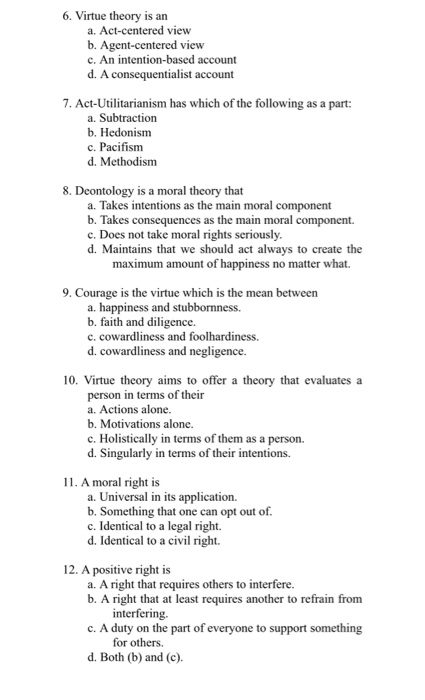
6. Virtue theory is an a. Act-centered view b.
6. Virtue theory is an a. Act-centered view b. Agent-centered view c. An intention-based account d. A consequentialist account 7. Act-Utilitarianism has which of the following as a part: a. Subtraction b. Hedonism c. Pacifism d. Methodism 8. Deontology is a moral theory that a. Takes intentions as the main moral component b. Takes consequences as the main moral component. c. Does not take moral rights seriously. d. Maintains that we should act always to create the maximum amount of happiness no matter what. 9. Courage is the virtue which is the mean between a. happiness and stubbornness. b. faith and diligence. C. cowardliness and foolhardiness. d. cowardliness and negligence. 10. Virtue theory aims to offer a theory that evaluates a person in terms of their a. Actions alone. b. Motivations alone. c. Holistically in terms of them as a person. d. Singularly in terms of their intentions. 11. A moral right is a. Universal in its application. b. Something that one can opt out of. c. Identical to a legal right. d. Identical to a civil right. 12. A positive right is a. A right that requires others to interfere. b. A right that at least requires another to refrain from interfering. c. A duty on the part of everyone to support something for others. d. Both (b) and (c)

Step by Step Solution

There are 3 Steps involved in it

1 Expert Approved Answer
Step: 1 Unlock blur-text-image

Question Has Been Solved by an Expert!

Get step-by-step solutions from verified subject matter experts

Step: 2 Unlock
Step: 3 Unlock

Students Have Also Explored These Related General Management Questions!