Question: 6) W03 Journal: Crucial Conversations Chapter 10 Case Study What to do 1. Go to Crucial Conversations Chapter 10, Yeah, But. 2. Choose only ONE
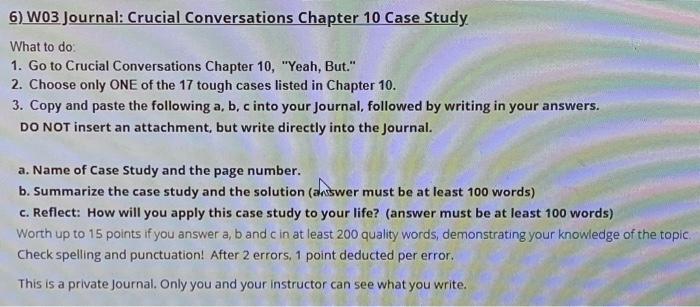
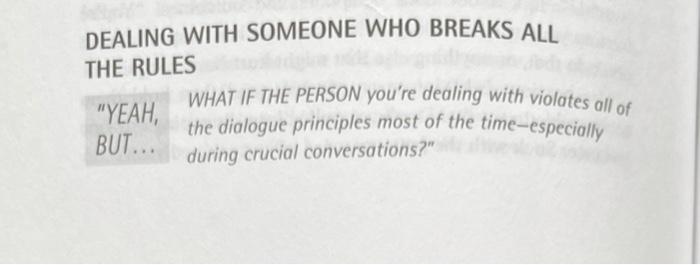
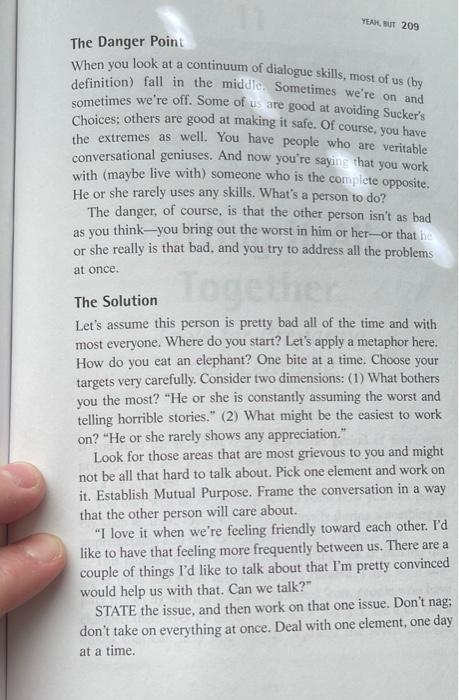
6) W03 Journal: Crucial Conversations Chapter 10 Case Study What to do 1. Go to Crucial Conversations Chapter 10, "Yeah, But." 2. Choose only ONE of the 17 tough cases listed in Chapter 10. 3. Copy and paste the following a, b, c into your Journal, followed by writing in your answers. DO NOT insert an attachment, but write directly into the journal. a. Name of Case Study and the page number. b. Summarize the case study and the solution (answer must be at least 100 words) c. Reflect: How will you apply this case study to your life? (answer must be at least 100 words) Worth up to 15 points if you answer a, b and in at least 200 quality words, demonstrating your knowledge of the topic Check spelling and punctuation! After 2 errors. 1 point deducted per error. This is a private Journal. Only you and your instructor can see what you write. DEALING WITH SOMEONE WHO BREAKS ALL THE RULES WHAT IF THE PERSON you're dealing with violates all of "YEAH, the dialogue principles most of the time-especially BUT... during crucial conversations?" YEAR, SU 209 The Danger Point When you look at a continuum of dialogue skills, most of us (by definition) fall in the middle. Sometimes we're on and sometimes we're off. Some of us are good at avoiding Sucker's Choices; others are good at making it safe. Of course, you have the extremes as well. You have people who are veritable conversational geniuses. And now you're saying that you work with (maybe live with someone who is the complete opposite. He or she rarely uses any skills. What's a person to do? The danger, of course, is that the other person isn't as bad as you think-you bring out the worst in him or her-or that he or she really is that bad, and you try to address all the problems at once. TO the The Solution Let's assume this person is pretty bad all of the time and with most everyone. Where do you start? Let's apply a metaphor here. How do you eat an elephant? One bite at a time. Choose your targets very carefully. Consider two dimensions: (1) What bothers you the most? "He or she is constantly assuming the worst and telling horrible stories." (2) What might be the easiest to work on? "He or she rarely shows any appreciation." Look for those areas that are most grievous to you and might not be all that hard to talk about. Pick one element and work on it. Establish Mutual Purpose. Frame the conversation in a way that the other person will care about. "I love it when we're feeling friendly toward each other. I'd like to have that feeling more frequently between us. There are a couple of things I'd like to talk about that I'm pretty convinced would help us with that. Can we talk?" STATE the issue, and then work on that one issue. Don't nag: don't take on everything at once. Deal with one element, one day at a time









 Study Help