







Question: 6. We consider the security services (A) confidentiality, (B) integrity, (C) authenticity, and (D) nonrepudiation, for a variety of simple protocols. The input is always
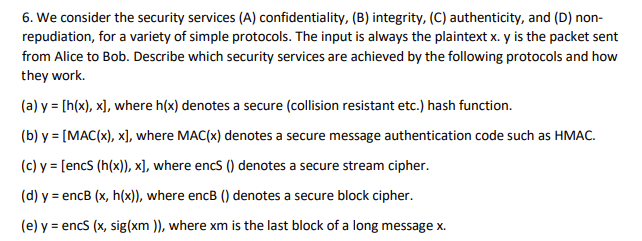 6. We consider the security services (A) confidentiality, (B) integrity, (C) authenticity, and (D) nonrepudiation, for a variety of simple protocols. The input is always the plaintext x. y is the packet sent from Alice to Bob. Describe which security services are achieved by the following protocols and how they work. (a) y = [h(x), x], where h(x) denotes a secure (collision resistant etc.) hash function. (b) y = [MAC(x), x], where MAC(x) denotes a secure message authentication code such as HMAC. (c) y = [encS (h(x)), x], where encS () denotes a secure stream cipher. (d) y = encB (x, h(x)), where encB () denotes a secure block cipher. (e) y = encS (x, sig(xm )), where xm is the last block of a long message x
6. We consider the security services (A) confidentiality, (B) integrity, (C) authenticity, and (D) nonrepudiation, for a variety of simple protocols. The input is always the plaintext x.y is the packet sent from Alice to Bob. Describe which security services are achieved by the following protocols and how they work. (a) y=[h(x),x], where h(x) denotes a secure (collision resistant etc.) hash function. (b) y=[MAC(x),x], where MAC(x) denotes a secure message authentication code such as HMAC. (c) y=[encS(h(x)),x], where encS () denotes a secure stream cipher. (d) y=encB(x,h(x)), where encB () denotes a secure block cipher. (e) y=encS(x,sig(xm)), where xm is the last block of a long message x
Step by Step Solution
There are 3 Steps involved in it

Get step-by-step solutions from verified subject matter experts
 Study Help