







Question: 6.18 (a) Let (Si, S;), i = 1, 2 be two measurable spaces. Let u be a prob- ability measure on (S1, Si) and let
![and let Q : S1 x S2 -> [0, 1] be such](https://s3.amazonaws.com/si.experts.images/answers/2024/07/668c21a0909c7_680668c21a0750fe.jpg)
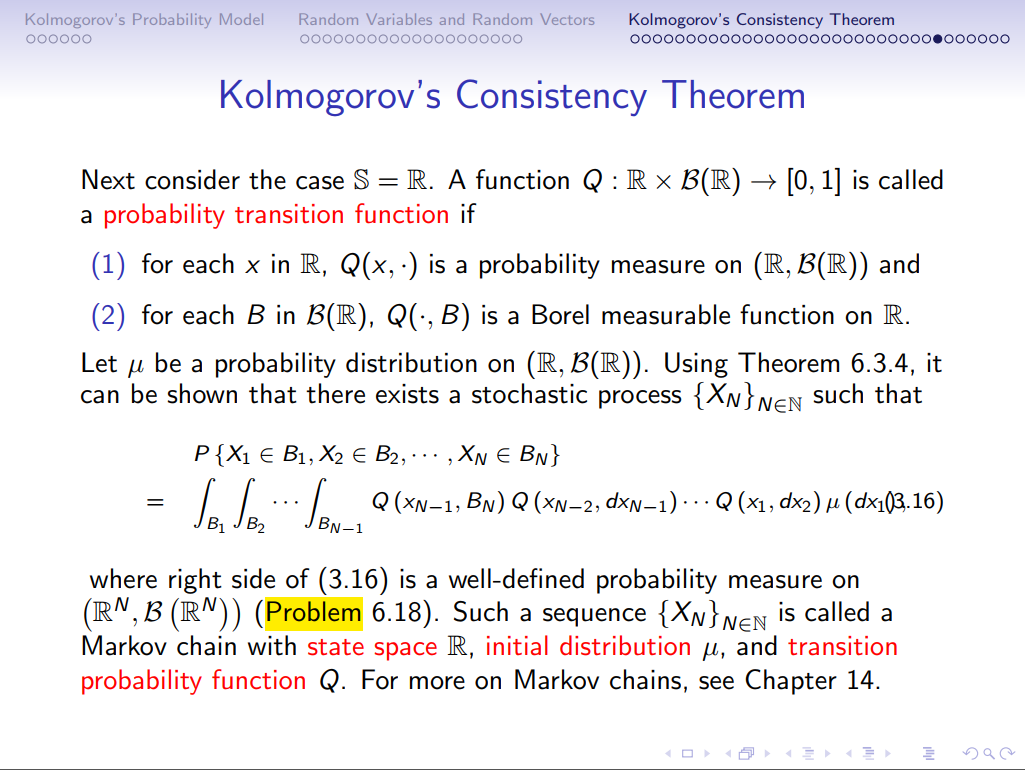
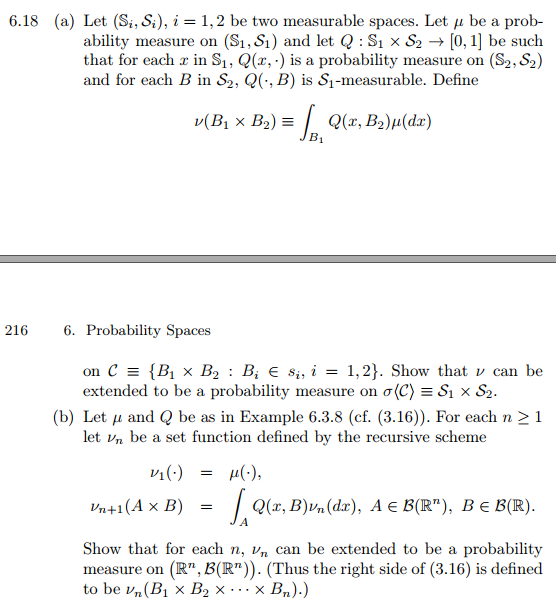
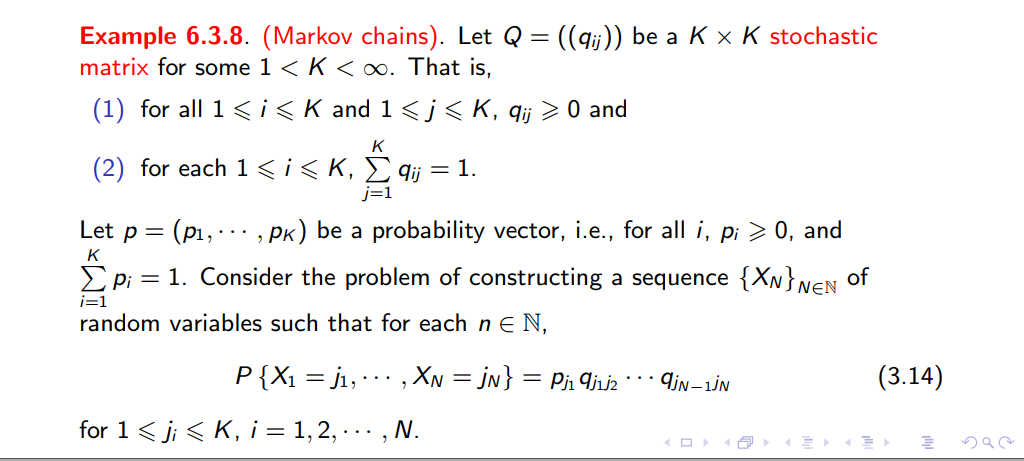
6.18 (a) Let (Si, S;), i = 1, 2 be two measurable spaces. Let u be a prob- ability measure on (S1, Si) and let Q : S1 x S2 -> [0, 1] be such that for each r in S1, Q(x, .) is a probability measure on (S2, S2) and for each B in S2, Q(., B) is S1-measurable. Define v(B1 X B2) = Q(x, B2)u(dx) 216 6. Probability Spaces on C = {B1 x B2 : B; E s;, i = 1, 2 }. Show that v can be extended to be a probability measure on o (C) = S1 x S2. (b) Let / and Q be as in Example 6.3.8 (cf. (3.16)). For each n 2 1 let In be a set function defined by the recursive scheme 1/1 (. ) = H(. ). Unti(A X B) = / Q(x, B)un(dx), ACB(R"), BEB(R). Show that for each n, In can be extended to be a probability measure on (R", B(R")). (Thus the right side of (3.16) is defined to be Un (B1 X B2 x . . . X B,).)Example 6.3.8. (Markov chains). Let Q = ((qi)) be a K x K stochastic matrix for some 1 0 and K (2) for each 1 0, and K _ pi = 1. Consider the problem of constructing a sequence { XN } NEN Of i=1 random variables such that for each n E N, P{X1 = ji, . .., XN = jN} = Pi qiLiz gin-IjN (3.14) for 1 0 and P {X1 = j} = pj for 1
Step by Step Solution
There are 3 Steps involved in it

Get step-by-step solutions from verified subject matter experts
 Study Help