





Question: 6.34 Consider the model in Exercise 6.12. Show that the Formal Likelihood Principle implies that any conclusions about # should not depend on the fact

6.34 Consider the model in Exercise 6.12. Show6.34 Consider the model in Exercise 6.12. Show

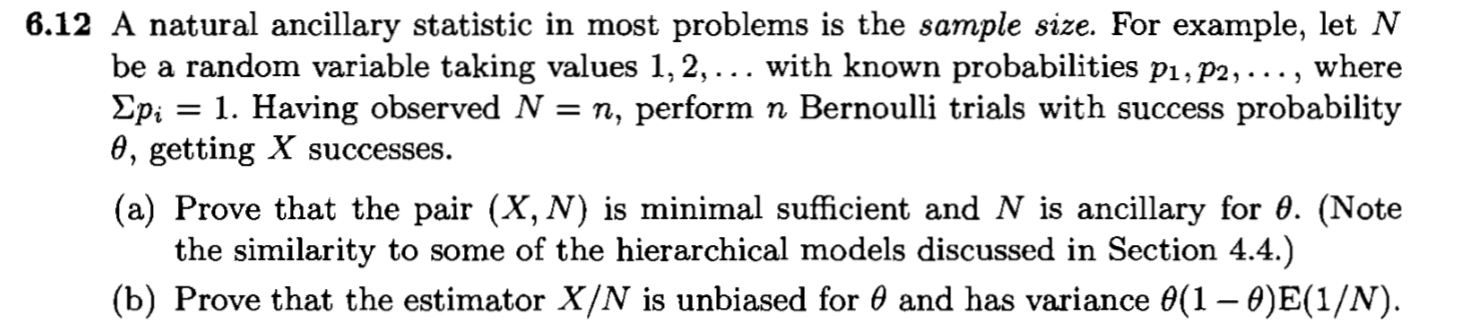
6.34 Consider the model in Exercise 6.12. Show that the Formal Likelihood Principle implies that any conclusions about # should not depend on the fact that the sample size n was chosen randomly. That is, the likelihood for (n,x), a sample point from Exercise 6.12, is proportional to the likelihood for the sample point x, a sample point from a fixed-sample-size binomial(n,1) experiment. 6.12 A natural ancillary statistic in most problems is the sample size. For example, let N be a random variable taking values 1, 2, ... with known probabilities P1, P2, ..., where pi 1. Having observed N = n, perform n Bernoulli trials with success probability 0, getting X successes. (a) Prove that the pair (X, N) is minimal sufficient and N is ancillary for 0. (Note the similarity to some of the hierarchical models discussed in Section 4.4.) (b) Prove that the estimator X/N is unbiased for 0 and has variance 0(1 - 1)E(1/N)

Step by Step Solution

There are 3 Steps involved in it

1 Expert Approved Answer
Step: 1 Unlock blur-text-image

Question Has Been Solved by an Expert!

Get step-by-step solutions from verified subject matter experts

Step: 2 Unlock
Step: 3 Unlock

Students Have Also Explored These Related General Management Questions!