







Question: 6-Write a truth table for the proposition: -(p^q)>(pvr) Consider a 1 to be true and a 0 to be false. P q I -(p^q)
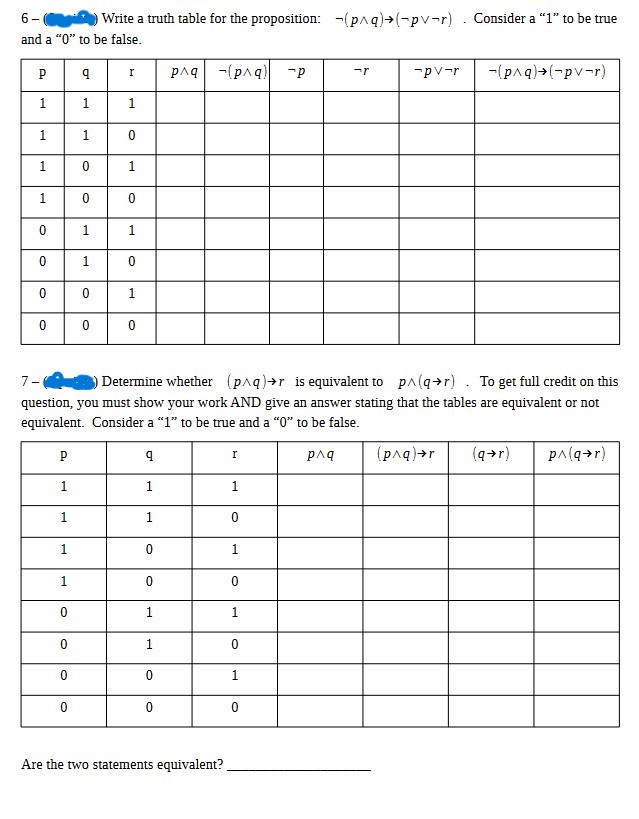
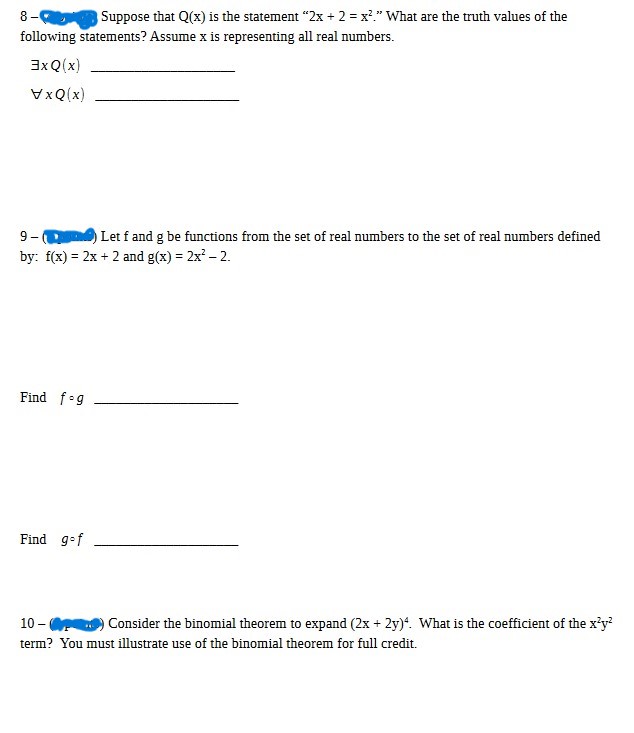
6-Write a truth table for the proposition: -(p^q)>(pvr) Consider a "1" to be true and a "0" to be false. P q I -(p^q) -P -r -pv-r 1 1 1 1 1 0 1 0 1 1 0 0 0 1 1 0 1 0 0 0 1 0 0 0 -(p^q)+(-pv-r) 7- Determine whether (p^q)r is equivalent to p^(qr) To get full credit on this question, you must show your work AND give an answer stating that the tables are equivalent or not equivalent. Consider a "1" to be true and a "0" to be false. P q r 1 1 1 1 1 0 1 0 1 1 0 0 1 1 1 0 0 1 0 0 0 Are the two statements equivalent? (p^q)r (q+r) P^(q+r) Suppose that Q(x) is the statement "2x + 2 = x." What are the truth values of the following statements? Assume x is representing all real numbers. 3xQ(x) VxQ(x) 9- Let f and g be functions from the set of real numbers to the set of real numbers defined by: f(x)=2x+2 and g(x) = 2x - 2. Find fog Find gof 10- Consider the binomial theorem to expand (2x+2y). What is the coefficient of the xy term? You must illustrate use of the binomial theorem for full credit.
Step by Step Solution
There are 3 Steps involved in it

Get step-by-step solutions from verified subject matter experts
 Study Help