





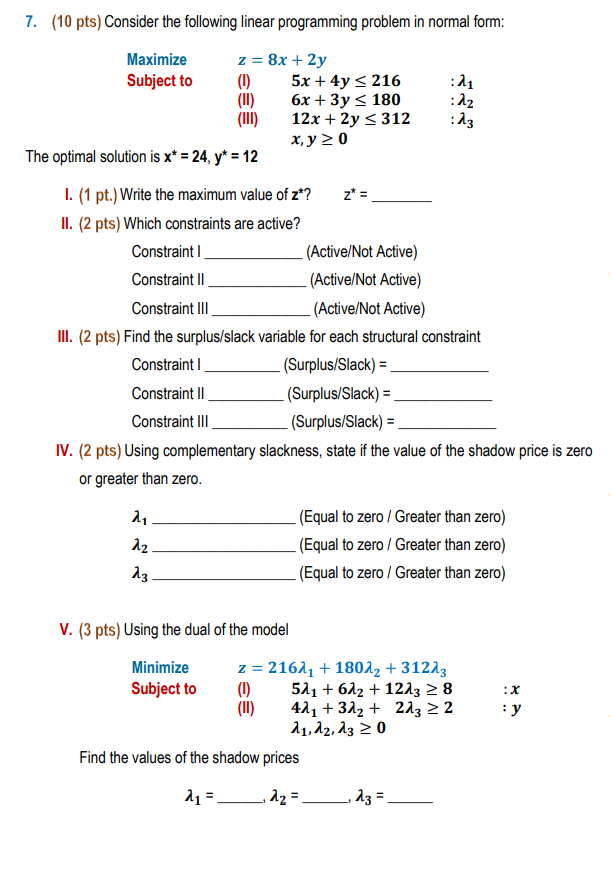
Question: 7. (10 pts) Consider the following linear programming problem in normal form: :12 :13 Maximize z = 8x + 2y Subject to (1) 5x +
7. (10 pts) Consider the following linear

7. (10 pts) Consider the following linear programming problem in normal form: :12 :13 Maximize z = 8x + 2y Subject to (1) 5x + 4y = 216 :21 6x + 3y = 180 (III) 12x + 2y 0 The optimal solution is x* = 24, y* = 12 1. (1 pt.) Write the maximum value of z*? z* = II. (2 pts) Which constraints are active? Constraint (Active/Not Active) Constraint II (Active/Not Active) Constraint 111 (Active/Not Active) III. (2 pts) Find the surplus/slack variable for each structural constraint Constraint (Surplus/Slack) = Constraint 11 (Surplus/Slack) = Constraint III (Surplus/Slack) = IV. (2 pts) Using complementary slackness, state if the value of the shadow price is zero or greater than zero. 21 12 (Equal to zero / Greater than zero) (Equal to zero / Greater than zero) (Equal to zero / Greater than zero) 23 V. (3 pts) Using the dual of the model :X Minimize z = 21621 + 18012 +31213 Subject to (1) 511 + 612 + 1213 2 8 (II) 421 +312 + 213 2 2 11, 12, 13 > 0 Find the values of the shadow prices :y 21 = ,12= .13 =

Step by Step Solution

There are 3 Steps involved in it

1 Expert Approved Answer
Step: 1 Unlock blur-text-image

Question Has Been Solved by an Expert!

Get step-by-step solutions from verified subject matter experts

Step: 2 Unlock
Step: 3 Unlock

Students Have Also Explored These Related General Management Questions!