







Question: 7 . 2 ( 8 * ) Write a computer program, using the algorithm in Example 7 . 2 , for simulating the hard -
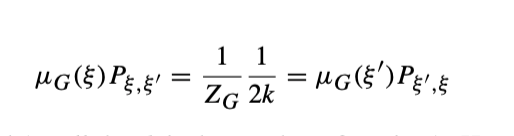
Write a computer program, using the algorithm in Example for simulating the hardcore model on a general k times k square grid. Then do some simulation experiments. Algorith in Example :
When you have managed to do this for, say, a times square lattice, consider the following: Think back to Example the Internet as a Markov chain Did that example seem to have a ridiculously huge state space? Well, you have just simulated a Markov chain whose state space is even bigger! It is not hard to show that the state space S as defined in contains at least k elements much larger than the number of web pages on the Internet today.
Example : The Internet as a Markov chain. Imagine that you are surfing on
the Internet, and that each time that you encounter a web page, you click on one
of its hyperlinks chosen at random uniformly If X n denotes where you are after
n clicks, then X X may be described as a Markov chain with state space
S equal to the set of all web pages on the Internet, and transition matrix P given
by
Pi j
di if page si has a link to page s j
otherwise,
where di is the number of links from page si To make this chain welldefined,
we also need to define what happens if there are no links at all from si We may,
for instance, set Pii and Pi j for all i j in that case, meaning that
when you encounter a page with no links, you are stuck. This is of course a very
complicated Markov chain especially compared to Examples and but it
has nevertheless turned out to be a useful model which under various simplifying
assumptions admits interesting analysis
A recent variant see Fagin et alFa of this model is to take into account
also the possibility to use back buttons in web browsers. However, the resulting
process X X is then no longer a Markov chain, since what happens when
the back button is pressed depends not only on the present state X n but in general
also on X X n Nevertheless, it turns out that this variant can be studied
by a number of techniques from the theory of Markov chains. We will not say
anything more about this model here.
A useful way to picture a Markov chain is its socalled transition graph. The
transition graph consists of nodes representing the states of the Markov chain,
and arrows between the nodes, representing transition probabilities. This is
most easily explained by just showing the transition graphs of the examples
considered so far. See Figure
In all examples above, as well as in Definition the rule for obtaining
X n from X n did not change with time. In some situations, it is more realistic,
or for other reasons more desirable, to let this rule change with time. This
brings us to the topic of inhomogeneous Markov chains, and the following
definition, which generalizes Definition
Step by Step Solution
There are 3 Steps involved in it
1 Expert Approved Answer
Step: 1 Unlock

Question Has Been Solved by an Expert!
Get step-by-step solutions from verified subject matter experts
Step: 2 Unlock
Step: 3 Unlock
 Study Help