







Question: 7 . 6 4 Tissue engineering involves the development of biological substitutes that restore or improve tissue function. Once manufactured, engineered organs can be implanted
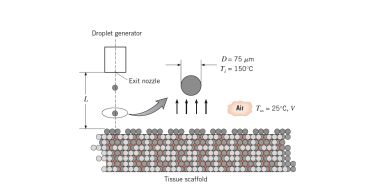
Tissue engineering involves the development of biological substitutes that restore or improve tissue function. Once manufactured, engineered organs can be implanted and grow within the patient, obviating chronic shortages of natural organs that arise when traditional organ transplant procedures are used. Artificial organ manufacture involves two major steps. First, a porous scaffold is fabricated with a specific pore size and pore distribution, as well as overall shape and size. Second, the top surface of the scaffold is seeded with human cells that grow into the pores of the scaffold. The scaffold material is biodegradable and is eventually replaced with healthy tissue. The artificial organ is then ready to be implanted in the patient. The complex pore shapes, small pore sizes, and unusual organ shapes preclude use of traditional manufacturing methods to fabricate the scaffolds. A method that has been used with success is a solid freeform fabrication technique whereby small spherical drops are directed to a substrate. The drops are initially molten and solidify when they impact the roomtemperature substrate. By controlling the location of the droplet deposition, complex scaffolds can be built up one drop at a time. A piezoelectric droplet generator is used to vibrate a shaft that, in turn, ejects small droplets through a precisionmachined nozzle. The device generates uniform, mdiameter drops at an initial temperature of Ti C The particles are sent through quiescent air at T C The droplet properties are kgm c JkgKa It is desirable for the droplets to exit the nozzle at their terminal velocity. Determine the terminal velocity of the drops. b It is desirable for the droplets to impact the structure at a temperature of TC What is the required distance between the exit nozzle and the structure, L
Step by Step Solution
There are 3 Steps involved in it
1 Expert Approved Answer
Step: 1 Unlock

Question Has Been Solved by an Expert!
Get step-by-step solutions from verified subject matter experts
Step: 2 Unlock
Step: 3 Unlock
 Study Help