Question: 7. A group of paramedics does not believe that the average number of calls in the morning, afternoon and night shifts are equal. They counted
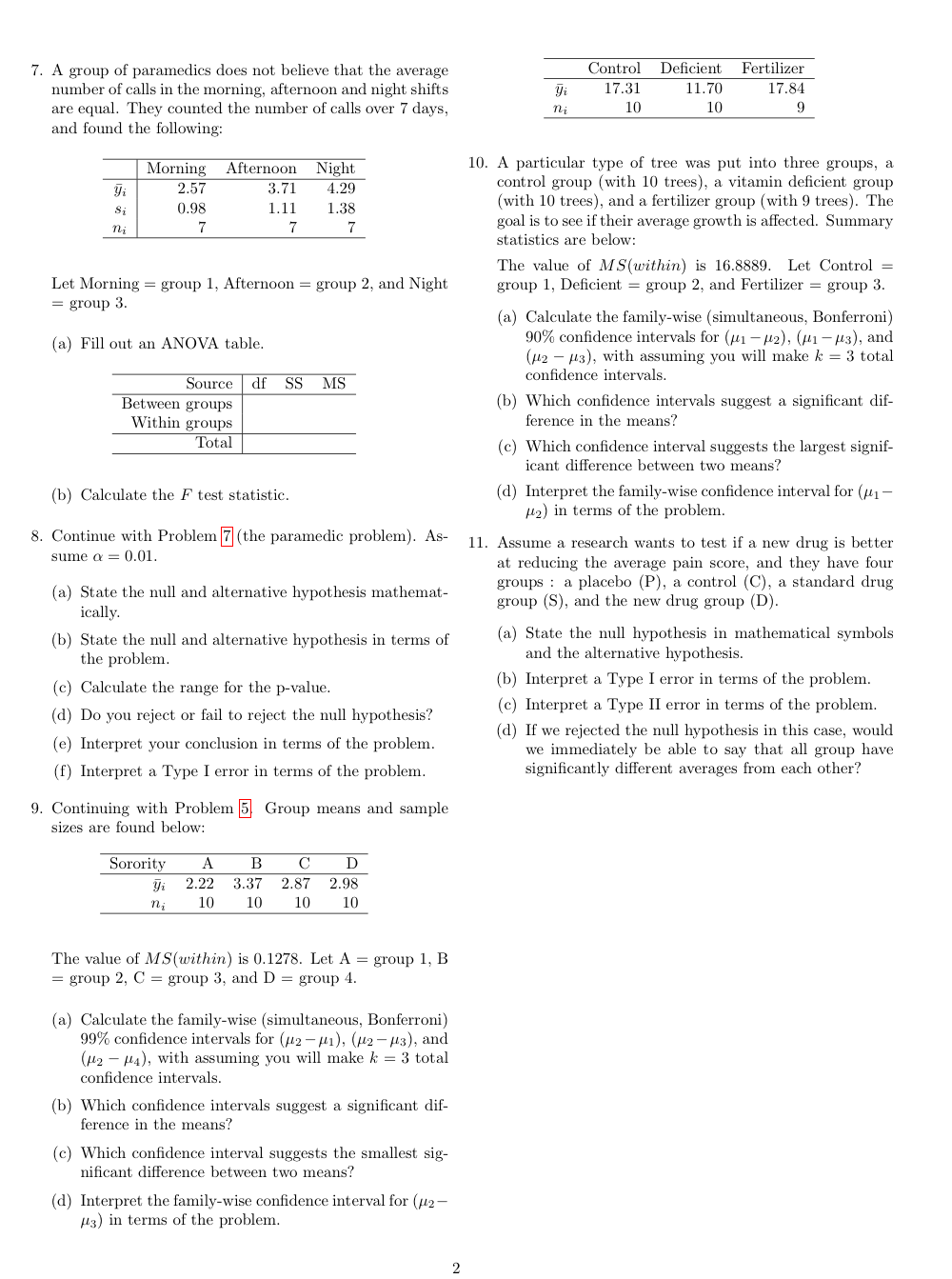
7. A group of paramedics does not believe that the average number of calls in the morning, afternoon and night shifts are equal. They counted the number of calls over 7 days, and found the following: Morning Afternoon Night i; 2.57 3.71 4.29 8 .98 1.11 1.38 i 7 7 7 Let Morning = group 1, Afternoon = group 2, and Night = group 3. (a) Fill out an ANOVA table. Source | df S5 MS Between groups Within groups Total (b) Calculate the F test statistic. . Continue with Problem |7|(the paramedic problem). As- sume o = (.01, (a) State the null and alternative hypothesis mathemat- ically. State the null and alternative hypothesis in terms of the problem. (b) (e (d (e) () Caleulate the range for the p-value. Do you reject or fail to reject the null hypothesis? Interpret your conclusion in terms of the problem. Interpret a Type I error in terms of the problem. . Continuing with Problem Group means and sample sizes are found below: Sorority A B C D g 222 337 287 298 1 10 10 10 10 The value of MS(within) is 0.1278. Let A = group 1, B = group 2, C = group 3, and D = group 4. (a) Calculate the family-wise (simultaneous, Bonferroni) 99% confidence intervals for (2 p1), (p2 ps), and (p13 prq), with assuming you will make k = 3 total confidence intervals. (b} Which confidence intervals suggest a significant dif- ference in the means? (c) Which confidence interval suggests the smallest sig- nificant difference between two means? (d) Interpret the family-wise confidence interval for {pa jt3) in terms of the problem. 10. 11. Control Deficient Fertilizer i 17.31 11.70 17.84 1 10 10 9 A particular type of tree was put into three groups, a control group (with 10 trees), a vitamin delicient group (with 10 trees), and a fertilizer group (with 9 trees). The goal is to see if their average growth is affected. Summary statistics are below: The value of MS(within) is 16.8889. Let Control = group 1, Deficient = group 2, and Fertilizer = group 3. (a) Calculate the family-wise (simultaneous, Bonferroni) 90% confidence intervals for (prg pa), (pr1 peg), and (p2 pea), with assuming vou will make & = 3 total confidence intervals. {b) Which confidence intervals suggest a significant dif- ference in the means? {() Which confidence interval suggests the largest signif- icant difference between two means? (d) Interpret the family-wise confidence interval for (j, #2) in terms of the problem. Assume a research wants to test if a new drug is better at reducing the average pain score, and they have four groups : a placebo (P), a control (C), a standard drug group (S), and the new drug group (D). (a) State the null hypothesis in mathematical symbols and the alternative hypothesis. (b) Interpret a Type I error in terms of the problem. () Interpret a Type II error in terms of the problem. {d) If we rejected the null hypothesis in this case, would we immediately be able to say that all group have significantly different averages from each other
Step by Step Solution
There are 3 Steps involved in it
1 Expert Approved Answer
Step: 1 Unlock
Question Has Been Solved by an Expert!
Get step-by-step solutions from verified subject matter experts
Step: 2 Unlock
Step: 3 Unlock
Students Have Also Explored These Related Mathematics Questions!









 Study Help