







Question: 7. An equal decrease in all bond interest rates A) increases the price of a five-year bond more than the price of a ten-year bond.
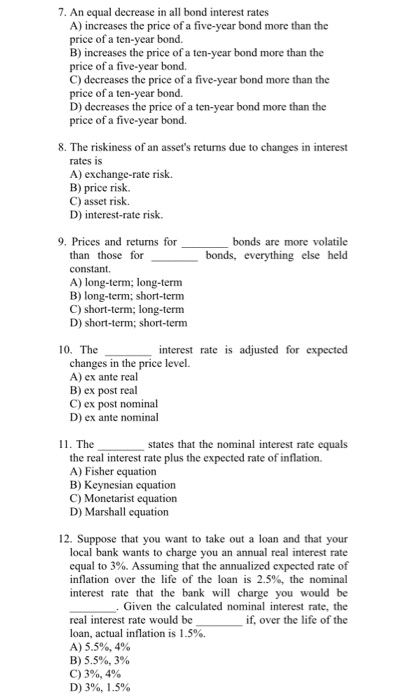
7. An equal decrease in all bond interest rates A) increases the price of a five-year bond more than the price of a ten-year bond. B) increases the price of a ten-year bond more than the price of a five-year bond. C) decreases the price of a five-year bond more than the price of a ten-year bond. D) decreases the price of a ten-year bond more than the price of a five-year bond. 8. The riskiness of an asset's returns due to changes in interest rates is A) exchange rate risk. B) price risk. C) asset risk. D) interest-rate risk. bonds are more volatile __bonds, everything else held 9. Prices and returns for than those for constant. A) long-term; long-term B) long-term; short-term C) short-term, long-term D) short-term; short-term 10. The interest rate is adjusted for expected changes in the price level. A) ex ante real B) ex post real C) ex post nominal D) ex ante nominal 11. The states that the nominal interest rate equals the real interest rate plus the expected rate of inflation. A) Fisher equation B) Keynesian equation C) Monetarist equation D) Marshall equation 12. Suppose that you want to take out a loan and that your local bank wants to charge you an annual real interest rate equal to 3%. Assuming that the annualized expected rate of inflation over the life of the loan is 2.5%, the nominal interest rate that the bank will charge you would be . Given the calculated nominal interest rate, the real interest rate would be if, over the life of the loan, actual inflation is 1.5%. A) 5.5%, 4% B) 5.5%, 3% C) 3%, 4% D) 3%, 1.5%
Step by Step Solution
There are 3 Steps involved in it

Get step-by-step solutions from verified subject matter experts
 Study Help