Question: 7 and 8 QUESTION 7 (For this problem. youll need to use JAMOVI or some other ANOVA calculator. Use the data in the file 'Beatles-fall20203
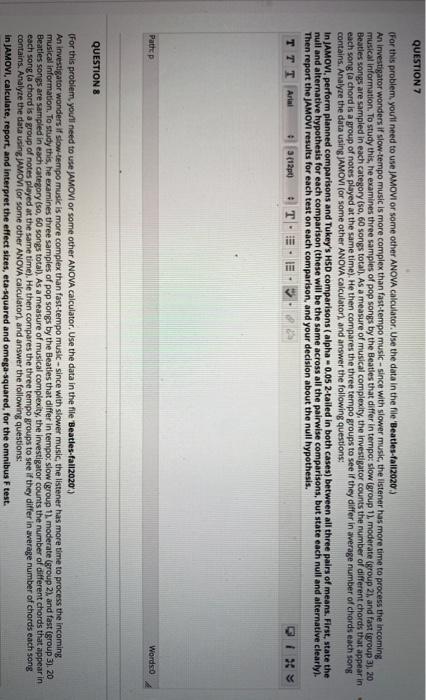
QUESTION 7 (For this problem. youll need to use JAMOVI or some other ANOVA calculator. Use the data in the file 'Beatles-fall20203 An Investigator wonders if slow-tempo music is more complex than fast-tempo music - since with slower music, the listener has more time to process the incoming musical information. To study this, he examines three samples of pop songs by the Beatles that differ in tempo slow (group 1), moderate (group 2) and fast group 3.20 Beatles songs are sampled in each category iso, 60 songs total). As a measure of musical complexity, the investigator counts the number of different chords that appear in each song (a chord is a group of notes played at the same time. He then compares the three tempo groups to see if they differ in average number of chords each song contains. Analyze the data using JAMOVI (or some other ANOVA calculator), and answer the following questions: In JAMOVI, perform planned comparisons and Tukey's HSD comparisons (alpha-0.05 2-tailed in both cases) between all three pairs of means. First, state the null and alternative hypothesis for each comparison (these will be the same across all the pairwise comparisons, but state each null and alternative clearly). Then report the JAMOVI results for each test on each comparison, and your decision about the null hypothesis. TTT Artal 3 (12) + T Path Words: QUESTIONS (For this problem, you'll need to use JAMOVI or some other ANOVA calculator. Use the data in the file Beatles-fall2020) An investigator wonders if slow-tempo music is more complex than fast-tempo music - since with slower music, the listener has more time to process the incoming musical information. To study this, he examines three samples of pop songs by the Beatles that differ in tempo slow (group 1). moderate (group 2), and fast group 3). 20 Beatles songs are sampled in each category (so, 60 songs total). As a measure of musical complexity, the investigator counts the number of different chords that appear in each sorg la chord is a group of notes played at the same time). He then compares the three tempo groups to see if they differ in average number of chords each song contains. Analyze the data using JAMOVI (or some other ANOVA calculator), and answer the following questions: in JAMOVI, calculate, report, and interpret the effect sizes, eta-squared and omega-squared, for the omnibus F test. QUESTION 7 (For this problem. youll need to use JAMOVI or some other ANOVA calculator. Use the data in the file 'Beatles-fall20203 An Investigator wonders if slow-tempo music is more complex than fast-tempo music - since with slower music, the listener has more time to process the incoming musical information. To study this, he examines three samples of pop songs by the Beatles that differ in tempo slow (group 1), moderate (group 2) and fast group 3.20 Beatles songs are sampled in each category iso, 60 songs total). As a measure of musical complexity, the investigator counts the number of different chords that appear in each song (a chord is a group of notes played at the same time. He then compares the three tempo groups to see if they differ in average number of chords each song contains. Analyze the data using JAMOVI (or some other ANOVA calculator), and answer the following questions: In JAMOVI, perform planned comparisons and Tukey's HSD comparisons (alpha-0.05 2-tailed in both cases) between all three pairs of means. First, state the null and alternative hypothesis for each comparison (these will be the same across all the pairwise comparisons, but state each null and alternative clearly). Then report the JAMOVI results for each test on each comparison, and your decision about the null hypothesis. TTT Artal 3 (12) + T Path Words: QUESTIONS (For this problem, you'll need to use JAMOVI or some other ANOVA calculator. Use the data in the file Beatles-fall2020) An investigator wonders if slow-tempo music is more complex than fast-tempo music - since with slower music, the listener has more time to process the incoming musical information. To study this, he examines three samples of pop songs by the Beatles that differ in tempo slow (group 1). moderate (group 2), and fast group 3). 20 Beatles songs are sampled in each category (so, 60 songs total). As a measure of musical complexity, the investigator counts the number of different chords that appear in each sorg la chord is a group of notes played at the same time). He then compares the three tempo groups to see if they differ in average number of chords each song contains. Analyze the data using JAMOVI (or some other ANOVA calculator), and answer the following questions: in JAMOVI, calculate, report, and interpret the effect sizes, eta-squared and omega-squared, for the omnibus F test









 Study Help