Question: 7 Answers please 1. (i) Define the terms sample space, event and random variable and give an example of each. [10 points] (ii) What is

7 Answers please
7 Answers please 1. (i) Define the terms "sample7 Answers please 1. (i) Define the terms "sample
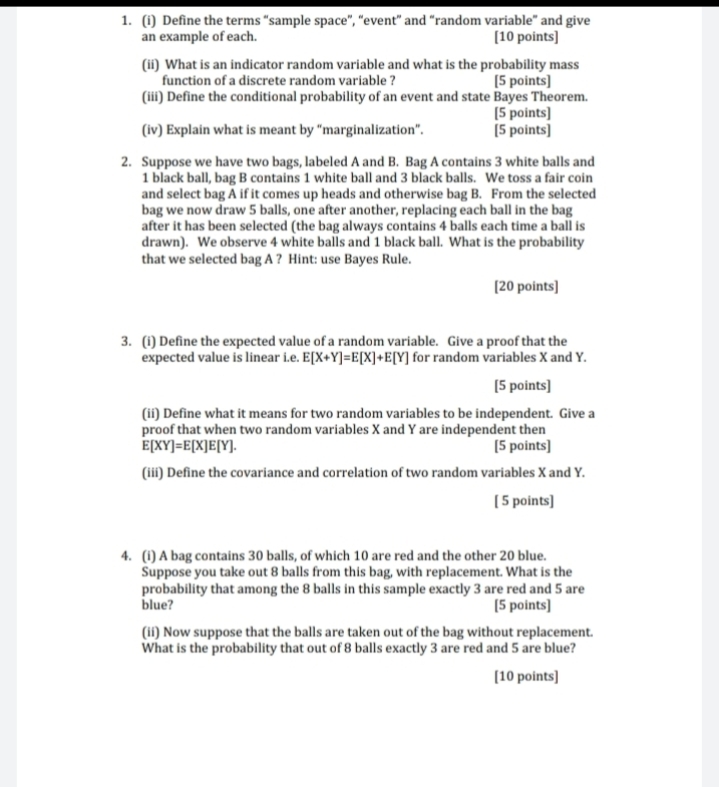
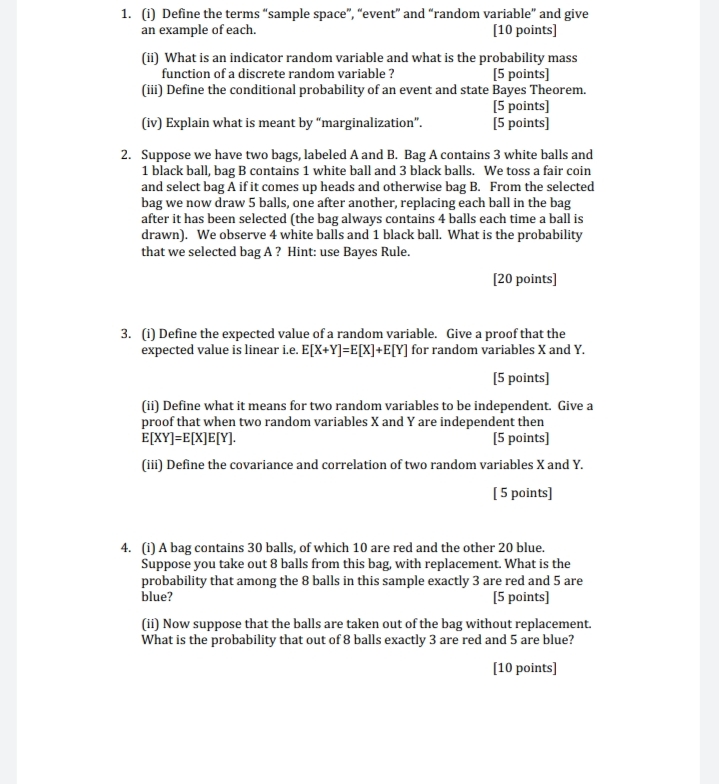
1. (i) Define the terms "sample space", "event" and "random variable" and give an example of each. [10 points] (ii) What is an indicator random variable and what is the probability mass function of a discrete random variable ? [5 points] (iii) Define the conditional probability of an event and state Bayes Theorem. [5 points] (iv) Explain what is meant by "marginalization". [5 points] 2. Suppose we have two bags, labeled A and B. Bag A contains 3 white balls and 1 black ball, bag B contains 1 white ball and 3 black balls. We toss a fair coin and select bag A if it comes up heads and otherwise bag B. From the selected bag we now draw 5 balls, one after another, replacing each ball in the bag after it has been selected (the bag always contains 4 balls each time a ball is drawn). We observe 4 white balls and 1 black ball. What is the probability that we selected bag A ? Hint: use Bayes Rule. [20 points] 3. (i) Define the expected value of a random variable. Give a proof that the expected value is linear i.e. E[X+Y]=E[X]+E[Y] for random variables X and Y. [5 points] (ii) Define what it means for two random variables to be independent. Give a proof that when two random variables X and Y are independent then E[XY]=E[X]E[Y]. [5 points] (iii) Define the covariance and correlation of two random variables X and Y. [ 5 points] 4. (i) A bag contains 30 balls, of which 10 are red and the other 20 blue. Suppose you take out 8 balls from this bag, with replacement. What is the probability that among the 8 balls in this sample exactly 3 are red and 5 are blue? [5 points] (ii) Now suppose that the balls are taken out of the bag without replacement. What is the probability that out of 8 balls exactly 3 are red and 5 are blue? [10 points]1. (i) Define the terms "sample space", "event" and "random variable" and give an example of each. [10 points] (ii) What is an indicator random variable and what is the probability mass function of a discrete random variable ? [5 points] (ii) Define the conditional probability of an event and state Bayes Theorem. (5 points] (iv) Explain what is meant by "marginalization". [5 points] 2. Suppose we have two bags, labeled A and B. Bag A contains 3 white balls and 1 black ball, bag B contains 1 white ball and 3 black balls. We toss a fair coin and select bag A if it comes up heads and otherwise bag B. From the selected bag we now draw 5 balls, one after another, replacing each ball in the bag after it has been selected (the bag always contains 4 balls each time a ball is drawn). We observe 4 white balls and 1 black ball. What is the probability that we selected bag A ? Hint: use Bayes Rule. [20 points] 3. (1) Define the expected value of a random variable. Give a proof that the expected value is linear i.e. E[X+Y]=E[X]+E[Y] for random variables X and Y. [5 points] (ii) Define what it means for two random variables to be independent. Give a proof that when two random variables X and Y are independent then E[XY]=E[X]E[Y]. [5 points] (iii) Define the covariance and correlation of two random variables X and Y. [ 5 points] 4. (1) A bag contains 30 balls, of which 10 are red and the other 20 blue. Suppose you take out 8 balls from this bag, with replacement. What is the probability that among the 8 balls in this sample exactly 3 are red and 5 are blue? [5 points] (ii) Now suppose that the balls are taken out of the bag without replacement. What is the probability that out of 8 balls exactly 3 are red and 5 are blue? [10 points]

Step by Step Solution

There are 3 Steps involved in it

1 Expert Approved Answer
Step: 1 Unlock blur-text-image

Question Has Been Solved by an Expert!

Get step-by-step solutions from verified subject matter experts

Step: 2 Unlock
Step: 3 Unlock

Students Have Also Explored These Related Mathematics Questions!